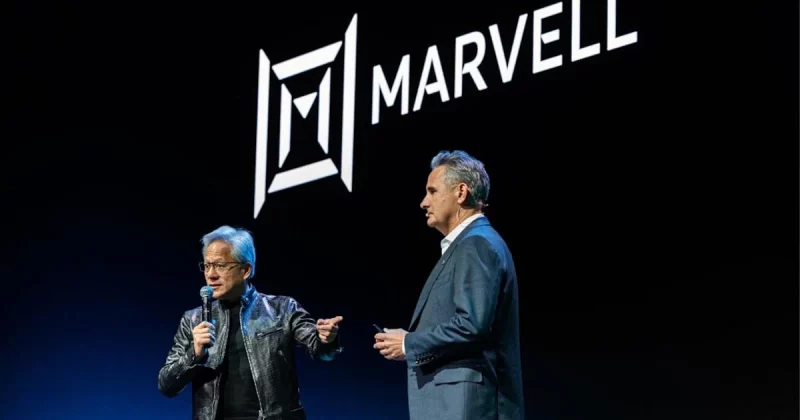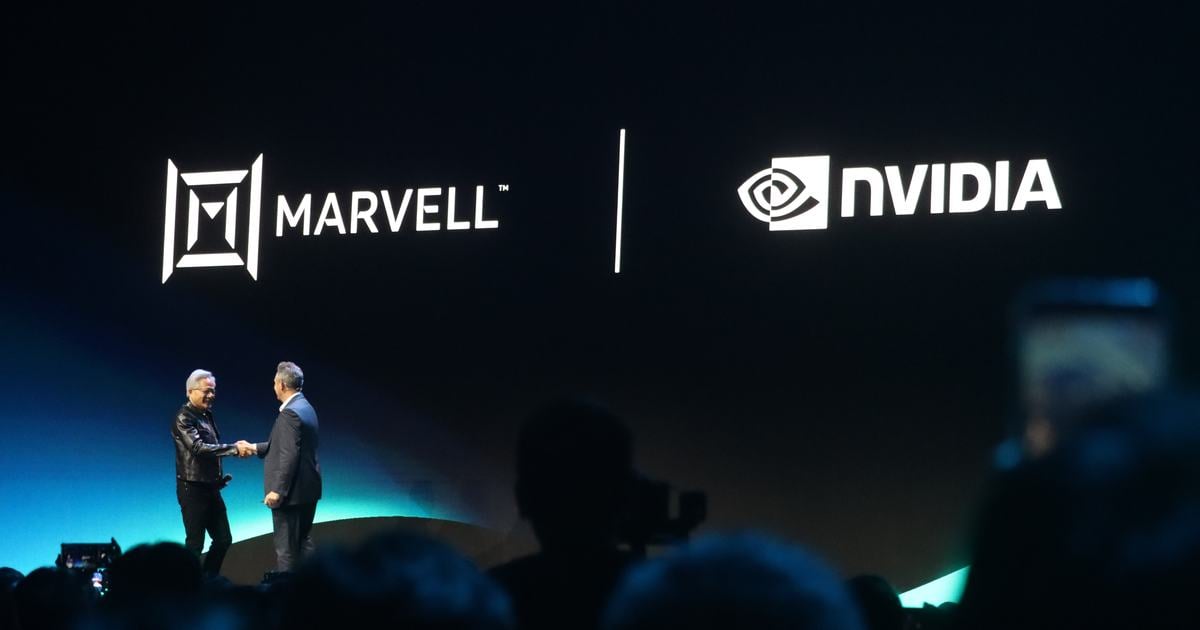
COMPUTEX 2026 The sun is slowly but surely setting on copper interconnects, Marvell CEO Matt Murphy claimed in his Computex keynote this week. Within the next decade the IP house expects photons to take the place of electrons and change the way datacenters are built and run in the process.And, if Nvidia CEO Jensen Huang is right, the widespread transition to silicon photonics technologies could make Marvell the next trillion dollar company.With a market cap of $191 billion, Marvell still has a long way to go, not that stopped Wall Street investors from sending the company’s share price on a 30 percent rally on the proclamation.
However, Huang’s prediction, made during Marvell’s Computex keynote this week, may be more than flattery. The large-scale deployment of AI infrastructure for training, inference, and agentic systems is already reshaping datacenter networks and pushing copper interconnects to the limit.
“The distance a signal can travel over a copper cable is inversely proportional to the bandwidth, so every time you double the bandwidth, you have to cut the distance in half,” Murphy explained.Today the fastest network interconnects operate at 200 Gbps per lane, but at these speeds copper cables can only carry a signal about 2.5 meters, effectively limiting interconnects.With the launch of its next-gen NVSwitch silicon in its Vera Rubin platform, Nvidia will double this again to 400 Gbps, halving copper's reach once again. There’s a reason the NVL72’s switches are located in the middle of the rack.“Going forward, even the connections within the rack will become optical,” Murphy said. “The whole industry knows this is coming. So, we've been preparing for this moment, not just Marvell, but the industry.”Optics offer much greater reach, but the tech isn’t without compromise. Pluggable optics are not only power hungry but they also fail.Power consumption is one of the reasons why Nvidia first revealed its NVL72 rack systems, Huang explained that using optics would have added another 20 kilowatts to the system’s then monstrous 120 kilowatt load.“You use optics wherever you must, you use copper wherever you can,” Huang said during Marvell’s keynote.While Huang expects copper interconnects to remain relevant for a while longer, Marvell is preparing for a future in which even PCB traces will be replaced by fiber optic cables.