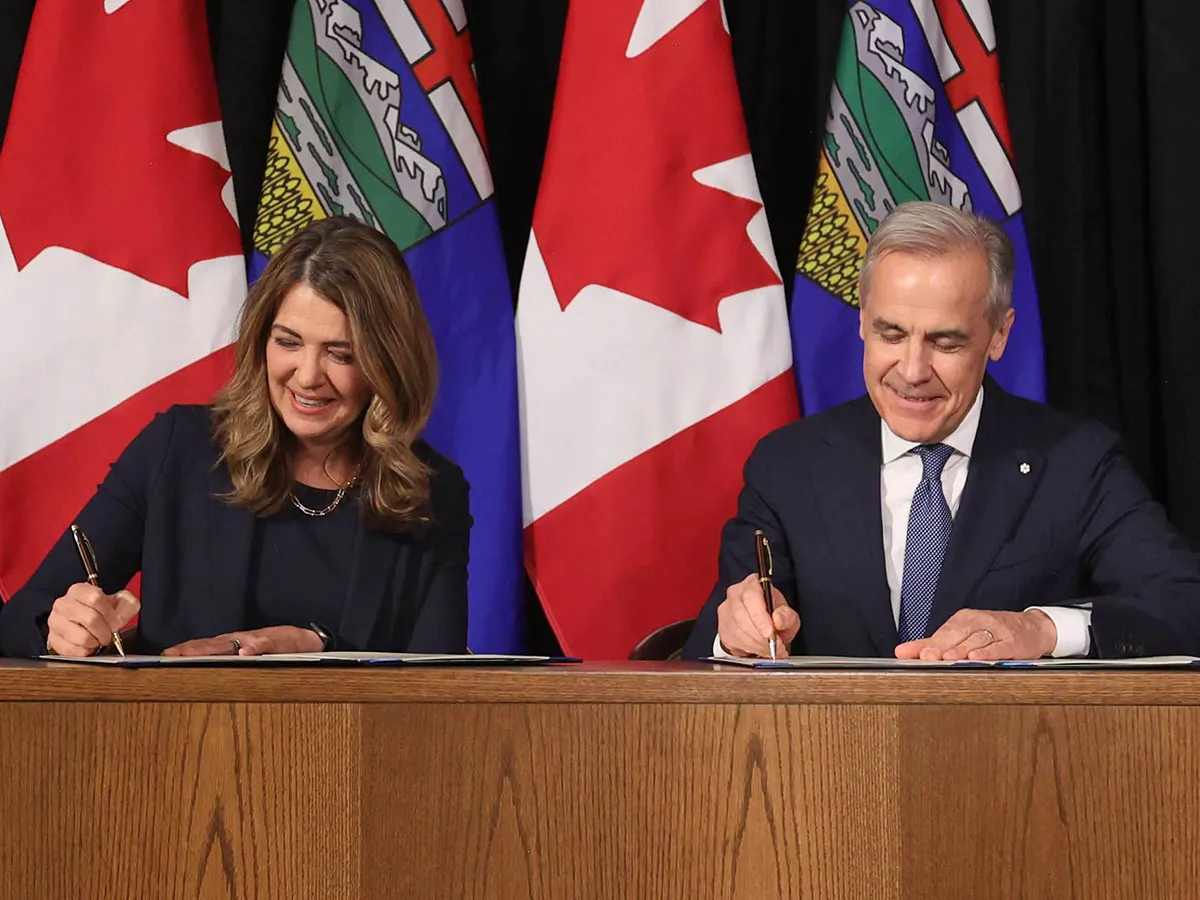
Skip to Content News Archives Economy Energy Oil & Gas Renewables Electric Vehicles Mining Commodities Agriculture Real Estate Mortgages Mortgage Rates Finance Banking Insurance Fintech Cryptocurrency Work Wealth Smart Money Wealth Management Investor Personal Finance Family Finance Retirement Taxes High Net Worth FP Comment Executive Women Puzzmo Newsletters Financial Times Business Essentials More Innovation Information Technology FP500 Podcasts Small Business Lives Told Tails Told Shopping Financial Post Store Obituaries Place a Notice Advertising Advertising With Us Advertising Solutions Postmedia Ad Manager Sponsorship Requests Classifieds Place a Classifieds ad Working Profile Settings My Subscriptions Saved Articles My Offers Newsletters Customer Service FAQ News Economy Energy Mining Real Estate Finance Work Wealth Investor FP Comment Executive Women Puzzmo Newsletters Financial Times Business Essentials HomeFP CommentTerence Corcoran: For PM Mark Carney, PM stands for PragMatistDoes the prime minister support fossil fuels and/or carbon reduction? Yes. Closer ties with U.S. or less? YesLast updated 1 hour ago You can save this article by registering for free here. Or sign-in if you have an account.Canadian Prime Minister Mark Carney greets people as he arrives to speak at the Economic Club in New York on May 28, 2026. Photo by ANGELA WEISS / AFP via Getty ImagesAs the Canada-United States trade talks launch into an uncertain trajectory, the ability of Canadian voters and foreign observers to determine where Prime Minister Mark Carney stands on national and international issues has become a little like reading the mind of a stock market. It could go either way.Subscribe now to read the latest news in your city and across Canada.Exclusive articles from Barbara Shecter, Joe O'Connor, Gabriel Friedman, and others.Daily content from Financial Times, the world's leading global business publication.Unlimited online access to read articles from Financial Post, National Post and 15 news sites across Canada with one account.National Post ePaper, an electronic replica of the print edition to view on any device, share and comment on.Daily puzzles, including the New York Times Crossword.Subscribe now to read the latest news in your city and across Canada.Exclusive articles from Barbara Shecter, Joe O'Connor, Gabriel Friedman and others.Daily content from Financial Times, the world's leading global business publication.Unlimited online access to read articles from Financial Post, National Post and 15 news sites across Canada with one account.National Post ePaper, an electronic replica of the print edition to view on any device, share and comment on.Daily puzzles, including the New York Times Crossword.Create an account or sign in to continue with your reading experience.Access articles from across Canada with one account.Share your thoughts and join the conversation in the comments.Enjoy additional articles per month.Get email updates from your favourite authors.Create an account or sign in to continue with your reading experience.Access articles from across Canada with one accountShare your thoughts and join the conversation in the commentsEnjoy additional articles per monthGet email updates from your favourite authorsSign In or Create an AccountorWithin his own Liberal party, murky political battle lines have been formed around contradictory policy stances on climate change, fossil fuels, trade and relations with the United States.Where does Carney stand on climate change and fossil fuels? In his Memorandum of Understanding (MOU) with Alberta Premier Danielle Smith, Carney simultaneously endorses increased oil production while pretending to reduce carbon emissions. Or, as viewed from the other side, he is pretending to boost fossil fuels while introducing uneconomic proposals to capture carbon emissions with industrial carbon taxes.Get the latest headlines, breaking news and columns.By signing up you consent to receive the above newsletter from Postmedia Network Inc.A welcome email is on its way. If you don't see it, please check your junk folder.The next issue of Top Stories will soon be in your inbox.We encountered an issue signing you up. Please try againCarney’s approach to relations with the United States is equally confusing. In his widely cited speech last week in New York, Carney told a business audience about how Canada and the United States can “consolidate our strengths” and “work together and compete with the rest of the world.” And then he bent his knee to President Donald Trump: “Canada Strong will help make America great again.”Too few observers have acknowledged the contradictions and tonal inconsistencies with Carney’s earlier claims that Canada was ready to sever trade and other ties with the United States. A year ago, Carney proclaimed Canada’s old relationship with the U.S. “over.” Only a few weeks ago he reiterated this approach in a video posted on YouTube: “The U.S. has changed” and Canada must look elsewhere for economic and political security, he said. “Many of our former strengths, based on our close ties to America, have become our weaknesses, weaknesses that we must correct.”Also in his New York comments last week, Carney the anti-fossil fuelist played another fossil fuel tune. Canada will increased liquid natural gas (LNG) exports to 50 million tons by 2030 and 100 million by 2040. That’s a lot of LNG production, a disturbing forecast for environmentalists who claim the production and transport cycle for LNG produces more carbon emissions than coal.No wonder former environment minister Steven Guilbeault has left the Liberal caucus and ex natural resources minister Jonathan Wilkinson has left Parliament. They have joined a line of activists, politicians and journalists who view Carney’s strategy as a betrayal. Writing in The Guardian, Vancouver climate journalist Seth Klein captured the shift in sentiment. “Canadian prime minister Mark Carney is not the climate guy you thought.” Carney’s signing of the pipeline MOU is another policy flip that will increase Canada’s carbon emissions, he said. However, “The Canadian climate movement is getting its bearings back,” Klein claimed.Among the movement’s leaders getting back into action is Rick Smith, head of the Canadian Climate Institute. When Carney became PM, Smith hailed an opportunity for Canada to establish a clear climate policy. “Accelerating Canada’s progress on climate change is an economic imperative in this time of global economic upheaval and uncertainty, he said.The MOU changes everything, said Smith last week, putting net-zero carbon emissions by 2050 out of reach for Canada. This week, Tim Gray, executive director at Environmental Defence Canada, warned that Carney appears to want to let the oil and gas industry do what it wants.That’s not quite the industry’s view. Carney’s stance on climate-versus-industry baffles commentators, critics and industry players who suspect the PM is still a backroom climate activist. Executives are understandably reluctant to publicly disparage the great uncertainty buried in the MOU’s pipeline and carbon capture plans. Major law firms, meanwhile, publicly outline where the industry stands. A Torys commentary concluded that “the question is whether political will can match the economic incentives for Canada to become a global energy superpower.”In other words, is PM Carney still a climate crusader, or is he now a backer of Canada’s oil and gas industries? Or both? Or neither?Similar questions surround Carney’s approach to the United States. After more than a year of posturing on the idea that Canada is going to walk away from the U.S. toward a new “Buy Canadian” economy built on trade with other countries, the prime minister is now doing what he has to do politically and economically. Canada needs the United States, whether it’s for trade or flying to the moon.At this point it is important to recall Carney’s official approach to government: principled pragmatism. As noted in one of my recent columns, in his Liberal leadership speech in March of 2025, Carney declared: “I am a pragmatist above all, so when I see that something’s not working, I will change it.” The title of his Davos speech was “Principled and pragmatic: Canada’s path.” Exactly how one blends principles with pragmatism is unclear.In his book Value(s): Building a Better World for All, Carney spends 500 pages dismissing the liberal concept of market “value” as a core economic principle. Value needs to be replaced by the plural “values” that can be defined arbitrarily under wavering unprincipled pragmatism — an approach echoed by others on the left who proclaim “the dangers of ideology and the virtues of pragmatism.”For PM Carney, PM stands for a Prag Matist who is driving Canada in contradictory directions. On climate, trade, artificial intelligence, space travel and other issues — where are we going? Join the Conversation This website uses cookies to personalize your content (including ads), and allows us to analyze our traffic. Read more about cookies here. By continuing to use our site, you agree to our Terms of Use and Privacy Policy.
Terence Corcoran: For PM Mark Carney, PM stands for PragMatist
Does the prime minister support fossil fuels and/or carbon reduction? Yes. Closer ties with U.S. or less? Yes. Find out more here
1,407 words~6 min read