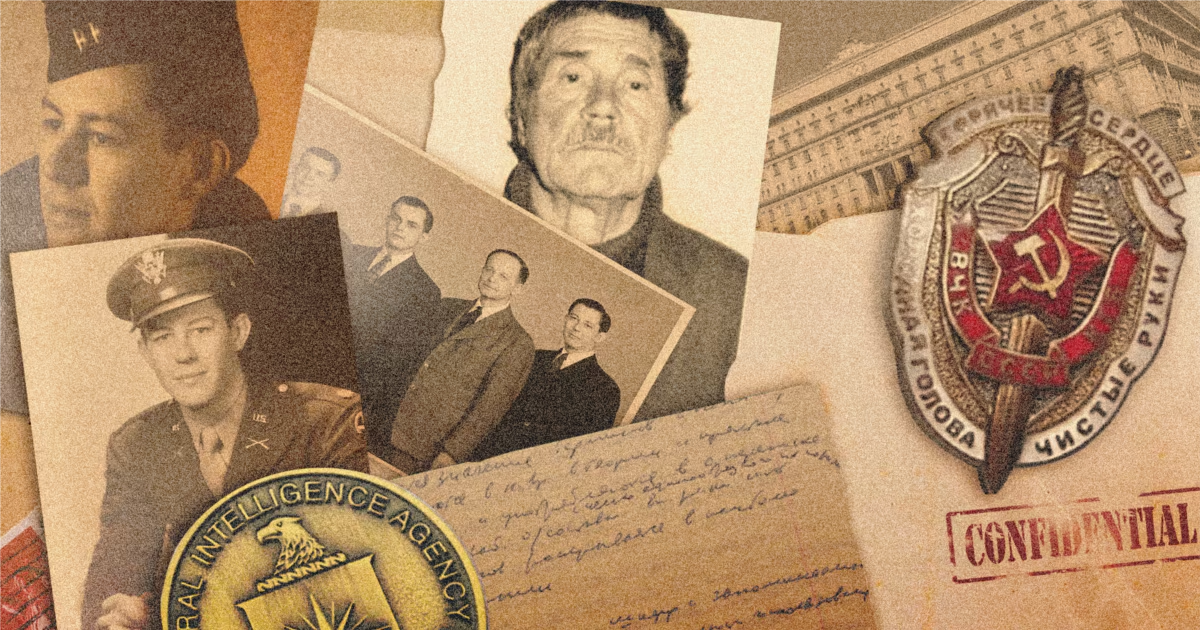
In September 1955, Robert F. Kennedy arrived in Moscow as part of an unusual Cold War driving tour of the Soviet Union. The future US senator's traveling companion was a prominent judge on the US Supreme Court.Their interpreter during the two-month journey across the closed-off country was a Russian-speaking former US Army officer whose position at the US Embassy in Tehran provided cover for his identity as a CIA agent: Frederick Flott.Back home in the United States, the trip brought wide attention to Kennedy, whose political career was on the upswing along with that of his older brother John, the future president.The trip also brought attention to Flott -- from the KGB. The Soviet spy agency assigned him a code name, Douglas, and went on to track him for the next two decades, hoping to cultivate him as a spy.
During World War II, Flott served in North Africa and later in France, where he worked with the French resistance sabotaging German positions.
In the early 1970s, the agency may have succeeded.The details of Moscow's pursuit of Flott are tucked away in an unpublished Russian-language manuscript housed in a collection of KGB documents called the Mitrokhin Archive.The files are named after Vasily Mitrokhin, a senior KGB archivist who spent years compiling thousands of pages of notes, then smuggling them out when he defected to Britain in the early 1990s.Over several pages of the manuscript, KGB interactions with, and surveillance of, an American code-named "Douglas" are described in detail. The code name is used in many of the mentions, but the file also specifically mentions the name "Flott," with accompanying biographical details that match Flott's government career.Among the most intriguing statements: that the KGB in June 1974 paid for Flott to travel to Moscow from Jakarta, where he worked as an embassy political officer, along with a $10,000 payment authorized by KGB chief Yury Andropov; and that Flott provided KGB officials in Washington with more than 100 classified State Department cables in the mid-1970s."It's unusual because it is a case from the Cold War that no one has ever heard of before," said Kevin Riehle, a former US national security and counterintelligence analyst who first came across the description of Flott and shared the original file with RFE/RL.