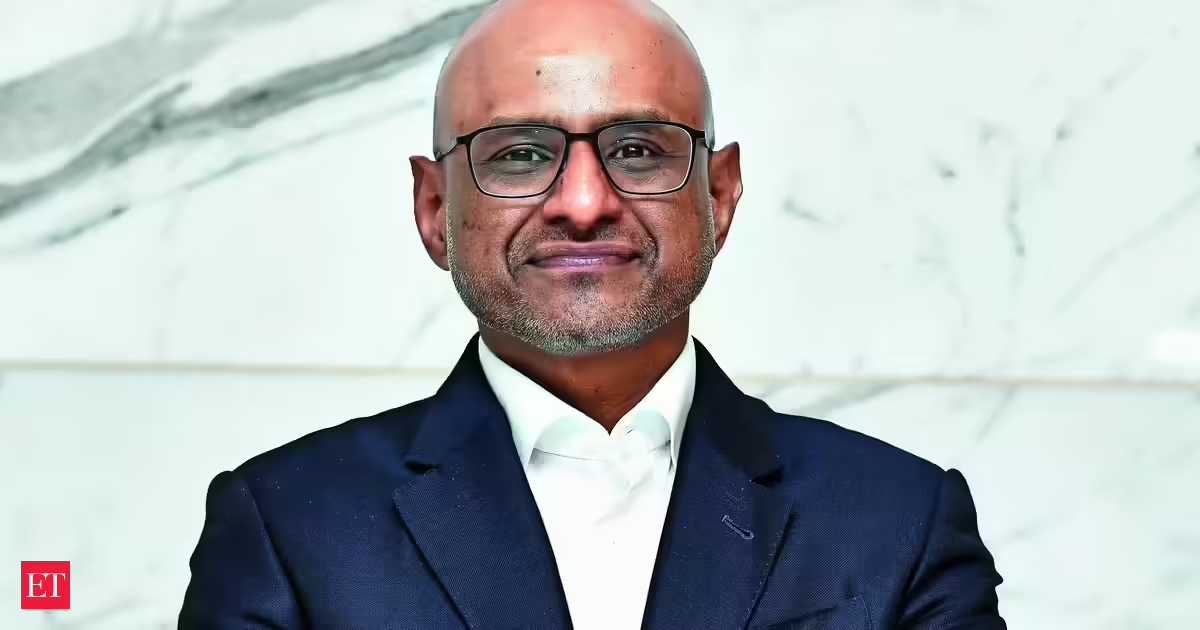
India needs to do a better job of positioning itself as a key beneficiary of the artificial intelligence revolution if it wants to attract larger flows of foreign capital, according to Vis Raghavan, head of banking and executive vice chair at Citi.In an interview to ToI's Mayur Shetty, Raghavan said global investors are increasingly directing capital towards markets and sectors perceived to be at the forefront of AI-led growth, resulting in a shift in investment priorities worldwide.Raghavan said India possesses several structural advantages that could make it a significant participant in the global AI ecosystem. These include a large pool of skilled talent, competitive operating costs and the potential to develop infrastructure across data centres, computing capacity and clean energy.He argued that India's ability to deliver computing capacity at significantly lower costs than many developed markets could strengthen its case as a global hub for AI-related infrastructure and services. However, this advantage has not been communicated effectively enough to international investors.Also read | Mukesh Ambani’s next big bet might not need humans at allAccording to him, India has the ingredients to become an important node in the global AI value chain, spanning intellectual property creation, digital infrastructure, energy transition initiatives and advanced technology development. With geographical barriers becoming less relevant in the digital economy, the country has an opportunity to participate across multiple layers of the AI ecosystem, from talent and innovation to hardware, hyperscale facilities and data-centre operations.Raghavan said greater macroeconomic stability, coupled with a clearer articulation of India's long-term AI opportunity, could help strengthen the country's appeal among global investors and support stronger foreign capital inflows.He noted that the impact of geopolitical tensions in West Asia has varied across regions. While the US has continued to witness strong risk appetite among investors, supported by a surge in technology and AI-related investments, India has remained largely driven by domestic participation from retail and institutional investors.According to Raghavan, foreign direct investment inflows into India have been constrained by concerns around energy security and elevated oil prices, as well as uncertainty among global investors regarding India's role in the emerging AI-driven economic landscape.Also read | Think tank makes strong case against US' new 12.5% tariff on IndiaHe said investment capital is currently gravitating towards opportunities offering superior growth potential, with AI-related businesses attracting a disproportionate share of global funding.This trend has created a sharp divergence in equity markets, particularly in the US, where technology and semiconductor companies have significantly outperformed broader sectors, he observed.The concentration of investment in AI-linked industries has also benefited economies with strong positions in semiconductor manufacturing and related supply chains, prompting a reallocation of capital that has affected investment flows into several emerging markets, including India.On the outlook for global interest rates, Raghavan said inflation trends, trade tensions and energy prices would remain the key determinants of bond yields. Market participants increasingly expect borrowing costs to remain elevated for a prolonged period, creating challenges for heavily indebted sovereigns, particularly in advanced economies.He, however, said corporate balance sheets remain healthy across major markets, with companies benefiting from manageable leverage levels and strong valuations. Businesses are therefore in a position to absorb higher financing costs or pass on part of the burden to consumers when required.Household consumption has also remained resilient, supported by stable labour markets and favourable wealth effects from strong equity market performance, although signs of caution are beginning to emerge.
India in right place at right time on AI but failing to make the right noises, says Citi's Vis Raghavan
India must highlight its AI power to attract global investment, says Citi's Vis Raghavan. Skilled talent, competitive costs, and infrastructure development are India's big advantages, but effective communication of these strengths is equally crucial, he points out.
564 words~3 min read