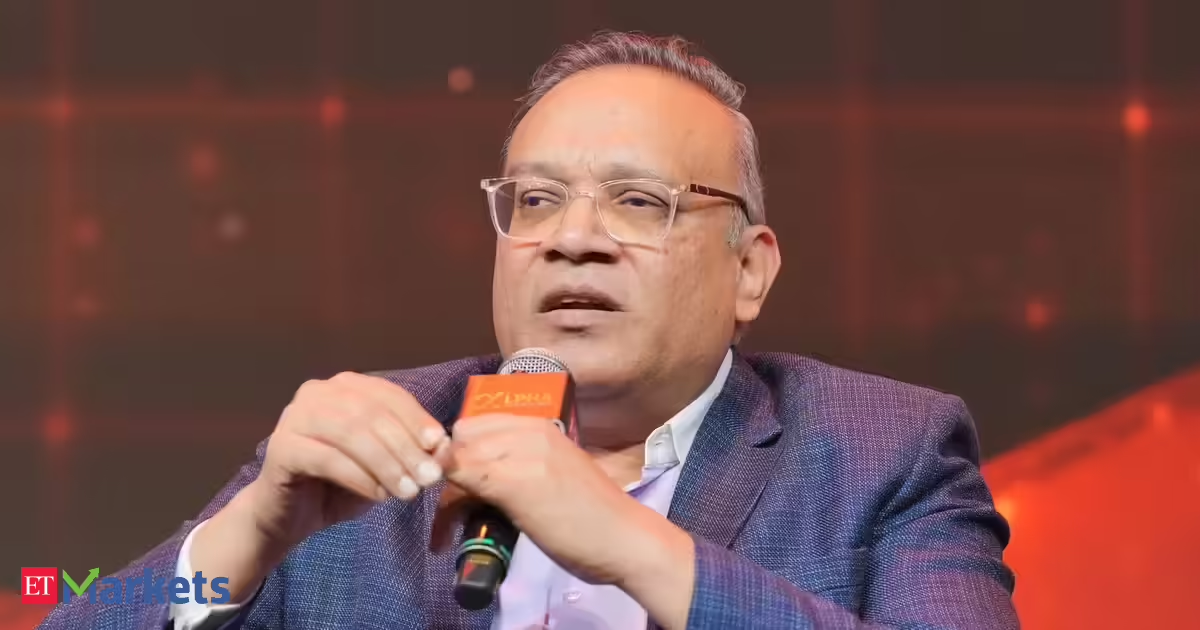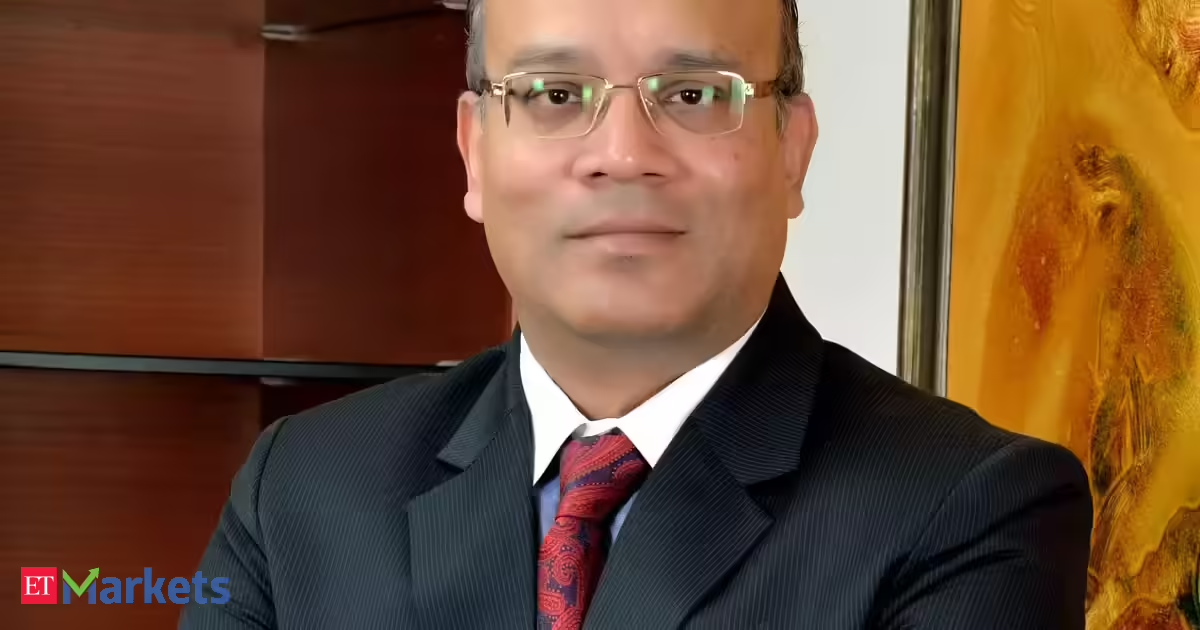
India's latest earnings season has largely met expectations, but market sentiment remains subdued. According to Prateek Agarwal, MD & CEO, Motilal Oswal AMC, the weakness in equities is less about corporate earnings and more about broader economic concerns and investor positioning.Speaking to ET Now, Agarwal argued that while companies continue to deliver expected numbers, investors are increasingly worried about underlying economic stress and its potential impact on future growth."Till the government and some of the PSUs take the shock, absorb the shock, it is not being transmitted to India Inc. Till then, the numbers will be as per expectation. It is like business as usual. The oil price increase has been transmitted only to a very small extent. So, it is not about numbers. It is about the fact that we, as an economy, do not look good just now. People understand it is stressed."He believes this stress is prompting foreign investors to reduce exposure, particularly in sectors where foreign ownership remains high."So, if you are stressed, then what do you sell? How do you manifest your thought into action? It is by selling what you have. So, banks, which are pretty heavy in the FPI ownership basket, are seeing selling on that count, is what my senses tell me."Large-Cap Weakness Masking Broader Market StrengthAgarwal pointed out that the performance of benchmark indices is being heavily influenced by two sectors—banking and information technology—which together account for nearly half of the large-cap index."IT, of course, is an AI trade. So, there it is sometimes positive, sometimes negative, but more to do with every new launch of a capability in AI. So that is the problem on the index. These two sectors put together make up close to 50% of the large-cap index and if these do not perform, the index will not perform."However, he emphasized that a different story is unfolding outside the benchmark."Life is outside of the index. So, where all of these less-owned-by-foreigners spaces are there, growth is continuing pretty strongly."According to Agarwal, market breadth has consistently outperformed the narrow set of index heavyweights over the past four quarters, and stock prices are increasingly reflecting that divergence.Chasing Growth, Not Market CapitalisationDiscussing investment opportunities, Agarwal stressed that his firm does not make investment decisions based on market capitalisation."We are not cap-focused; let me start by saying that. We are growth-focused as a house."He highlighted themes such as electric vehicles, digital businesses, capital markets, and pharmaceuticals as areas where growth remains robust, regardless of company size."Look at spaces like EV. There is nothing which is there in the large-cap space or mid-cap space. Two pure EV companies, both are in the small-cap space."Similarly, he noted that many beneficiaries of the semaglutide opportunity in pharmaceuticals, as well as several digital and capital-market-linked businesses, are concentrated in the mid-cap and small-cap universe."You want something which is moving up the cap tables, which we believe is enabled by strong, sustained, multi-year earnings growth."Why Value Investors May Like ITWhile Agarwal's portfolios remain underweight large-cap IT due to a lack of high growth, he acknowledged that the sector is becoming increasingly attractive from a valuation perspective."So, for Indians, Indian IT, especially with the rupee depreciation, is a great story over Financial Year 2027."He explained that foreign investors often compare Indian IT companies with global peers such as Accenture and Cognizant, many of which currently offer stronger growth at lower valuations."Foreigners will look at dollar earnings and dollar earnings growth. We in India will look at rupee earnings growth."Agarwal believes the current wave of AI-led disruption could create opportunities for smaller technology firms."When disruption happens, the larger a business is, the more pain it is, simply speaking. So, if you are in the mid-cap space, the disruption is an opportunity for you to gain market share."Energy Security and Electrification Emerging as Structural ThemesLooking beyond quarterly earnings, Agarwal sees India's response to elevated oil prices creating significant long-term investment opportunities."If the issue is oil price increase and it is unsustainable, how do we get over it? So that the next time it happens, we are better prepared. It is by increasing electricity generation through domestic sources."He expects policymakers to accelerate investments across coal, coal gasification, compressed biogas, renewable energy, and electric mobility."Expect more focus on coal. It sounds strange, but coal is what we have. We need electricity. This is a country of 145 crore people. It is the cheapest form of electricity."According to him, electrification could drive power demand growth at a pace that exceeds overall economic growth over the coming years.Import Substitution and Defence Gain MomentumAnother major theme emerging from current geopolitical and economic challenges is import substitution. "Importing less, how do we do it? By incentivising domestic industry for import substitution."Agarwal expects continued policy support through production-linked incentives, cheaper land availability, and revenue-based incentives aimed at strengthening domestic manufacturing.He also sees defence as a long-duration growth story, driven by changing geopolitical realities and evolving warfare technologies."Every country, for its stability, will end up trying to be in a better position versus what you have seen. So, this again becomes a multi-multi-year growth theme, not only in India but globally."Private Banks Losing Their Premium?One of Agarwal's most striking observations was on the banking sector, particularly the narrowing gap between private and public-sector banks.Historically, investors paid a premium for private lenders because of superior growth rates and better asset quality. Agarwal believes those advantages are diminishing."Now it is all the same. They have all grown large. They are growing in line with the economy and in line with PSUs and incurring something similar in terms of NPAs."Yet valuations remain sharply different. "Today they are priced at least two times more expensive than PSUs." As a result, he expects further valuation convergence between the two segments."So, I think while they may have declined materially versus where they used to trade before, the convergence in delta of what they were performing versus the PSUs is evaporating very rapidly, which means the valuation should also converge much more going forward."Reflecting that view, many of his investment portfolios have little or no exposure to traditional banking stocks."For a long while, many of our constructs have been running with zero banks. We may have some fast-growing NBFCs, but otherwise many of our constructs are actually zero banks, zero large-cap IT, and zero consumers as well."The Bottom LineAccording to Agarwal, investors focused solely on benchmark indices may be missing where India's strongest earnings growth is emerging. While banking and large-cap IT continue to dominate index performance, several of the country's most compelling long-term opportunities—from electrification and defence to digital businesses, pharmaceuticals, EVs, and capital-market plays—remain concentrated in the mid-cap and small-cap segments.For growth-oriented investors, the next phase of market leadership may lie well beyond the traditional index heavyweights.
Defence, power and import substitution are emerging as long-term winners: Prateek Agarwal
Indian corporate earnings are meeting expectations, but market sentiment is subdued due to broader economic concerns, not company performance. Foreign investors are reducing exposure, particularly in heavily owned sectors like banking. While large-cap indices are weighed down by IT and banking, growth is strong in mid and small-cap segments, driven by themes like EVs, digital, and defence.
1,125 words~5 min read