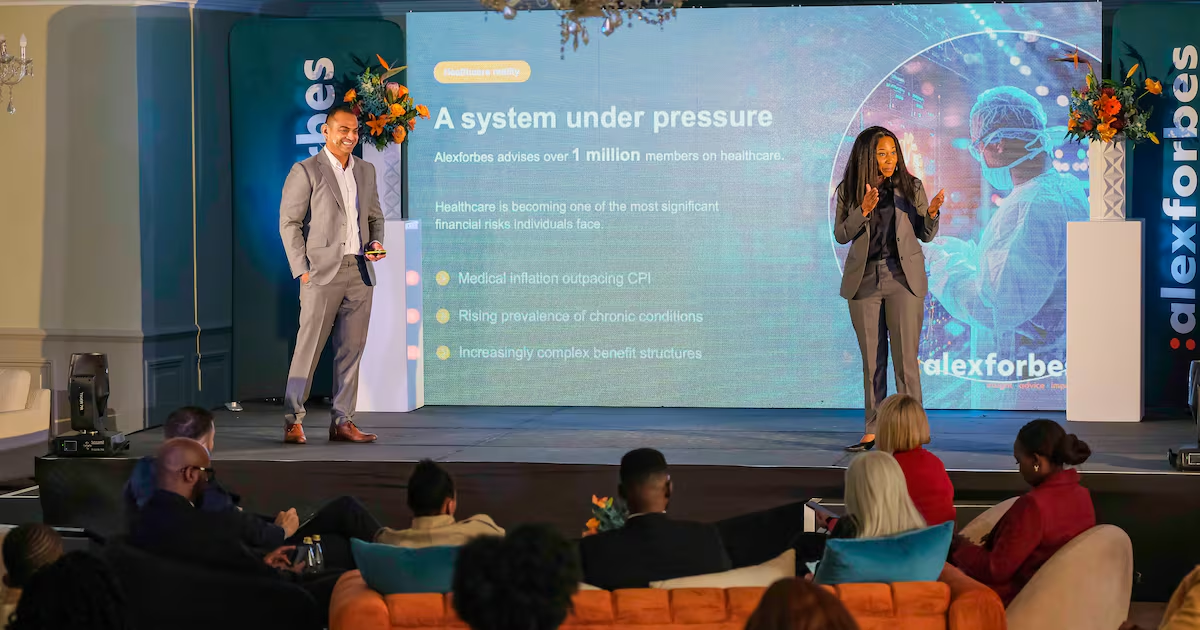
South Africa is entering an era where confidence will no longer be built through rhetoric, but through consistent execution.That sentiment lingered throughout the recent Alexforbes Hot Topics dialogue, hosted in partnership with Business Day and Arena Events.Masterfully moderated by journalist, broadcaster and conversation strategist Iman Rappetti, the dialogue unpacked South Africa’s increasingly familiar posture of “cautious optimism”, a phrase that has quietly embedded itself into the country’s economic and social lexicon.Yet as Business Day editor Luke Feltham observed in his opening remarks, optimism rarely arrives with a qualifier. It is usually understood as the absence of caution, not its companion. In South Africa, however, optimism has become more restrained, shaped by lived experience, tempered by disappointment, but still present enough to resist surrender.AI, purpose and the discipline of discernmentThat tension between possibility and pragmatism carried into a compelling address by Dr Andy Mabaso, group chief technology officer at Altron, who urged organisations to rethink their approach to artificial intelligence (AI).Rather than treating AI as a disruptive force requiring wholesale reinvention, Mabaso argued that most organisations had lost sight of a more fundamental truth: their core business remains unchanged. “Your business has not changed,” Mabaso says, cautioning against the rush to adopt AI tools without first identifying the real problems they are meant to solve.He distinguished between productivity AI, tools that enhance individual work such as generative platforms; and operational AI, which sits within core systems like fraud detection, risk management and customer service automation. While the former improves efficiency, the latter reshapes operations at scale.For financial services businesses, this distinction matters. The value of AI will not come from experimentation alone, but from its ability to improve outcomes at scale, especially in areas such as risk management, retirement advice and client experience.Importantly, Mabaso warned against outsourcing human judgement to machines. He emphasised that discernment, context and trust remain inherently human responsibilities, particularly in African contexts where locally relevant data and culturally grounded systems are essential to reducing bias and improving relevance.Information overload and the crisis of trustThe conversation on decision-making deepened with insights from Butši Tladi and Avishal Seeth of Alexforbes, who shifted the focus from technology to its human consequences. They painted a sobering picture of a society saturated with information, yet increasingly uncertain about what to trust. In an environment shaped by algorithms, AI-generated content and constant digital noise, misinformation is no longer defined only by its existence, but by how confidently it is consumed.Echoing Mabaso’s caution about critical thinking, Tladi and Seeth emphasised that access to information does not automatically produce better decisions, particularly when it comes to financial security, healthcare and retirement planning.Drawing on insights from more than a million retirement fund members, they highlighted how economic pressure and behavioural complexity were reshaping financial decision-making. In many households, immediacy is overtaking long-term decision-making, not by choice, but by necessity.This is where Alexforbes sees a clear role to play: not in providing more information, but in building trust, guiding behaviour and helping clients make better decisions under pressure.This set the stage for macroeconomic reflections from Mpho Molopyane, chief economist at Alexforbes, who located these behavioural and institutional pressures within a global economy defined less by short-term shocks and more by structural volatility.Rather than viewing uncertainty as a temporary phase, Molopyane argued that it had become a permanent feature of the global landscape, requiring a different approach to investing and expectation setting.She emphasised the role of thoughtful diversification in navigating this complexity. Not as a defensive tactic, but as a deliberate strategy to build resilient portfolios that can absorb shocks, manage downside risk and participate in long-term growth.In this context, diversification becomes critical not only for managing risk, but for managing investor expectations, helping members remain invested and avoid reactive decision-making in volatile environments.From optimism to executionThe panel discussion featuring Kenny Fihla from Absa, Dawie de Villiers from Alexforbes and Busisiwe Mavuso of Business Leadership South Africa (BLSA) brought the afternoon’s themes into sharper focus.Busisiwe Mavuso of BLSA, Dawie de Villiers of Alexforbes and Kenny Fihla of Absa. (Alexforbes) Across different vantage points, the message converged on a single reality: South Africa does not have a strategy problem, it has an execution problem. While policy intent exists, delivery remains inconsistent.While acknowledging modest improvements in certain macroeconomic indicators, Fihla cautioned that growth remained too weak to absorb unemployment or expand productive capacity at meaningful scale.De Villiers highlighted that investor sentiment was increasingly conditional, shaped less by rhetoric and more by confidence in consistent reform and delivery. Mavuso, meanwhile, framed competitiveness as the defining question, arguing that South Africa’s trajectory would depend not on what was promised, but on what was implemented with discipline and speed.A shared diagnosisWhat emerged across the discussion was not disagreement, but layered consensus. South Africa’s constraint is systemic. Policy intent is present, but institutional capacity and execution lag behind.Fihla’s concern with growth, De Villiers’ focus on capital confidence and Mavuso’s emphasis on competitiveness all pointed to the same conclusion: credibility is now earned through delivery, not design.Ultimately, confidence in South Africa will be shaped by consistency, accelerated implementation and the gradual rebuilding of trust between public systems, business and citizens navigating an environment defined by constraint, complexity and uncertainty.Watch the full Alexforbes Hot Topics dialogue:• About the author: Zipho Dolamo is a freelance business writer who helps individuals and organisations communicate their ideas with purpose and impact.This article was sponsored by Alexforbes.
In a society saturated with information, who can you trust to help you make decisions?
SPONSORED | Business and economic leaders at Alexforbes Hot Topics dialogue converge on one point: credibility is earned through delivery, not design
897 words~4 min read