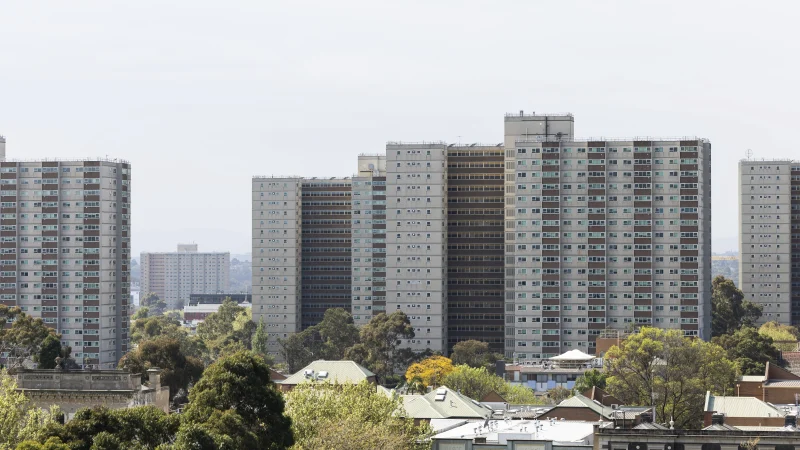
June 3, 2026 — 4:12pmA secret plan exists that would throw out height controls across Melbourne, with government papers targeting hundreds of train stations for high-rise towers in a radical expansion of Labor’s transport zone policy.The sweeping expansion would dramatically increase the total number of activity centres from 60 to 210, essentially turning almost every train station in Melbourne into a high-density housing zone.Planning Minister Sonya Kilkenny and Premier Jacinta Allan. Chris HopkinsBriefs created in late 2024 reveal the Department of Transport and Planning advised then-incoming treasurer Jaclyn Symes that the activity centres program must be dramatically expanded by 2028 to meet ambitious housing targets set in Daniel Andrews’ last days as premier.Under the state’s current framework, the government has already designated 60 activity centres across Melbourne – including areas such as Camberwell, Brighton, Ringwood and Frankston – where it is seizing local planning controls. In these zones, the government allows developers to bypass local councils to build high-density apartments up to 20 storeys.But Treasury documents tabled in parliament on Monday show the government has created plans to aggressively increase this footprint to meet its target of building 800,000 new homes over the next decade.“The [activity centres program] should be expanded to an additional 150 train stations and tram line locations by 2028 to reach the 800,000 target,” the official briefing papers states.The tabled papers, released more than a year after an order in parliament called for their release, also expose internal concerns within Treasury over whether the government’s high-density push is economically viable.Treasury officials warned Symes that soaring construction costs threatened to stall major apartment developments, raising serious doubts about whether developers will actually build the tens of thousands of apartments the government is counting on.Contacted on Tuesday, a spokesman for Symes said the advice contained in the brief was not government policy.Activity centres are designated commercial and transport hubs prioritised for intense apartment and townhouse development. The state government has created new planning regulations, including height limits, for each of the zones.The program is designed to shift Melbourne’s population growth away from the urban fringe and into established suburbs with existing public transport infrastructure.It has already faced fierce backlash from some councils and residents’ groups, which have accused the government of a centralised power grab that erodes local communities’ say over high-rise developments.While the government’s planning overhaul has been welcomed by economists and industry groups for cutting red tape, independent think tank the Grattan Institute has also warned that only a fraction of the targeted homes are currently economically viable.The Coalition has opposed the activity centre program. Shadow attorney-general and Brighton MP James Newbury has vowed to “rip up” the high-rise plans if elected.On Wednesday, Liberal MP David Davis moved a motion in the upper house to revoke planning rules across 25 activity centres as well as the mid-rise code, which makes it easier to build homes of four to six storeys.Opposition planning spokesman David Southwick said the secret plans to extend high-rise activity centres to a further 150 locations should concern all Victorians.“Under Labor, Victorians have no voice and no choice in what is being built in their community,” he said. “Only the Liberals and Nationals will restore the voice of local residents and work with communities, not against them, to get more homes built right across the state.”Planning Minister Sonya Kilkenny accused the Liberals of “working overtime” to block the construction of new homes.“The status quo is not an option. We need to deliver more housing choice close to trains, trams, schools and jobs,” she said.In Andrews’ dying days as premier in 2023, he announced the ambitious target of 800,000 new homes over a decade. Despite completing more homes than any other jurisdiction, the state government has since been consistently about 20,000 homes behind its 80,000-homes-a-year target.That target has been criticised for being arbitrarily high and led to pressure to implement planning reforms that were diminishing the quality of housing stock.David Hayward, an emeritus professor of public policy at RMIT University, said the more the government failed to meet its housing targets, the more likely it would be that it would further loosen its planning laws.Activity centres are proposed for areas close to transport in suburbs such as Camberwell.Wayne Taylor“But it won’t deliver what they’re intending – the private market simply can’t deliver it,” he said. “They need to bite the bullet and accept they need to take a bigger role in financing housing directly.“As they try to alter regulatory framework [they are] going to end up with perverse outcomes, an ugly city and dwellings that are not fit for purpose.”YIMBY lead organiser Jonathan O’Brien said he supported the department’s proposal, saying it would make sense to expand broadly at locations near public transport, instead of picking and choosing only certain stations.“It would enable [people] to choose where they want to live and enable a larger set of options for development across our city,” he said.Start the day with a summary of the day’s most important and interesting stories, analysis and insights. Sign up for our Morning Edition newsletter.From our partners
Secret government plan for radical expansion of suburban high-rise push
There are currently 60 high-rise activity centres. A secret state government proposal calls for 150 more.
845 words~4 min read