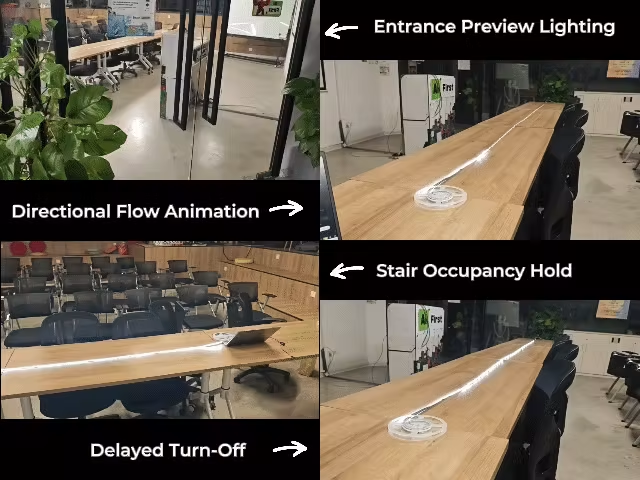
The Starting Point: A YouTube VideoThis project began after I came across a stair lighting video on YouTube.The concept was simple but fascinating: two mmWave radars detect a person's movement direction, and the stair lights illuminate sequentially like flowing water, either from bottom to top or from top to bottom.The original project was built around Home Assistant and included a complete automation setup and tutorial.My first reaction was:"I want to build one too."However, it didn't take long before I realized I didn't want to replicate the original design exactly.Why I Didn't Choose Home AssistantThe reason was fairly simple.Although Home Assistant is an incredibly powerful platform, it doesn't really fit my environment.I live in a relatively small apartment where devices are located close together, and I generally prefer lightweight standalone systems rather than maintaining a large smart-home ecosystem.There was also a practical networking consideration.I primarily rely on mobile internet and didn't want to maintain additional network infrastructure just for a stair lighting system.At the same time, the two radar nodes still needed a way to communicate wirelessly.That ultimately led me to ESP-NOW.As it turns out, ESP-NOW is almost ideal for this kind of project:No router requiredNo cloud dependencyLow latencyDirect peer-to-peer communicationLightweight enough for embedded systemsSystem ArchitectureThe system consists of:A radar detects movement or human presencePresence information is transmitted via ESP-NOWThe system determines walking directionThe LED state machine executes the animationThe lights remain on briefly before gradually turning offUnlike cloud-based smart-home solutions, everything runs locally.This results in extremely low response latency while eliminating the need for Wi-Fi infrastructure.Hardware SelectionPower SystemPower delivery turned out to be one of the most important parts of the entire project.Rather than powering the LED strip directly from the ESP32, I used an LED driver board I used the LED driver board I had helped design earlier as the power foundation.led driver board
Building a Smart Stair Light with ESP32-C6 and mmWave Radar
From Prototype to PCB: Building a Radar-Based Stair Lighting System (In Testing) By Carla Guo.
2,108 words~10 min read