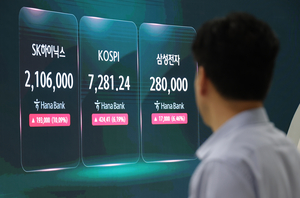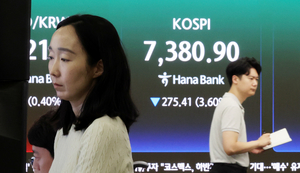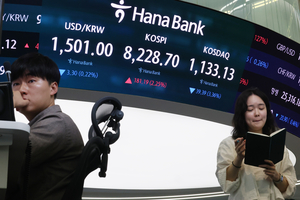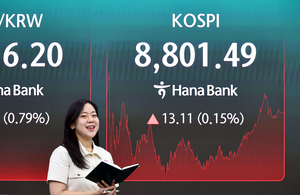
Korea's first single-stock leveraged products reach trading levels rarely seen in global markets, prompting concerns over market distortions An electronic board at Hana Bank's dealing room in Seoul shows the Kospi closing 0.15 percent higher at 8,801.49 on Tuesday. (Yonhap) South Korea's newly launched single-stock leveraged exchange-traded funds tied to Samsung Electronics and SK hynix are trading at levels rarely seen in major global markets, with turnover in some products already exceeding that of the underlying shares themselves.The development has raised concerns that trading in the products akin to derivatives could begin influencing the stocks they are designed to track — a dynamic that industry officials often describe as the "wag the dog" effect.Why investors are paying attentionAccording to Korea Exchange data on Tuesday, average daily turnover in leveraged ETFs linked to Samsung Electronics reached 3.7 trillion won ($2.44 billion), compared with 12.54 trillion won in turnover for Samsung Electronics shares themselves.The gap is also narrowing rapidly for SK hynix. Leveraged products tied to SK hynix generated 9.2 trillion won in average daily turnover, equivalent to roughly 59 percent of turnover in the underlying shares, only five trading days after launch.The figures only grow when similar leveraged products listed in Hong Kong are included.The Tesla yardstickThe contrast with the United States is stark.Tesla, one of the world's most heavily traded stocks and a favorite among retail investors, records average daily turnover of about $19.3 billion. Its largest leveraged product, the Direxion Daily Tesla Bull 2X Shares (TSLL), generates about $1.12 billion in daily turnover.That means turnover in the leveraged product amounts to just 5.8 percent of trading in Tesla shares.Put differently, Tesla stock trades roughly 17 times more than its largest leveraged ETF."Even TSLL, the world's largest leveraged Tesla product, does not come close to matching turnover in the underlying stock," an industry official said. "Compared with the US market, the current situation in Korea appears excessive."Why this mattersThe concern is not simply that the products are popular.Leveraged ETFs aim to deliver twice the daily return of their underlying stocks. To maintain that exposure, they must buy or sell shares near the market close every day.As assets and trading volumes grow, those rebalancing transactions can become large enough to affect the prices of Samsung Electronics and SK hynix themselves.This is what market participants refer to as a "wag the dog" scenario — when activity in derivative products begins driving movements in the underlying assets rather than merely tracking them.How the mechanism worksETF prices are expected to closely follow their net asset value, or NAV, which reflects the value of the underlying holdings.When demand for leveraged products surges, however, ETF prices can rise above NAV, creating a premium.Liquidity providers then buy Samsung Electronics or SK hynix shares to hedge their exposure and close the gap. Those purchases can push the stocks higher.The reverse is also true. Heavy selling of leveraged products can force liquidity providers to sell underlying shares, amplifying declines."When month-end or quarter-end rebalancing takes place, large sell orders can hit the market," another industry official said. "That could lead to sharp declines in share prices and should be viewed as a warning signal."Is the activity real?Some officials argue that headline turnover figures may exaggerate actual investor demand.They note that a significant portion of trading comes from transactions between liquidity providers and market makers, which can inflate turnover without reflecting fresh investor money entering the products.Others counter that regardless of how the trading is generated, the growing size of the leveraged ETF market means rebalancing flows will increasingly be transmitted to the underlying stocks.That is why regulators and market participants are paying close attention. The question is no longer whether single-stock leveraged ETFs have become popular, but whether they are becoming large enough to influence the prices of Korea's most important stocks.
Samsung leveraged ETFs outtrade underlying shares; Tesla's never have
South Korea's newly launched single-stock leveraged exchange-traded funds tied to Samsung Electronics and SK hynix are trading at levels rarely seen in major gl
TL;DRAI
Samsung and SK Hynix leveraged ETFs trade at volumes matching underlying shares—far exceeding US levels—creating "wag the dog" risk. Daily rebalancing could drive prices in Korea's chipmakers rather than track them, amplifying quarter-end volatility.
633 words~3 min read