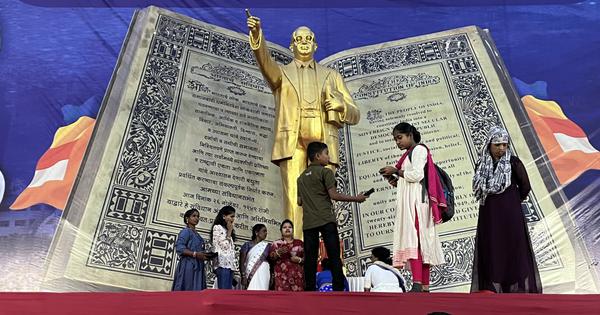
An order of the Madurai bench of the Madras High Court in G Rajesh v State of Tamil Nadu on April 30 has drawn attention for an unusual reason.The case involved the desecration of a poster of BR Ambedkar. But instead of confining itself to the ordinary logic of criminal proceedings under the Scheduled Castes and the Scheduled Tribes (Prevention of Atrocities) Act, the court accepted a compromise between the parties, directed the accused to read Ambedkar’s writings, examined them orally on those writings and recommended the wider inclusion of Ambedkar’s ideas in school curricula.The order, delivered by Justice L Victoria Gowri, states that the matter was approached “not merely adjudicatory, but also reformative”. Social harmony, the court observed, cannot be maintained “merely by criminal prosecution after damage is done” and the constitutional value of fraternity “cannot be left to chance”.This is what makes the order both striking and difficult.Moving beyond a purely punitive understanding of the law, the court attempted to open constitutional space for apology, repentance, pedagogy, and social transformation. However, when the Scheduled Castes and Scheduled Tribes (Prevention of Atrocities) Act, 1989, is already underenforced, such an approach could reinforce an already entrenched culture of impunity.Why compromise is troublingOffences under the Scheduled Castes and Scheduled Tribes (Prevention of Atrocities) Act are largely non-compoundable or settled out of court for good reason. Caste-based harms are often “resolved” outside formal legal processes through intimidation, pressure or unequal social bargaining. The law was designed precisely to ensure that caste humiliation is treated not as a private matter, but as a public wrong.That concern becomes sharper in light of the chronic judicial retrenchment of the remedial and preventive objectives of the Act. Courts operate within a system where complainants already face serious obstacles in securing effective enforcement of the law.FIRs are often not even registered, investigations and prosecutions are weak, and judicial discourse around the supposed “misuse” of the Act has weakened its enforcement.The Madras High Court was itself conscious that the alleged act could not be treated as merely private in character. It acknowledged that the desecration of Ambedkar’s image carried “social resonance extending beyond the immediate party”. The court also considered whether the apology offered by the accused was genuine or merely tactical.What followed was extraordinary. The accused were questioned in camera on Ambedkar’s life, scholarship, constitutional role and public service. The order records that they answered nearly 30 questions satisfactorily and had “really read and understood the substance” of Ambedkar’s writings.The court concluded that the matter had moved “beyond the stage of mere compromise” and had become one of “demonstrable repentance and measurable reformation”.Fraternity beyond symbolismThe significance of the order lies in how it deploys fraternity. Ambedkar’s well-known invocation of liberty, equality, and fraternity in the Constituent Assembly has shaped constitutional imagination; yet fraternity has remained comparatively underdeveloped in juridical reasoning.Here, however, fraternity is not treated merely as ceremonial rhetoric. The court invokes fraternity as a constitutional idea through which repentance, pedagogy, and social reform are brought within the judicial response to caste harm.This becomes especially visible in the court’s curricular directions. It calls upon the Tamil Nadu government to introduce lessons on Ambedkar’s constitutional role, scholarship, and social thought from Classes III to X, and directs the state to file a compliance report in 2027.The judgment therefore attempts to connect legal response with educational reforms and constitutional pedagogy rather than punishment alone.The danger of routinising remorseYet the difficulty lies precisely here.The language of fraternity can easily travel beyond the exceptional facts of a single case. Once apology and remorse begin to occupy the centre of judicial reasoning in caste-based offences, courts may increasingly rely upon them as grounds for diluting the force of the Act itself.A young accused person expresses regret. A compromise is reached. Some symbolic act of reconciliation is performed before the court. Criminal proceedings are then quashed in the name of fraternity.That possibility is troubling because caste oppression has historically been normalised within society itself. The Scheduled Castes and Scheduled Tribes (Prevention of Atrocities) Act was enacted to deter and prevent caste-based violence, not to displace accountability in favour of reconciliation.The Madras High Court order should therefore not be read either as a model solution or casually dismissed. Its importance lies elsewhere. It opens a conversation Indian courts have rarely engaged seriously: whether apology, pedagogy, and social transformation can meaningfully coexist with the deterrent structure of the law.That is a profound question. But where legal enforcement itself remains fragile, the language of transformation could also become a pathway to impunity.Sumit Baudh is the author of the forthcoming Routledge monograph Law at the Intersection of Caste, Class, and Sex.
Fraternity and caste society: The prospects and risks of a Madras High Court order
The order invokes fraternity as a constitutional idea linked to apology, pedagogy, and social reform. But could it weaken enforcement of the anti-caste law?
TL;DRAI
Madras High Court mandated an unusual remedy: the accused read Ambedkar's works, answered oral questions, and schools must include Ambedkar in curricula—a reformative response beyond criminal punishment. The approach risks normalizing compromise in weakly-enforced caste cases, potentially enabling impunity.
795 words~4 min read