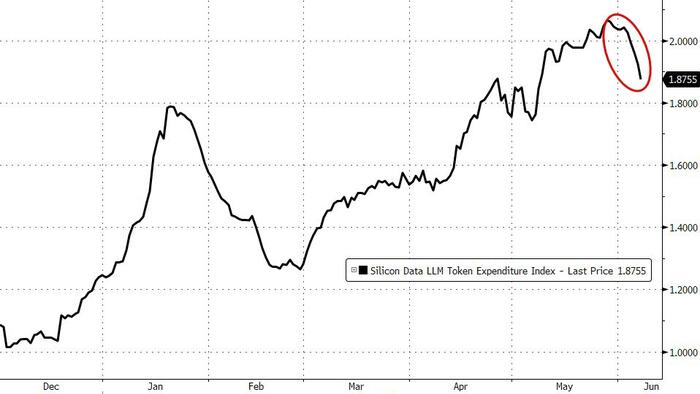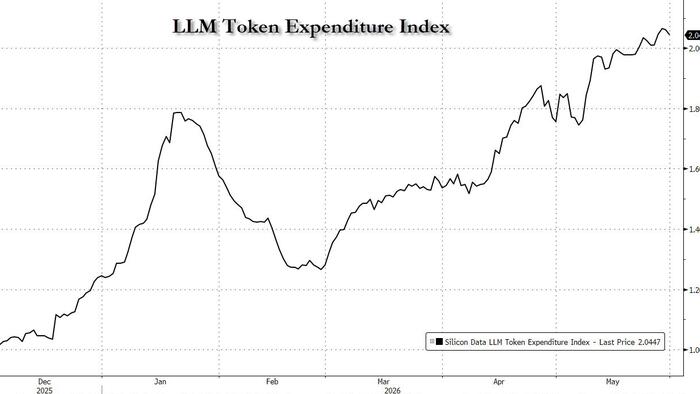
Now that attention within the AI revolution has one again firmly turned toward the cost-benefit equation (i..e., ROI) of tokens (see "From Singularity To Tokenomics: The AI Narrative Just Hit A Serious Snag") in particular, and the trillions behind the AI spending rollout in general, and we say once again because every few months we get some iteration of the following report from Goldman published almost two years ago today...... we have more bad news: according to a global survey by Bain, cost savings from automation are broadly falling short of projections. Which means that those expecting big savings from their investments in artificial intelligence, which is most companies, will be disappointed. The missed targets “should be making executives uncomfortable,” since many of them are approving increased spending for artificial intelligence on the basis of expected savings, the consulting firm said in a report shared exclusively with Bloomberg News. The problem is there are little actual savings to speak of. The survey, completed in April, was based on responses from executives at 951 companies with more than $100 million in revenue, across nine sectors: retail, technology, advanced manufacturing, healthcare, consumer products, energy, financial services, telecom/media/entertainment and insurance.It found that among companies measuring their AI cost savings, the largest share (40%) realized reductions of 10% or less. Predictably, most had been expecting to see far more meaningful improvement, especially since they spent far more than that on the new technology. Here’s the part that Bain found the most troubling: 44% of large companies that are funding their next wave of AI spending are basing those investments on the last round of savings - savings that haven’t yet materialized. “The prior wave underdelivered. The savings pool is smaller than assumed,” Bain warned. “And the investment case for the current wave was sized against projections rather than actuals.” Kinda like the bubble in AI forward earnings: based on projections - which as any intern can tell you can flip on a dime - rather than actuals. “Self-funding the next wave from past returns sounds like discipline. In reality, it is a circular bet with a structural leak,” the firm cautioned, and concluded that "The technology worked. The value didn’t arrive."Whether driven by hope or FOMO or a blend of both, the AI boom is exposing divides between promise and reality. An MIT research report last year showed that 95% of corporate AI pilots fall flat and concluded that the “primary factor keeping organizations on the wrong side of the GenAI Divide is the learning gap, tools that don't learn, integrate poorly, or match workflows.” So Bain’s latest survey wasn’t the first evidence of AI underdelivering so far on expectations. And it’s not likely the last either.But the Bain report isolated a different problem: “Despite a decade of investments in data modernization running well into hundreds of billions of dollars globally, the No. 1 reason AI programs underperform is that companies cannot reliably get access to their own data,” Bain said.“Companies that don’t validate their reinvestment math against what automation actually returned, rather than what it was supposed to return, are compounding risk rather than managing it” the Bain report concluded, confirming what many have already sensed: virtually nobody has done effective ROI analysis amid a technological rollout that has already soaked up more than $1 trillion in capital, the return on which appears to be modest at best. Bain's prescription: Instead of waiting to structure all of their data to make it ingestible by AI, companies should start with what’s available to feed into the models, and then use AI to help sort out how to structure the rest.Meanwhile, companies that were meeting their savings targets reported running into barriers with data structure and accessibility at even higher rates than those missing their targets, but they were less likely to report organizational challenges such as insufficient budgets or competing priorities.Adding fuel to the fire, a comparable report from Gartner found that over 40% of agentic AI projects will be canceled by the end of 2027, due to escalating costs, unclear business value or inadequate risk controls. “Most agentic AI projects right now are early stage experiments or proof of concepts that are mostly driven by hype and are often misapplied,” said Anushree Verma, Senior Director Analyst, Gartner. “This can blind organizations to the real cost and complexity of deploying AI agents at scale, stalling projects from moving into production. They need to cut through the hype to make careful, strategic decisions about where and how they apply this emerging technology.”As such, Gartner recommends agentic AI only be pursued where it delivers clear value or ROI, noting that "Integrating agents into legacy systems can be technically complex, often disrupting workflows and requiring costly modifications. In many cases, rethinking workflows with agentic AI from the ground up is the ideal path to successful implementation."“To get real value from agentic AI, organizations must focus on enterprise productivity, rather than just individual task augmentation,” said Verma. “They can start by using AI agents when decisions are needed, automation for routine workflows and assistants for simple retrieval. It’s about driving business value through cost, quality, speed and scale.” The problem, it now appears, is that virtually nobody has done an actual ROI analysis. But with token costs now soaring...... the time has finally arrived, and as enterprises pull back in horror from the "great promise" of the agentic black hole, one can easily understand why both OpenAI and Anthropic, both of which are extrapolating their burst in agentic revenue in perpetuity, are rushing to go public before the market once again does the ROI math.
"The Value Didn't Arrive": Bain Finds Cost-Savings From AI Are Falling Far Short Of Projections
“Companies that don’t validate their reinvestment math against what automation actually returned, rather than what it was supposed to return, are compounding risk rather than managing it.”
TL;DRAI
Bain: 40% of firms achieved <10% AI cost-cuts; 44% now fund next-wave spending on unproven prior returns. 40% of agentic AI projects cancel by 2027 due to costs and unclear ROI; the core blocker remains unreliable data access.
937 words~4 min read