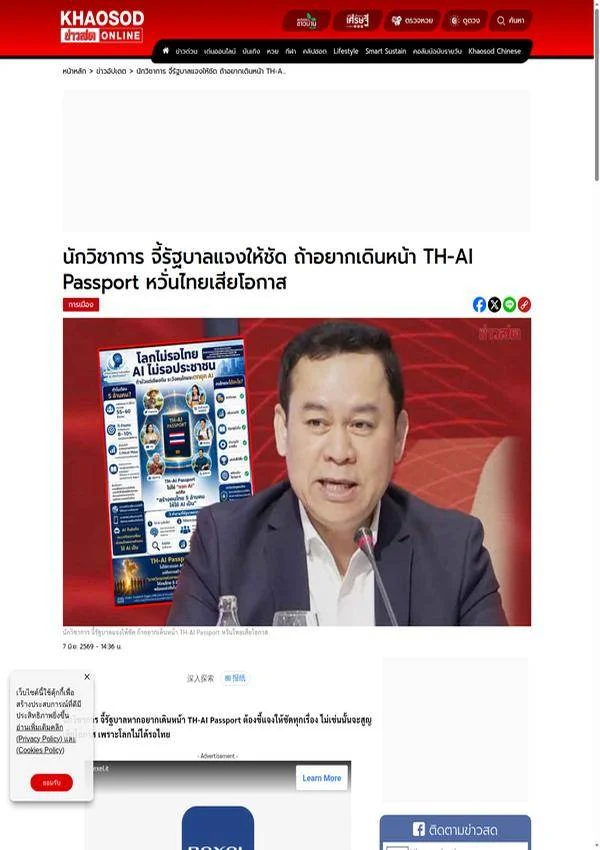
The government's TH-AI Passport project risks becoming a costly subsidy for foreign artificial intelligence (AI) platforms unless it is redesigned around targeted model access based on task complexity, domestic innovation and measurable productivity gains, says a trade group.Without stronger support for Thai developers, local large language models (LLMs), startup credits, domestic AI infrastructure and transparent usage reporting, the project could increase short-term AI adoption while leaving Thailand more dependent on global technology providers, rather than helping to build a sustainable national AI structure, according to the AI Entrepreneur Association of Thailand (AIEAT) and technology pundits.
Under the first phase of the scheme, the government plans to spend 1.6 billion baht to procure professional and premium generative AI models for free use by up to 5 million Thais aged 15 and older.
Framed as a national investment in human capital and AI capability, the scheme has drawn scrutiny over its scale, procurement process and value for money.
AIEAT proposed eight guidelines to ensure the project delivers maximum benefits in terms of both budget efficiency and the development of Thailand's AI capabilities.