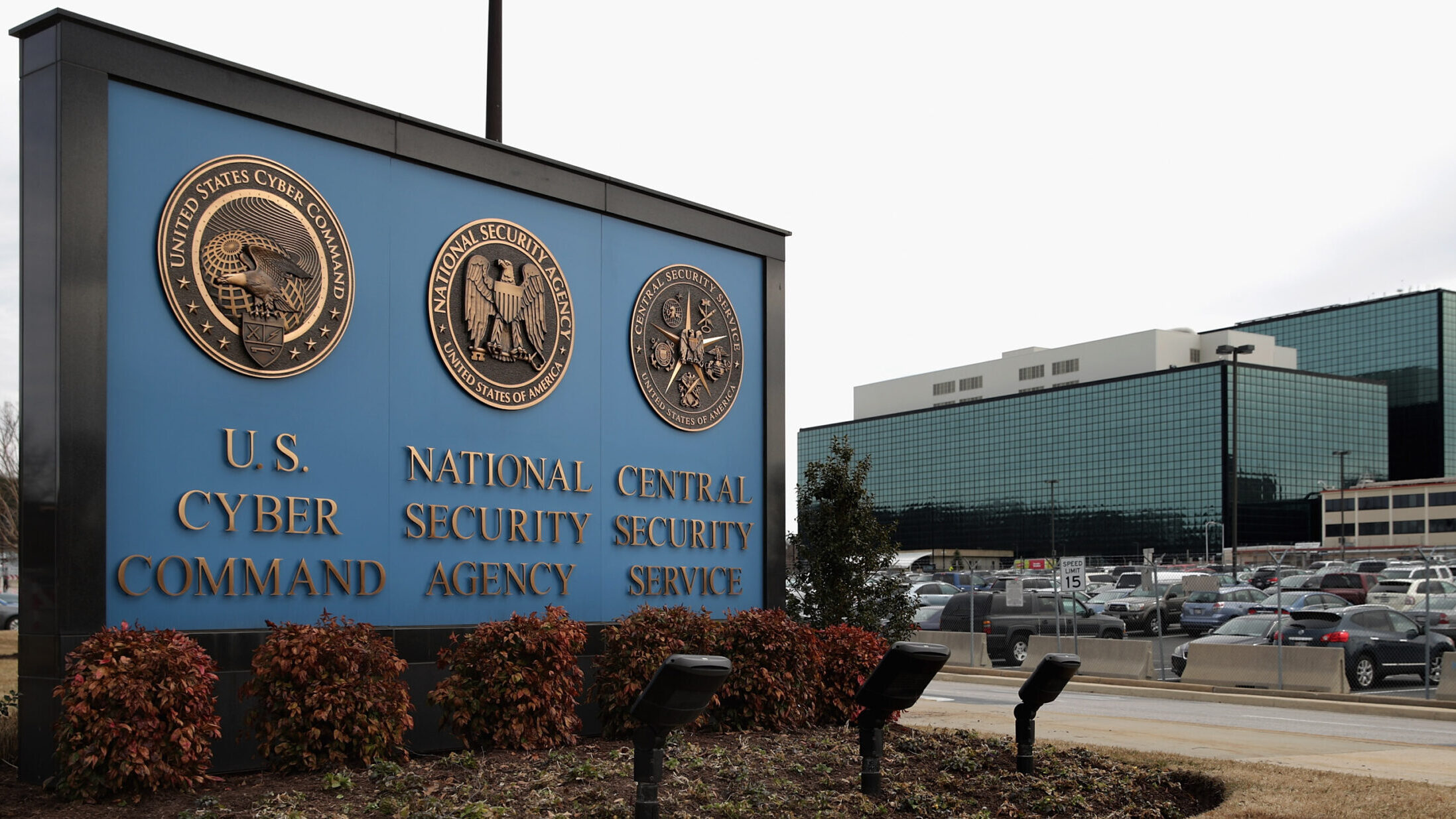
The seals of the U.S. Cyber Command, the National Secrity Agency and the Central Security Service greet employees and visitors at the campus the three organizations share March 13, 2015 in Fort Meade, Maryland. (Photo by Chip Somodevilla/Getty Images)
WASHINGTON — After weeks of delay, the White House issued an intensely anticipated executive order today that creates a new “voluntary framework” for government oversight of cutting-edge AI, with the National Security Agency playing a central role.
The “voluntary framework” in the executive order essentially asks that companies developing “covered frontier models” — as defined by the NSA — give government agencies and select “trusted partners” in the private sector early access to their models for 30 days prior to publication. The EO does not detail how the NSA will define “covered frontier models,” although it does require the NSA to consult with a wide range of other agencies, from Commerce to Homeland Security to the Treasury.
While most of the system the executive order set up is indeed voluntary, there’s no opting-out of the NSA oversight. Instead, the document directs the NSA to “develop and maintain a classified benchmarking process to assess the advanced cyber capabilities of AI models” — that is, to assess whether or not any given AI could be a dangerously powerful tool for hackers. The AI developers themselves may or may not be informed of those assessments, “as appropriate.”