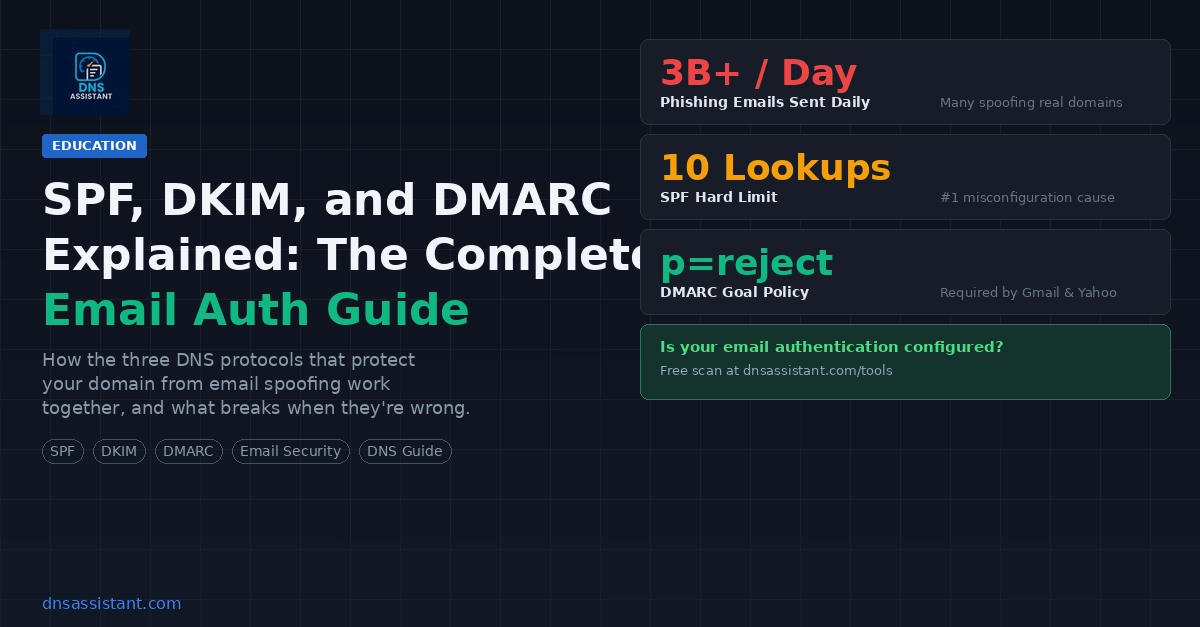
Every day, over 3 billion phishing emails are sent worldwide. Many of them claim to be from legitimate organizations: your bank, your employer, your SaaS provider. The recipients see a familiar domain in the "From" field and trust it. But the email didn't come from that organization at all. It came from an attacker who exploited a gap in the domain's email authentication configuration.
Three DNS-based protocols exist specifically to prevent this: SPF, DKIM, and DMARC. Together, they form a layered defense that tells the receiving mail server who is authorized to send email on your behalf, proves that messages haven't been tampered with in transit, and defines what should happen when authentication fails.
When configured correctly, these three protocols make it extremely difficult for attackers to spoof your domain. When misconfigured, or missing entirely, your domain becomes an open invitation for phishing, business email compromise, and brand impersonation.
This guide explains how each protocol works, how they fit together, the most common misconfigurations that break them, and how to verify your setup is correct.
Why Email Authentication Matters