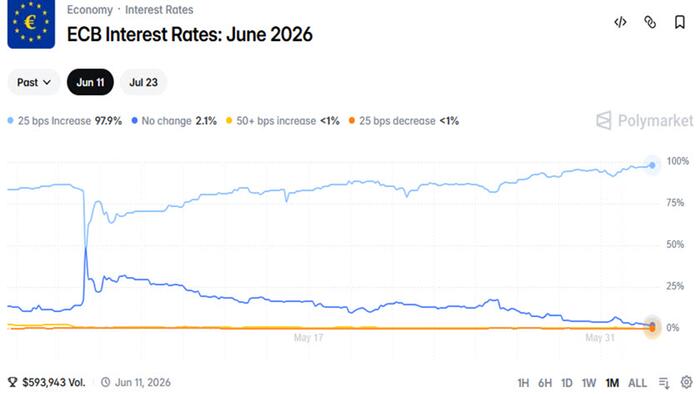
Euro Area inflation topped 3% for the first time since September 2023, further cementing expectations for a rate hike when the ECB meets next week. Consumer prices rose 3.2% from a year ago in May, and up from 3% the previous month, in line expectations. But core inflation, which excludes volatile items like food and energy, jumped more than anticipated to 2.5% (technically 2.55%), while the closely watched services gauge jumped to 3.5%, the highest since last November, and non-energy industrial goods inflation printing at 0.87%YoY.Energy inflation increased to 10.9%YoY, while food, alcohol and tobacco inflation fell to 1.97%YoY, notably below the weak 2.2%YoY Goldman was expecting.“The acceleration of headline and core inflation in May cements the case for a 25 basis-point rate increase from the ECB next week. Those moves have been driven by services prices, which have probably been pushed up by pass-through from oil prices. That may be used by the hawks on the Governing Council to argue broad-based inflation requires a follow-up move in September” said Bloomberg economist David Powell. Incorporating the May flash release into the Euro area inflation path, but also accounting for the potential Easter-related nature of the outsized move in services which should not be fully persistent, Goldman's medium-term path continues to show core inflation at a weak 2.5%yoy in 2026, peaking at 2.7%yoy in 2027Q2 before gradually declining to 2.0%yoy in 2028Q4, above the ECB staff March projections. As for headline inflation, Goldman expects it to peak at 3.4%YoY in Q4, using the bank's latest baseline path for gas and oil prices.The latest hot inflation print has cemented the ECB's first rate hike since September 2023 on June 11, with officials appearing to conclude that they can no longer wait to respond to the fallout from the Middle East conflict. ECB rate hike odds are now at 98% on Polymarket. They’re worried chiefly about workers demanding steep pay rises and firms boosting selling prices, viewing such consequences as probably now inevitable as the war drags on.Source: PolymarketMost policymakers, however, remain cautious on the path beyond June according to Bloomberg, as growth in the region’s 21-nation economy also takes a hit. Business activity shrank in May at the quickest pace since 2023.ECB Executive Board member Isabel Schnabel, viewed as the most hawkish Governing Council member, suggested Monday that it’s too early to specify how many rate increases may be needed. Lithuania’s Gediminas Simkus has said a second move after June “is more likely than not,” though it’s unclear when.“It’s quite important to react in a timely manner to this emerging inflationary environment so we can prevent a possible acceleration of inflation and the inflationary spiral, prevent it at its very beginning with the least possible impact on the economy,” Simkus said Tuesday in Vilnius.His Finnish counterpart Olli Rehn described inflation expectations as still anchored so far, but said action is needed this month to keep prices under control. “While inflation risks have increased, a rate increase in June would be an insurance one, but not due to entrenched inflationary pressures,” he said in a speech.Today's CPI print should not have been a major surprise: data last week showed inflation gathering pace in three of the bloc’s biggest member states, and remaining well above the ECB’s 2% target in all of them. Propelled by the war-induced surge in energy costs, May readings for France, Italy and Spain quickened to 2.8%, 3.3% and 3.6%, while the headline number for Germany moderated to 2.7%.
Euro Area Inflation Tops 3.0% For First Time Since 2023, Cementing ECB Rate Hike
“The acceleration of headline and core inflation in May cements the case for a 25 basis-point rate increase from the ECB next week."
TL;DRAI
Euro Area inflation rose to 3.2% YoY in May (highest since Sept 2023), driven by services (+3.5%), pushing the ECB's June 11 rate hike. Higher rates reduce tech infrastructure/AI capital and boost borrowing costs, forcing CTOs to prioritize growth spending.
579 words~3 min read