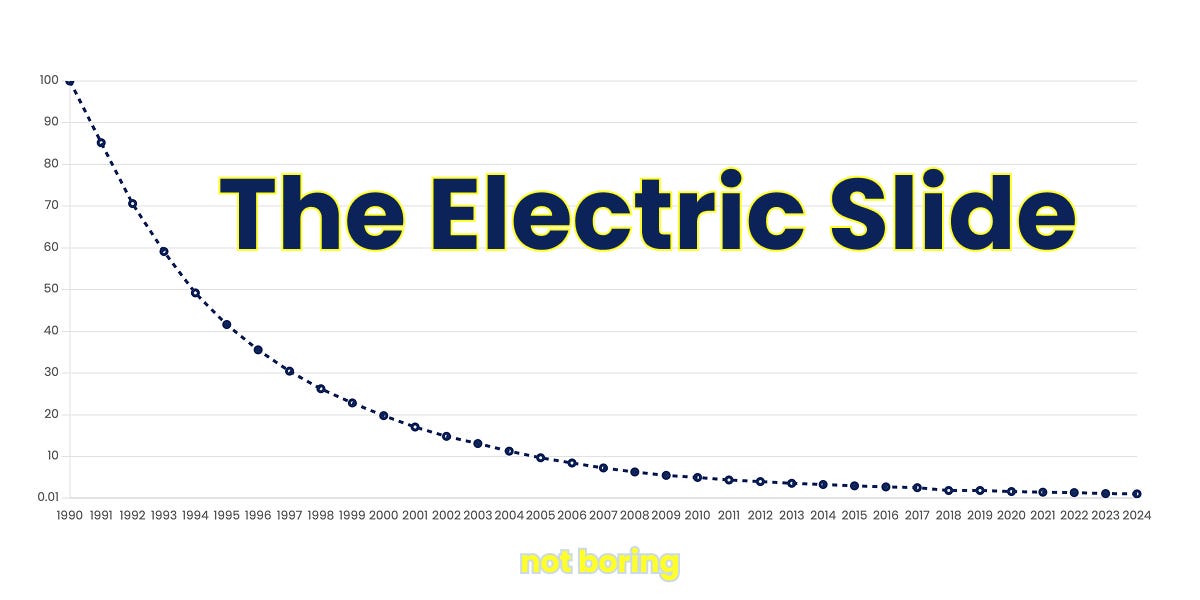
Welcome to the 730 newly Not Boring people who have joined us since our last essay! Join 268,518 smart, curious folks by subscribing here:Hi friends 👋,Happy Tuesday! Welcome to a Deep Dive I’ve been excited to write since The Electric Slide, about a company I invested in to build one layer of the Electric Stack - motors and actuators - in America.If you’ve heard of Westmag, it might be because they make really great hats. Everyone loves the Westmag hats. I’m wearing one right now, which co-founder David Hansen gave me right off his head. This hat, I think, in a decade or two, will be a collector’s item.I think that because over the past year, in stealth, Westmag has been making a lot more than hats. It’s been making motors and actuators, and it’s been making them to scale, so that in a decade or two, when we sit on the grass looking up at drone-decorated skies while robots do our chores, those drones and robots will be driven by Westmag motors and actuators.Let’s get to it.Launch fast. Design beautifully. Build your company’s website on Framer.Framer helps teams design, build, and launch their marketing sites lightning fast. With the ability to publish hundreds of CMS pages in a single click, operate at a global scale with seamless localization, and even host unified content across multiple domains, teams have never been able to ship faster. Companies like Miro, Bilt, and Perplexity trust Framer to achieve:Speed without chaos: ship pages and updates faster without turning the site into a fragile set of one-off hacks.Reduced dependency: shift routine brand and marketing work out of product engineering queues.Production-grade foundation: Run real marketing systems (CMS, SEO, performance optimization) with governance and collaboration.👉 Build your company’s site on Framer todayIf you drive out to South San Francisco, past and away from the city’s “Stop Hiring Humans” billboards and into the industrial part, you will find a low-slung facility from which David Hansen and Jordan Sanders plan to sling American-made motors and actuators to the American companies making drones, robots, and eventually, anything that moves under the power of electrons.It is called Westmag, a portmanteau of Western and Magnetics, which pretty much sums up the mission. Electric motors are spinning magnets, and if America is to participate in the coming electric revolution, we are going to need to make them in the West.This is the kind of statement you read on Twitter, at varying degrees of jingoism, as in “Get those Chinese motors out of my yard.” But it isn’t self-evident that we need Western motors, or, therefore, Westmag. The promise of globalization was cheaply-made Chinese motors powering expensively-designed American products for the benefit of all mankind.Certainly, we want to design our own robots and drones. Intellectual Property is what America does best. We probably want to manufacture them here, or in a friendly country, too. Even if you don’t believe the China hawks’ predictions that there will be a hot Great Power Conflict within the decade, it is better to err on the side of not putting a heavy, software-controlled, and easily-bugged Chinese hunk of metal inside every American home, or, eventually, putting every American human inside a flying, software-controlled, and easily-bugged Chinese hunk of metal to fly through the sky.But where do you draw the line?Should you make every magnet that goes inside every motor in the USA? Should you mine the rare earths that make the magnets here, mine them elsewhere and refine them here, or import them? The rare earths are commodities, after all, and impossible to bug or remotely control with known technology. And even assuming that you want to make everything here, is there a company to be built doing so? Who in their right mind would want to compete with China’s massive scale and subsidy advantages?American motors seem to violate both David Ricardo’s concept of Comparative Advantage and Michael Porter’s Five Forces. And yet, Westmag exists, and I invested in the company, alongside a16z, Founders Fund, Lux Capital, NFDG, Menlo Ventures, and my Electric Slide co-author, Sam D’Amico.In that essay, I wrote, “I even just invested in a stealth company making electric motors.” Westmag is that company. We also shared the reason America wants a company like Westmag, and many similar ones in all areas of the Electric Stack, to exist in America:Manufacturing and design are inextricably linked. When you make things, you learn how to make them better. You learn which parts of the underlying stack need to be improved, improve them, and make better products. This is a theme that comes up over and over again in our Electric Stack story.In the Electric Era, maintaining design leadership without manufacturing leadership is not a coherent strategic position, and one that gets less coherent the better you believe AI will get.Elon has solved this by building practically everything inside of his own companies. There is a parallel American ecosystem emerging to serve the growing number of electric companies not in the Elonverse. Westmag will be the winning motor company in this ecosystem, and will, in turn, enable its customers to win.In a time of experimentation and innovation, like the one drones and robots are in today, if you place component manufacturing near product manufacturing, the whole machine spins faster. This is particularly true when, to say nothing of geopolitics and everything of commerce, American companies are producing at volumes at which they are not Chinese component suppliers’ top priority.But that is half the story, a geopolitical imperative, not a corporate strategic one.The other half of the story is why a specific company like Westmag should exist, and how it can generate persistent differential returns in a market in which practically zero-margin Chinese alternatives exist. While we will tell the whole thing, that’s the half we’ll focus on today.It’s a story about Westmag specifically, and motors and actuators specifically, but it’s also the story of how to ride the Red, White, and Blue premium for just as long as you need to without counting on it long-term in order to kickstart demand and ride that growing volume down the cost/performance curve until, without subsidies and without patriotic premia, you can use scale and proximity and flexibility and speed to compete on overall system cost and win.This, to be sure, is a scale game, and that’s not the type of game we’ve played well recently. As David said, “Motors are capped at 100% efficiency, so most improvements are incremental. So you can go from 89% to 91%, but it turns out that doesn’t matter at all if you don’t make it and get it adopted at scale.” Previous attempts to compete in motors were focused on those efficiency gains or theoretical breakthroughs at the expense of the ability to quickly reach meaningful adoption and scale, he continued:Actually building a lot of it is the only way to get good at building it. China’s strength, which we are replicating, is building a lot of things and then improving it along the way. Bespoke low volume doesn’t create a manufacturing powerhouse with compounding advantages.Westmag plans to build a manufacturing powerhouse by focusing on scale. As Jordan put it:We are first focused on scale: scaling what works now and what is in demand now, while in parallel innovating on, and through scaling that, we will drive this virtuous feedback loop of innovations in how we manufacture and how we design motors, both for manufacturability but also for performance. You only get good at the stuff if you build a lot of it. And then you only win the market if you can actually get it out to the market in large numbers.So this is a story about why and how to build electric motors in America for economic reasons, how to build them at scale, and how to win. And it’s a story about what it will mean for the rest of America’s electric ecosystem, alongside which Westmag is growing up, if it does.It begins with what electric motors are, why they’re important, and where they’re made today.In The Electric Slide, we used the electric motor as the vehicle for understanding the whole Electric Stack, because the motor is where everything comes together. The batteries supply power to the electromagnets that create rotating fields that pull the Neodymium magnets around and around, coordinated by the embedded compute that takes in data from sensors and tells the power electronics how to flip the current thousands of times per second to create the smooth rotation that turns electrical power into mechanical power.Specifically, in a brushless DC motor, which power drones and the actuators inside humanoid robots, the stator, the part that holds still, is a ring of copper coils wound around teeth of laminated electrical steel, and the rotor, the part that spins, is studded with permanent neodymium magnets.The controller fires the stator coils in a precise rotating sequence. Three phases switch on and off thousands of times per second, so that the magnetic field appears to whirl smoothly around the stator. The permanent magnets in the rotor chase that rotating field and never quite catch it, and that perpetual chase is what spins the shaft. As we wrote:The magnetic force is doing the spinning. Everything else is about getting the magnets in the right place with the right polarity; nature does the rest.An electric motor simply directs electromagnetic forces that want to move towards equilibrium.The “brushless” part is an upgrade from older motors, which used carbon brushes to physically scrape current onto a rotating commutator, a mechanical hack that worked well enough but wore out, sparked, and capped achievable speeds. If you swap the brushes for electronics, you get a motor that is quieter, more efficient, more controllable, capable of tens of thousands of RPM, and good for a billion rotations before anything wears out. Which is why it has become the motor of choice for almost everything that needs to move precisely under software control, which is an increasingly large number of things.If you want a deeper understanding of how electric motors work, check out our explainer, How Electric Motors Work, or watch this video:For our purposes, what you need to know is that any electric product that moves is basically a bunch of actuators, of which motors are a subset, converting some form of energy into physical motion, wrapped in bodies that allow them to understand the world around them and move certain ways in response. The bill-of-materials (BOM) for a humanoid robot, for example, is roughly 50% actuators with motors and magnets at their core, which act as their joints.“Motors are simple,” Jordan told me, someone to whom motors are not simple, when I visited the proto-motor factory. “They’re just magnets and copper wire wrapped around some electrical steel.”From a materials perspective, motors are simple. Making motors, however, turning those materials into a precision component at scale, is much more complex.A brushless DC motor is a bundle of compounding tolerance requirements. The electrical steel arrives as thin sheets that have to be stamped into laminations, coated to prevent eddy currents, and stacked into a stator with the layers aligned to within a hair. Copper wire, sometimes thinner than a human hair itself, has to be wound around the stator teeth at a precise tension, in a precise pattern, with as much copper crammed into the available slot area as physically possible.Then there are the magnets. Neodymium magnets get pressed into the rotor at orientations specified to a fraction of a degree, and magnetized in place by fixtures that fire enormous bursts of current through coils to align the magnetic domains. Increasingly, you can get blocks of neo magnets in the US, but what you get is a slab of metal that isn’t yet magnetized or cut to the right shape. To turn block into a usable motor magnet you have to cut it (small-motor magnets are curved, and the curve is not easy), shape it, coat it, and magnetize it. No one does this in America today, so if you want to do it right and quick (i.e. if you don’t want to send the American magnet block to China or Malaysia and back), you probably need to do it yourself. If you get the orientation slightly wrong, your field ends up lumpy. If your field is lumpy, your motor cogs, vibrates, and wastes energy.Stack those tolerances on top of each other (lamination, winding, magnet orientation, rotor balance, bearing fit, etc…) and you start to see why motor manufacturing is mostly a process problem, not a materials problem. The materials are simple. The process is annoyingly precise.That is why, as much as their total dominance of the rare earth magnet supply chain or (no longer) cheap labor, China is so good at this. Over the past thirty years, they have made a lot of motors, and in the process, they have written a library of institutional knowledge. The winding machines in Shenzhen have been refined by a thousand small revisions. Chinese line workers know what a properly-wound stator feels like in their hands. Their test rigs have been calibrated against millions of motors.This knowledge compounds for you, just like the tolerances compound against you, and it’s only if the knowledge wins that you can produce a lot of motors, cheaply and reliably. For the past three decades, China has been doing all of the compounding.Like every layer of the Electric Stack, electric motors were invented in the West and Japan. Michael Faraday of cage fame built the proto-motor in London in 1821. A decade later, in Princeton, Joseph Henry discovered that you could make incredibly powerful electromagnets by wrapping insulated wire around iron cores.The Joseph Henry Papers ProjectForty years later, in 1871, Zénobe Gramme built the first commercially successful generator, using electromagnets for the field magnets, powered by some of the current it generated itself in a process called self-excitation. In the 1950s and 1960s, American researchers began replacing mechanical commutators with electronic switching, and in the 1960s and 1970s, Japanese firms like Yaskawa, Panasonic, Sony, and later Mabuchi aggressively productized compact permanent‑magnet motors as transistors and then MOSFETs got cheaper. These were the first truly mass‑manufactured, consumer‑scale BLDC motors.In 1983, in a story that you need to read if you haven’t, Sumitomo’s Masato Sagawa (Japan) and GM’s John Croat (US) independently discover Nd₂Fe₁₄B, the modern neo magnet, and presented their findings at the same conference in Pittsburgh.Masato Sagawa Presents at the 1983 MMM ConferenceSumitomo perfected sintered high‑performance blocks, while GM’s Magnequench division perfects bonded molded magnets, both of which were used in neodymium magnets’ alpha product: 3.5” hard-disk drives (HDD), which relied on two small electric motors, voice coil motors and spindle motors.As 3.5” HDDs overtook 5.25” HDDs, neo magnets swept the market.Sources: The Innovator’s Dilemma, industry interviews, HDD teardown reports, and trade dataAnd as neo magnets scaled, they and the motors they powered got cheaper, unlocking new use cases, more scale, better price-for-performance, and therefore more use cases, and more scale, in a virtuous cycle that we are still riding today. You can read the full story in The Electric Slide.Today, however, the products that run on electric motors don’t run on American-made electric motors or neo magnets.In 1995, GM, under financial pressure, sold 80% of Magnequench for $70M to a “US‑led” consortium that was, in reality, two PRC‑controlled companies led by Deng Xiaoping’s sons‑in‑law. CFIUS approved the deal on the condition of a 5‑year pledge to keep production in the US. Long before the five-year pledge expired, Magnequench’s Chinese owners had already cloned the Indiana lines in Tianjin. By 2003, the US plant shut down.In parallel, as part of Xiaoping’s long-term plan, China came to dominate rare earth mining and manufacturing, including the mining and manufacturing of neodymium. By the early 2000s, having undercut them on price and environmental standards, China forced the US’ only big rare earth mine, Mountain Pass, into bankruptcy, and came to control the full rare‑earth → NdFeB magnet chain that is essential for high-performance BLDC rotors.But supply without demand does not an industrial superpower make. Enter Shenzhen.Shenzhen was a small fishing village of about 30,000 people across the border from Hong Kong before Xiaoping, as part of his “reform and opening” policy, designated it the opening country’s first Special Economic Zone in May 1980.Construction Site in Shenzhen SEZ, 1980, Leroy W. Demery, Jr.Throughout the 1980s and into the 1990s, China’s quasi-capitalist city exploded. Cheap labor poured in from across China to fill the demand for hands: Shenzhen had quickly become a hub for assembly and low-end manufacturing. Soon, dozens of contract manufacturers were making toys, watches, and all manner of cheap electronic devices.BYD started in Shenzhen, to execute an arbitrage: reverse engineer Japanese battery manufacturing processes and replace all of the expensive automation with Shenzhen’s cheap, abundant labor. Over time, Wang Chuanfu’s company built out Shenzhen’s battery supply chain while becoming the world leader in electric vehicles, one feeding the other. If you make the components, you can make better products.Johnson Electric, founded in Hong Kong in 1959 by Wang Seng Liang and his wife, set out to manufacture miniature DC motors specifically for the booming Hong Kong toy industry. When Xiaoping opened the Pearl River Delta to ~capitalism, Johnson moved production across the border, like many of Hong Kong’s electronics companies. By the 1990s, more than 80% of Hong Kong’s factories had moved to the mainland, mostly into the Pearl River Delta. Per the (surprisingly shitty) Porter’s Five Forces website entry for Johnson Electric, “the 1980s show a shift toward application‑specific motion solutions as automation and automotive electrification rose.” By the 1990s and early 2000s, “Johnson Electric established mainland China production and verticalized stamping, molding, and magnetics to protect margins; it diversified from brushed motors into BLDC, stepper, linear actuators and subassemblies.”Thanks in part to the competence that Johnson Electric had built in motor manufacturing, Shenzhen became the epicenter of the RC hobby industry, which refined brushless motors specifically. The next big thing will start out looking like a toy.So by the time that Frank Wang used the proceeds from selling flight-control parts to universities and Chinese power companies to move to Shenzhen and start Da-Jiang Innovations, or DJI, the city was already the place where almost every component a flying camera needs was already being made within a couple hours’ drive of his apartment, by people who had been making them for years. RC hobbyists were refining the brushless motors, and the speed controllers to drive them. BYD had already been making lithium cells and packs for a decade. Camera modules were widely available hand-me-downs from the smartphone industry that had turned Shenzhen into the best place on Earth to turn a bare Sony sensor into a working, calibrated eye for a few dollars. Gimbals, plastics, PCBs, radios, and GPS units were available on a quick stroll through Huaqiangbei, the city’s electronics district, where Wang could pull from some 30 billion components crammed into a single square mile, get a custom PCB turned around in 90 minutes, and go from sketch to prototype in a few days.HuaqiangbeiCheap labor had attracted BYD, Johnson Electric, and countless other manufacturers to Shenzhen, but it was the components and expertise they’d built with that labor that made the city an ideal place to start a drone company in 2006.But precisely because components were so widely available, a hundred copycats could pull them off the same shelves. So DJI started vertically integrating. It built the flight controller first, because that was the part Wang understood best, and the cost fell from several thousand dollars in the mid-2000s to a few hundred by 2012. Then they developed the gimbal in-house and shrunk until it cost a tenth of the professional rig it replaced. Then the camera. Then, eventually, the propulsion system itself, the motor and ESC and propeller, designed as a single matched unit.Today, DJI makes something like 70-80% of the drones in the world, and it is, by itself, supplying itself, the largest drone motor manufacturer in the world by a wide margin. It got so good at making motors that it’s even started selling its Avinox e-bike motors to other companies.Thanks in large part to DJI, but also to the ecosystem it grew up in and Xiaoping’s foresight, to the fact that someone buying a motor can also buy a battery and power electronics and custom-made PCBs right next door, China absolutely dominates the world’s production of drone motors.That same expertise allows them to dominate the world’s production of robot actuators, each of which has a drone motor at its core.Which means, along with all of those batteries and power electronics and custom-made PCBs, that China absolutely dominates the world’s production of drones and robots.Because if you want to build products on the Electric Stack, it is critical to have fast-turn components available nearby.On its face, it is not bad that China dominates drone motor and actuator production. In a frictionless utopia, it would be great.A company in one country (say, America) would design a drone or a robot or anything that moves, they would send the specs for the components they need to a bunch of other countries (like, for example, China) where they could be made best-for-the-cost, those countries would make the components and ship them near-instantly back to the buyer, the buyer would assemble those components into a finished drone or robot or whatever, and it would sell them to customers around the world, each of whom would benefit from a product made in the most efficient way possible.Sure, America could design and manufacture here, and there was a time in the 1970s when we were better at both designing and manufacturing than China, but if we’re better at designing than manufacturing, and if design captures more of the value, we can design here and manufacture in China, which has a comparative advantage in manufacturing.Comparative advantage is a concept coined by the economist David Ricardo in 1817 to explain why countries engage in international trade even when one country’s workers are more efficient at producing every single good than workers in other countries. When Nobel Laureate Paul Samuelson was challenged to “name me one proposition in all of the social sciences which is both true and non-trivial” by the mathematician Stanislaw Ulam, he thought for a few years and came back with comparative advantage: “That it is logically true need not be argued before a mathematician; that it is not trivial is attested by the thousands of important and intelligent men who have never been able to grasp the doctrine for themselves or to believe it after it was explained to them.”This is the logic that policymakers and economists used to justify globalization and the World Trade Organization, and it fueled China’s rise.From the reform era through WTO accession in 2001 and into the 2000s, China was labor-abundant and capital-and-skill-scarce, so it specialized in labor-intensive assembly while the US specialized in the capital-, IP-, and skill-intensive ends. For a while there, it worked as planned. Americans were smiling all the way to the bank.The Smiling Curve depicts how “value added varies across the different stages of bringing a product on to the market in an IT-related manufacturing industry,” and therefore, where value is captured.This was the dream. China would sit low in the middle while America captured value on both sides. The iPhone is a canonical example. Kraemer, Linden, and Dedrick’s 2010 teardown found that Apple captured 58.5% of the value of the iPhone 4/3G in profits, while China’s labor earned just 1.8% of the value.Data: Kraemer, Linden, and Dedrick, Capturing Value in Global NetworksBut China, as we’ve seen, didn’t plan to stay on the bottom lip, and it didn’t, because doing the assembly taught it the adjacent capabilities. Assembling electronics pulled it into making components, then the tooling and machines that make components, then design itself. Serving as the world’s factory was a thirty-year education that pulled China up the smile curve and across the product space into denser, more complex nodes. Over time, the country’s edge became capability instead of labor cost.Today, in a specific set of sectors, China holds an absolute advantage, with the lowest cost and highest capability and most complete stack, all at once, such that capital and capability rationally flow toward China rather than away. The advantage rests on scale economies (largest volume → furthest down the learning curve → lowest unit cost), agglomeration (the Shenzhen/Pearl River cluster where all of the inputs, tools, and skill sit within a short radius), accumulated process knowledge, and vertical integration.This is the situation we described in The Electric Slide. China doesn’t hold an advantage in everything, but it certainly does hold the advantage in the Electric Stack.“Today, China produces 75% of lithium-ion batteries globally and manufactures 90% of the neodymium magnets that make motors spin. In power electronics and embedded compute, it’s rapidly gaining ground.” As a result, the world’s leading drone company (DJI), electric vehicle company (BYD), and humanoid robotics (Unitree, although the market is still very small) are all Chinese. As the WSJ reported, even Tesla is turning to China for Optimus’ actuators.Read statically, at a moment in time in the late 20th Century, comparative advantage correctly identified assembly as the low-margin thing for America to offload. Read dynamically, however, low-margin assembly was the tuition that China paid to climb up the value ladder into absolute advantage over America in a category that I believe will define the future.Again, there is a way to read all of this as “China Bad,” which isn’t particularly interesting. Certainly, if China is currently America’s greatest adversary and largest geopolitical threat, it is not ideal that they produce the magnets, motors, and batteries on which our drones, future humanoid soldiers, and all manner of electric vehicles run. It is in America’s defense interest to incentivize the production and consumption of American components by American companies, and it is doing that, as we will discuss.But America’s goal should not simply be to survive militarily, but to thrive economically through the Electric Era, when almost everything we combust fuel to power today, and many things that aren’t currently possible, will need to be rebuilt on the Electric Stack.And to do that, we will need to manufacture key components here, right next to the companies that make the products that use them because maintaining design leadership without manufacturing leadership is not a coherent strategic position.In 2010, former Intel CEO and Silicon Valley legend Andy Grove wrote an editorial for Bloomberg Businessweek titled How to Make an American Job.In it, he argued that it was unsustainable for Silicon Valley to pay a small number of Americans increasingly high compensation while hollowing out manufacturing jobs, and correctly predicted that China’s lithium-ion battery dominance would lead to EV dominance.There’s more at stake than exported jobs. With some technologies, both scaling and innovation take place overseas.What microprocessors are to computing, batteries are to electric vehicles. Unlike with microprocessors, the U.S. share of lithium-ion battery production is tiny.That’s a problem. A new industry needs an effective ecosystem in which technology knowhow accumulates, experience builds on experience, and close relationships develop between supplier and customer. The U.S. lost its lead in batteries 30 years ago when it stopped making consumer electronics devices. Whoever made batteries then gained the exposure and relationships needed to supply batteries for the more demanding PC laptop market, and then after that, for the even more demanding automobile market. U.S. companies did not participate in the first phase and consequently were not in the running for all that followed. I doubt they will ever catch up.Grove disagrees with the then-(and maybe still-) popular idea “that as long as ‘knowledge work’ stays in the U.S., it doesn’t matter what happens to factory jobs… Not only did we lose an untold number of jobs, we broke the chain of experience that is so important in technological evolution. As happened with batteries, abandoning today’s ‘commodity’ manufacturing can lock you out of tomorrow’s emerging industry.”Sixteen years on, it’s safe to say that Andy Grove was right.“Without scaling, we don’t just lose jobs — we lose our hold on new technologies,” he wrote, long before LLMs — so put away your Pangrams. “Losing the ability to scale will ultimately damage our capacity to innovate.”What I like about Grove’s analysis, apart from his predictions proving correct, is that it was written at a time when more Americans viewed China’s ascendency as a positive than a negative.It rests on economic and industrial rather than geopolitical logic; it is offensive, not defensive. And he is arguing that to innovate in America, you need to manufacture the key components here, too.To make great American drones and robots, for example, you need to manufacture motors and actuators in America, too.The next question is: given the intense competition, is there a way to build a profitable drone motor and actuator company in America?It is de rigueur to care about drone motors, and to want to make them in America, but David Hansen has been obsessed with motors and the Chinese manufacture thereof for longer than some would-be motor mavens have been alive, and he has the tweets to prove it.An archaeological dig through his account finds that he began reply-guying to tweets on IEEE electric motor-related articles in November 2018 with his own YouTube rabbit hole discoveries on BLDCs.That’s the same year that David went to China for the first time, to walk Huaqiangbei for himself and begin sourcing for the self-balancing, AI-copiloted e-bike company he would cofound in Seattle in 2018, Weel.Weel custom designed and built its motors and actuators by hand, due to the fact that there wasn’t yet an off-the-shelf Chinese actuator that worked for their needs. Most small component suppliers didn’t even have English-language websites; it just wasn’t worth it, they had all the demand they could get from customers who spoke Mandarin.But something you learn about David is that he wants to get to the center of things, to speak to the suppliers’ suppliers’ suppliers directly, to see what he can buy from as close to the source as possible, and to learn how the source does what it does. Despite his best efforts, he was basically stonewalled, until COVID-19 happened and the world shut down.All of a sudden, there wasn’t too much demand to waste time talking to the persistent American with the small orders anymore, and there was plenty of time to waste:I learned the Chinese supply chain in 2020 and 2021. When China shut down for COVID, the suppliers were all stuck at home, downloaded WhatsApp, and started replying more to Western companies. Over 2020 you suddenly saw them building English websites — small suppliers with a dozen people who’d never have bothered before, since they already had the channels. A lot of factories went direct that year, just as a means of survival.So 2020 and 2021 is when I started buying a lot of stuff direct from China: magnets, stators, other parts you couldn’t buy from the factory as easily before. Everybody’s stuck at home in both countries, talking over the internet and buying stuff.A quick Twitter search verifies the timing, because around 2020 is when David, aka @boxcardavid, started becoming the motor guy on Twitter.(Lore: David’s handle is @boxcardavid because he lived in this train car for most of his 20’s. If you’re trying to make motors or actuators, this is who you’re competing with.)You could tell the man liked motors back in the COVID times, but he really let his motorhead flag fly starting in 2024, when he started figuring out what to do after Weel. Teardowns, comparisons, technical debates, knockoffs, factories. If you were one of the small handful of Americans who cared about brushless motors before they were cool, you probably followed David.David Hansen 🇺🇸 🇳🇿@boxcardavidWhich motor is 2000 watts?
America Spins on Westmag
Building the Electric Stack by making motors and actuators next to drones and robots
TL;DRAI
Westmag manufactures American motors and actuators for drones and robots, backed by a16z and Founders Fund. Vertical manufacturing-design integration preserves IP control and reduces China supply-chain dependency in the Electric Stack.
11,289 words~51 min read