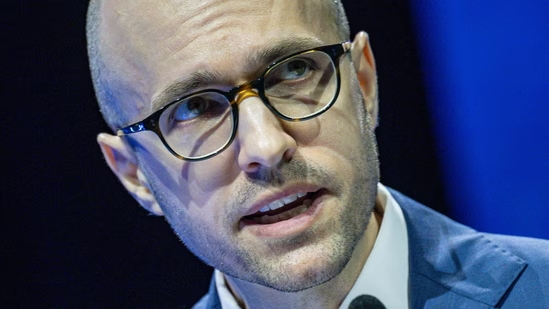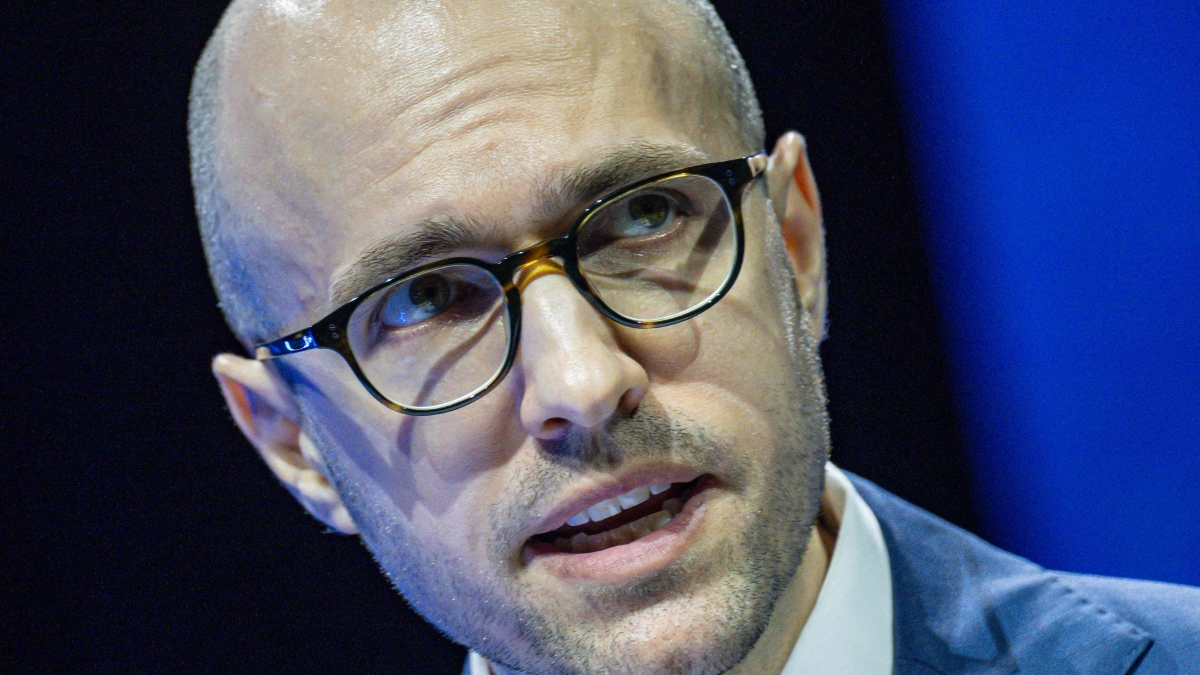
The head of The New York Times newspaper launched a scathing attack on artificial intelligence companies, accusing them of "shameless theft of intellectual property" and of threatening journalism. He was speaking at a global media congress on Monday in the southern French city of Marseille.
Issued on: 02/06/2026 - 16:45
3 min Reading time
According to Arthur Gregg Sulzberger, president and publisher of the prestigious The New York Times newspaper, "tech giants strip-mine news websites without permission or compensation." He was addressing newspaper and news site executives from around the world gathered on the first of a three-day World News Media Congress. Sulzberger accused artificial intelligence companies' "hijacking of the public square is made possible by the original sin that animates their AI products – a brazen theft of intellectual property that has occurred at an unprecedented scale." "They reclaim this stolen content as if they were its authors, thus diverting the audience and revenue" of news sites," he declared in a speech that was met with enthusiastic applause. He added that the news sector "has been too quiet, too passive and too fragmented in the face of abuses by the companies leading the AI revolution." Fragile business model While The New York Times a strong presence in the American press with more than 13 million subscribers to its print and digital products, thanks in particular to strong diversification (podcasts, cooking recipes), the United States has lost up to 3,000 newspapers in the last two decades, Sulzberger recalled. "I fear we are careening toward a future with fewer and fewer journalists to do the expensive, difficult work of original reporting," he said. Already facing competition from social media, traditional media outlets are seeing their fragile business model put under pressure by chatbots like ChatGPT (OpenAI). French press take on digital databases to defend journalist copyright against AI These chatbots respond directly to user requests, thanks to AI models that feed on the internet, particularly press content, consequently reducing traffic to news sites. Sulzberger, whose company is suing OpenAI, the creator of ChatGPT and Microsoft over the use of copyrighted work, said AI companies are "consolidating their outsize control over our data and our attention" but are "failing to embrace a core responsibility that comes with this power – to ensure the public has access to trustworthy news and information." The legal battle that has lasted two and a half years and has already cost the thriving American newspaper "more than $20 million" (€17 million) in legal fees. "AI companies know this: most media outlets don't have the resources to go to court to enforce their rights," he added. Crucial moment in media history After the arrival of the internet and social media, "we are once again at a crucial moment in the history of media," Ladina Heimgartner, president of WAN-IFRA and CEO of the Swiss media group Ringier Media, told French news agency AFP. "We are experiencing an unacceptable loss of value," but we can only "move forward by engaging in dialogue with tech companies," she added. The tech giant Google, one of the first to reach agreements to pay news publishers for their content, is a partner of the conference, co-organised by CMA Media, the media arm of the French shipping company CMA-CGM. AI assistants 'not reliable' when it comes to news, major European study finds Representatives from OpenAI have also been invited. For Jean-Christophe Tortora, CEO of CMA Media, a "new deal between publishers, tech platforms, and the government" is needed to address the threat to the "sustainability" of the press. "Those who think we can get away with it by each making deals on our own with one or two platforms, that's a short-term bet," he warned, while media outlets and AI players have already concluded compensation agreements. In France, Apig, a collective body representing nearly 300 French daily newspapers, announced on Monday that it is suing the Californian company Brave, which operates an internet browser and search engine, accusing it of plundering its members' content using artificial intelligence. (with AFP)