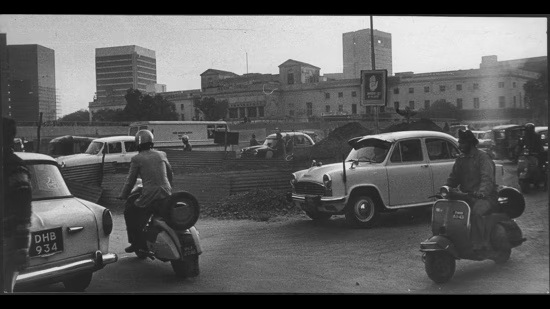
In the India of the 1980s, the silicon metal controversy has erupted, and the newly appointed Prime Minister, Rajiv Gandhi, has to make a tough choice. Import silicon or back indigenous technology, a cause he championed.The inner circle of Connaught Place, New Delhi, on 02 January 1985. (HT Photo by Santosh Gupta.)Based on true events, Ramjee Chandran’s debut novel takes readers on a roller coaster ride.A chance meeting of two professors from the prestigious Indian Institute of Science in Bangalore, G Suryan and Vasudeva Murthy, with the general manager of Mettur Chemicals, RV Ramani, in 1963 sets off a chain of events which ends up intriguing the Russians, the Americans and the French – and, in turn, India’s intelligence agencies.Suryan and Murthy take a bumpy bus ride to Mettur dam in Tamil Nadu to get a kilo of hydrogen. When Ramani, whose plant makes caustic soda, learns that the professors need the hydrogen to make silicon metal, he is jubilant. He decides to work with them and launches a new company, Metkem Silicon.20 years later, the company is ready to apply for a licence to make silicon metal and the plant has the capacity to meet the projected demand of 25 metric tonnes a year. Just then, the Department of Electronics (DoE) bulldozes their two decades of hard work, with its announcement about setting up a plant to make 200 metric tonnes of silicon metal a year, for which technology will be imported from the US.Arrogant and shrewd Anand Seshadri heads the DoE. Because of his father’s proximity to former prime minister Indira Gandhi, throughout his bureaucratic career, Seshadri not only got to choose which department he would work in, but also his bosses. He would then boss over his bosses.Seshadri has now reached the peak of his career, and the power that he once craved for has lost its sheen. He now longs to leave behind a legacy, his legacy. The answer seems to lie in silicon metal, the successful production of which would help him grab the attention and respect of the international scientific community. He uses bureaucratic tools to “shoot down” and “discredit” MetKem, and his father’s fading connections to hack his way “through the thick jungle of red tape”. He picks out Hemlock Corporation in the US to provide technology for National Silicon Facility (NSF) – which would wipe out Metkem Silicon.However, through his source at DoE, scientist Angela Britto, Metkem Silicon’s suave lobbyist Adityan Nilla aka Solly Nilla sniffs out how Seshadri is trying to destroy the company. He briefs the two professors and Ramani about the goings-on in DoE and offers a solution -- zero in on a superhero in the government who was “senior, politically well-connected, and more, importantly, reliant on Seshadri’s failure for their own success”.Solly and Seshadri then try to outwit each other, dragging in a host of other entities and institutions, making this a full blown Silicon Metal Controversy.While Seshadri is busy manipulating the government machinery to officially destroy Metkem, Solly works overtime to scrape out tidbits of information from Seshadri’s kingdom, and ruin his best laid plans.Britto, one of his prime partners in crime contemplates her relationship with Solly: “What a weird situation this was. She was his mole, his inside source, his carrier pigeon. But she did not think she was being used – she was using Solly back…”The new young Prime Minister hated the chaos and rowdiness of Indian politics and did not really care for power. “His ideas were ahead of similar movements in the controlled economies,” writes Chandran, who was himself a lobbyist in New Delhi in the 1980s.When he learns about the controversy, Rajiv Gandhi is quite mad: “I smell something foul… if this company…Metkem Silicon has the technology, it’s silly to import it! Shouldn’t we at least check out the Indian company first?”Unfortunately, the PM’s man tasked with the job is a Seshadri stooge. He checks out the flora and fauna of Mettur, but skips the inspection of the actual plant. His unfavourable report – that Metkem’s technology is elementary, therefore, technology should be imported – almost seals the company’s fate.Solly comes to Metkem’s rescue but not before the Russians, the Americans, and the French all get interested in silicon. While India primarily used silicon metal to make solar panels, elsewhere in the world it was used to make silicon chips for defence equipment. The CIA and the KGB were keeping tabs to find out if silicon was being exported to each other’s countries. Apart from the foreign spies, Solly is tailed by India’s agencies too.Chandran’s acerbic wit in exposing the functioning of the government is unmissable. When Metkem applies for an industrial licence, the Ministry of Industry assigns silicon metal to the Department of Mines and Metals because of the word “metal” in its title. Metkem is denied permission to drill for oil even though this isn’t part of the company’s production profile. “I can’t believe how utterly absurd the government can be,” Ramani exclaims.Another time, when a spy is caught on the wrong foot in this tale of espionage, deceit and sexual escapades, he tells his boss that his aunt has died in Mongolia. “Who made a call to you from Mongolia to India? Isn’t that difficult?...What was your aunt doing in Mongolia?”“She was making handcrafted sweaters from yak hair and selling it to the US,” the spy shot back.Chandran captures the pulse of 1980s India very well recalling a world where communication was restricted to landlines and garbled faxes, journalists enjoyed working on investigative stories, Fiats and Ambassadors zipped down Delhi’s near-empty roads, and IIM professors got ₹60 as travel allowance.Chandran successfully maintains the pace of a nail-biting thriller right through this nearly 500-page tome. Some portions, especially those about R&AW, are a bit repetitive. Still, this is a must-read for lovers of espionage novels.Lamat R Hasan is an independent journalist. She lives in New Delhi.
Review: For No Reason At All by Ramjee Chandran
Set in 1980s India, this spy thriller, that presents acerbically witty insights into how the government functions, maintains its pace over 500 pages
986 words~4 min read