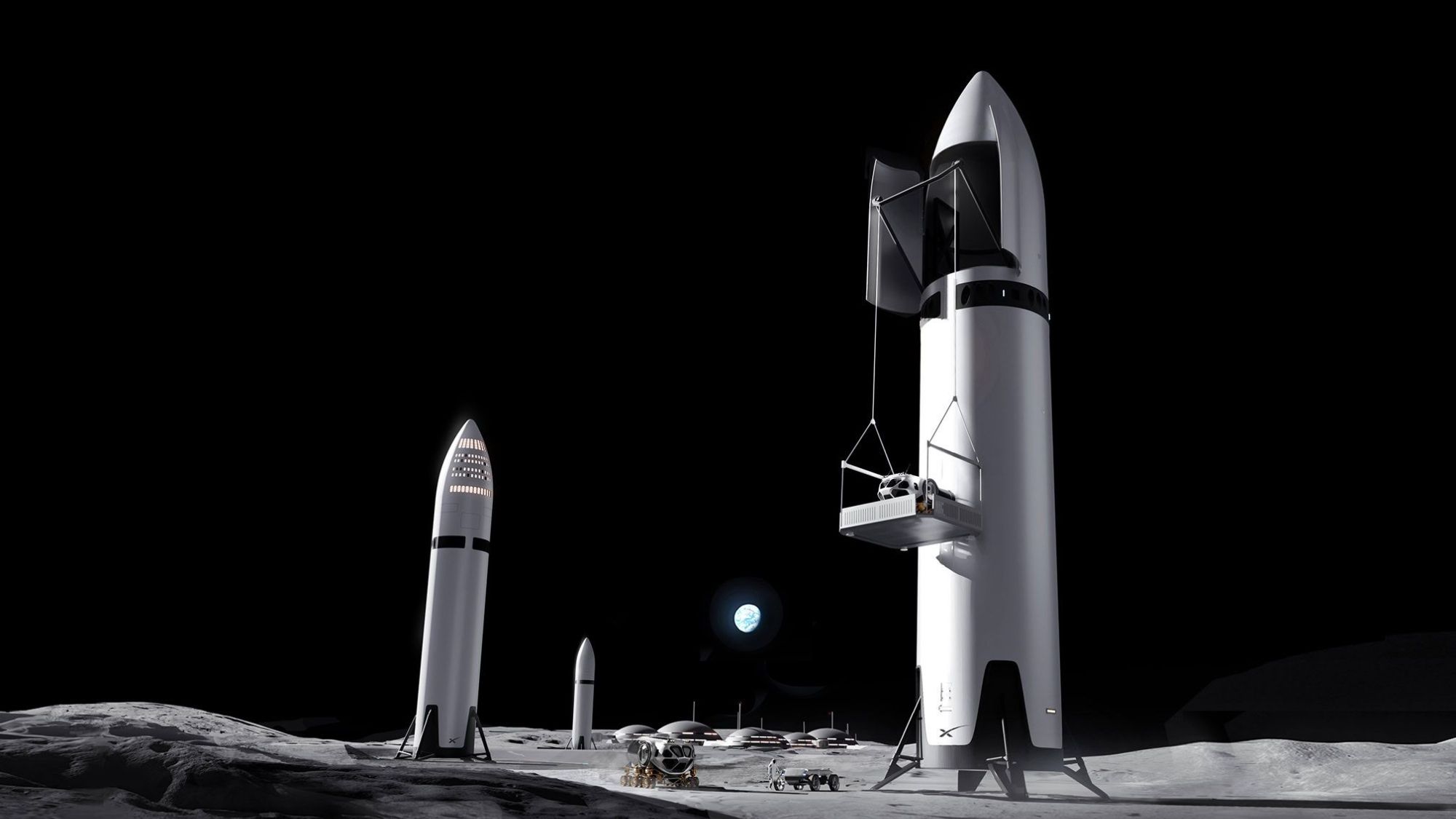
Artist's illustration of several SpaceX Starship upper stages on the moon.
(Image credit: SpaceX)
On May 20, SpaceX filed with the U.S. Securities and Exchange Commission (SEC) key documentation for an initial public offering (IPO) of stock.An IPO signals that a private company is now selling shares to the public on a stock exchange. SpaceX's long-anticipated move could become the largest IPO in history, perhaps giving a $2 trillion dollar valuation to the company, which will soon be listed on the ticker as SPCX.SpaceX's SEC Form S-1 is a vital registration step for U.S.-based companies planning an IPO, detailing significant corporate information to assist investors."This prospectus contains forward-looking statements that are subject to a number of risks and uncertainties, many of which are beyond our control," SpaceX wrote in the S-1. "You should read this entire prospectus carefully before making an investment decision."The prospectus adds: "We face a number of challenges relating to our business and growth strategy and, ultimately, the achievement of our mission to make life multiplanetary, understand the true nature of the universe, and extend the light of consciousness to the stars."Space.com reached out to a number of experts about what the SpaceX IPO means for markets and individual investors — and the implications for a new wave of high-tech listings seeking fame and fortune.The Elon factorShaun Davies is an associate professor of finance at the Leeds School of Business at the University of Colorado Boulder. He told Space.com that people should view this as much bigger than just "another IPO.""This could be one of the largest IPOs in history, both from a valuation perspective and from the sheer amount of attention it will attract," Davies said. "Everyone will be watching because of the Elon factor … Love him or hate him, you know who he is."What makes it unique is that SpaceX is no longer just a rocket company, Davies said. "When people hear 'SpaceX,' they think rockets, NASA partnerships, and commercial space travel. That is certainly part of the story," he said.But this is also tied to the company's Starlink internet megaconstellation and increasingly to xAI, a division of SpaceX, and the broader artificial intelligence (AI) arms race that is playing out right now, said Davies.Similar in view is Ann Lipton, a professor and the Laurence W. DeMuth Chair at the University of Colorado Boulder's School of Law.Lipton said the hype surrounding the IPO "does seem to have piqued investor interest in space stocks more generally. But it's true that the financials being disclosed suggest that SpaceX's profitability is being used to finance artificial intelligence development."