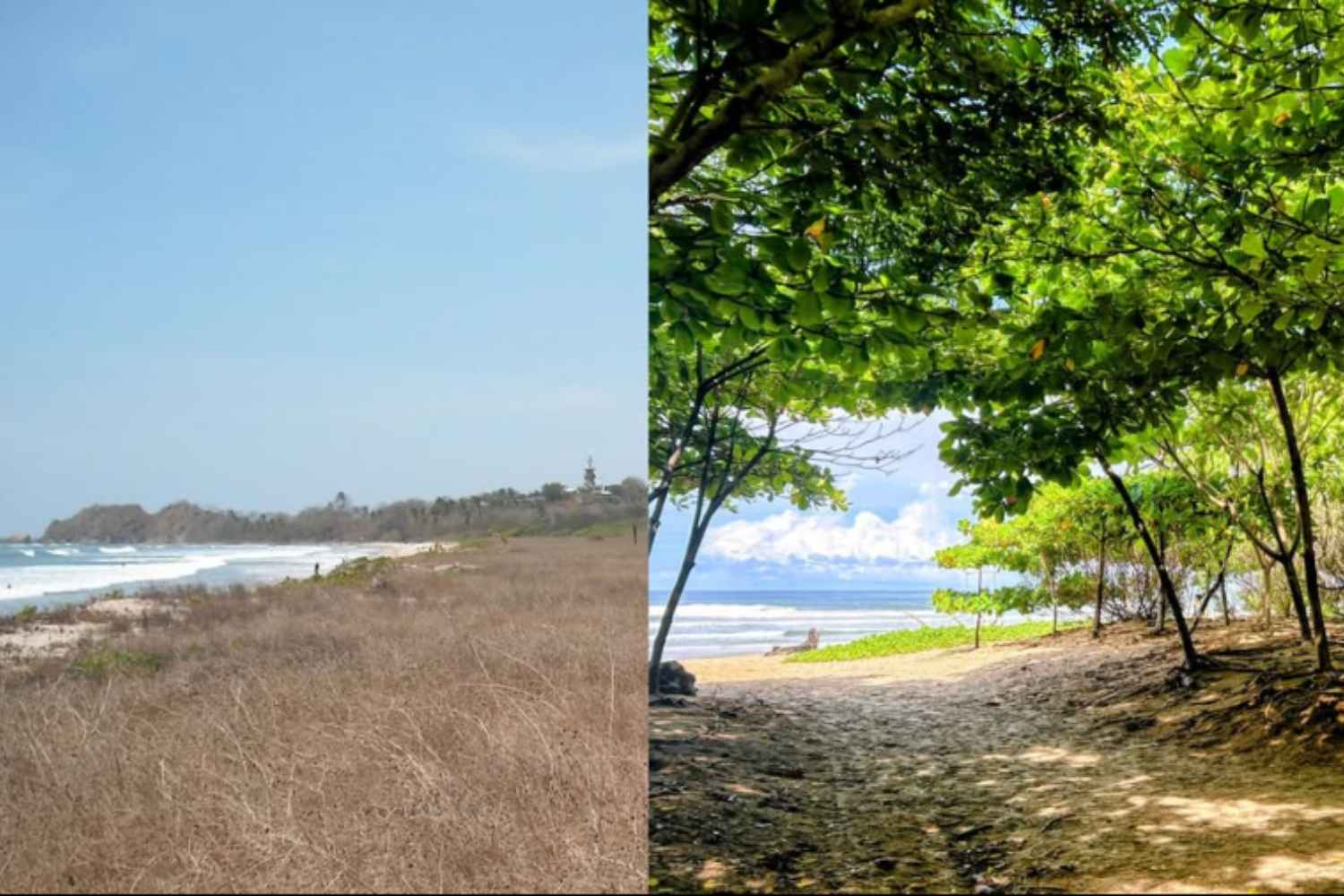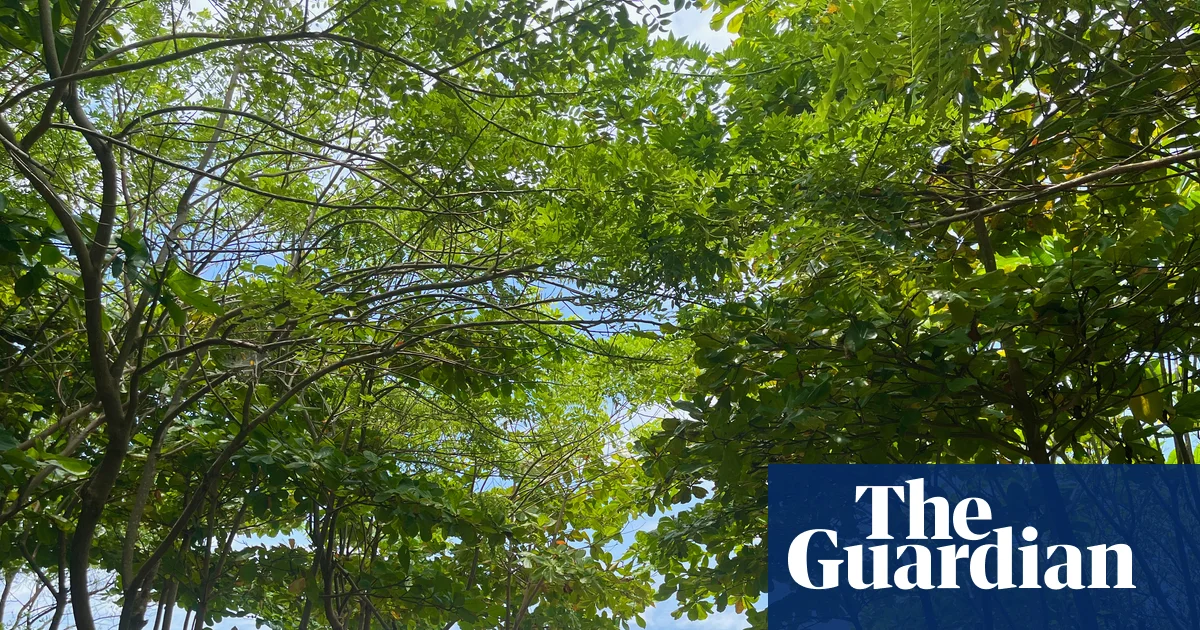
Pointing to a photograph of dry brown long grass hugging the shoreline, Gerardo Bolaños stands in front of a green oasis of seedlings and trees potted in black plastic bags. “This is what Playa Guiones looked like when we started in 2011,” says the executive director of Costas Verdes, a Costa Rican nonprofit.As howler monkeys growl in the background, Bolaños points to the picture next to it – an image of the same patch of land but with scores of flourishing, lush green trees. Today, he says, this is how the beach looks.The reason for the stark difference, says Bolaños, a straight-talking man with a coloured tattoo of the turquoise-browed motmot bird on his left arm, is a sustained tree-planting programme that Costas Verdes started in 2011.Playa Guiones in 2011 before the tree planting project. Photograph: HandoutThe project has transformed deforested Pacific coastlines into thriving ecosystems through a community-driven environmental project that has planted more than 100,000 native trees across 34 beaches, reviving wildlife habitats and combating decades of deforestation from cattle farming.Costas Verdes was founded by then Costa Rican university student Max Tattenbach in 2009. A keen surfer, he wanted to restore the shoreline at his favourite surf spot, Playa Hermosa.Map of Costa Rica“Playa Hermosa is about 6km [3.5 miles] of beach, and it only had one [area of] shade along the entire beach,” says Tattenbach. “I used to go surfing there and take my then girlfriend and now wife. She didn’t surf and liked to read and chill on the beach, but Playa Hermosa had no shade, so she didn’t like going, and it started to become an issue. I promised her I would reforest Playa Hermosa so we could enjoy the beach.”He later decided to extend his mission and restore forests along the north Pacific coast by planting native species through community-based reforestation.Volunteers clear a burned area of Playa Guiones ready to plant trees in 2025. Photograph: Courtesy of Costas VerdesWalk along the seafront in Nosara, over 100km further down the coast from Hermosa, and the plan appears to have paid off, with thousands of trees such as tropical almond trees, madero negro (Gliricidia sepium) and frangipani lining the trails and offering shade to beachgoers, creating a thriving ecosystem for wildlife.Bolaños, who joined the organisation as a volunteer in 2011, became project director three years later and executive director in 2024, says deforestation has changed the area’s landscape. “Last century, we had great coastal forests all along the Pacific coast of Costa Rica,” he says.Gerardo Bolaños planting trees for Costas Verdes on Playa Guiones. Photograph: HandoutBolaños estimates that between the 1940s and 1970s, Costa Rica lost 70% of its forest cover, including along the Pacific coast.He puts this down to a boom in livestock farming. “Farmers burned the ecosystems and grew grass to feed the cattle. It was extremely aggressive, poorly planned,” he says. “The beachfronts were devastated by cattle farming.”In the north Pacific region, where the Costas Verdes project is based, deforestation rates were among the highest in the country, says Bernal Herrera-Fernández, professor and researcher at the International Institute for Wildlife Management and Conservation at the National University of Costa Rica.“Land management practices frequently involved the recurrent use of fire, which hindered natural forest regeneration and accelerated soil degradation processes,” he says. “The close relationship between the expansion of the cattle industry and high deforestation rates, commonly referred to as the ‘hamburger connection’, extended beyond the north Pacific region and affected large areas throughout Central America.”A sliding image that shows a brown, dry area of grass with very few shrubs or trees in 1971 and the same area from a similar angle with slightly more greenery Playa Guiones in 1971, when the area had been heavily deforested by livestock farming, and in 2011 when reforestation efforts began.After the decline of international beef prices in the mid-1980s, the government gradually withdrew its support for the expansion of the cattle industry, says Herrera-Fernández.Meanwhile, in the 1970s, Costa Rica bolstered its environmental policies. It established the 1977 maritime zoning law, which recognised the 200-metre coastal strip as state property that must be protected as part of national heritage, and guaranteed public access to the first 50 metres, according to Gerardo Avalos, professor of tropical ecology at the University of Costa Rica.A bundle of other legislation, including the 1996 Forestry Law and the 1998 Biodiversity Law, completed the state’s arsenal to prevent environmental degradation, setting the stage for restoration. “Together, this framework integrates principles of public access, regulated use and ecological conservation aimed at protecting coastal ecosystems from tourism and urban development,” says Avalos.Two photographs, the first showing the beach area with some scrubby growth and small amounts of greenery in 2011, the second showing a thickly planted and lush area of trees. Playa Guiones in 2011 and then in 2025 after 14 years of tree planting.After the legislation passed, the farms were abandoned and the forests were left to regrow on their own. But in most cases, that did not happen as anticipated. “The soils lost their fertility and their capacity to be restored. Their resilience was compromised because of bad and extensive farming practices on very poor soils,” says Bolaños.With no government programmes or funding to restore these areas, Tattenbach stepped in. He worked with park rangers to unofficially start a tree nursery in Nosara and enlisted friends to help plant trees, with the first reforestation project taking place in Playa Hermosa in 2010.Bolaños leads the celebrations at Playa Guiones as the programme’s 100,000th tree is planted. Photograph: HandoutWith the help of volunteers, including schoolchildren and tourists, projects have since followed across the Pacific coast. As a result of the extensive reforestation, the organisation says it has seen the return of animals such as the howler monkey in the beach area of Guiones in 2022 and the variegated squirrel in the trees planted in Nosara and Hermosa.Herrera-Fernández says projects by organisations such as Costas Verdes are a fundamental element of conservation success in the country. “Such restoration efforts can help re-establish ecological corridors that facilitate species movement, which is essential for maintaining ecosystem integrity and ensuring the long-term viability of species populations,” he says.But planting trees on such a scale is not without its challenges. Despite planting native species, Bolaños estimates that at the Guiones project only 40% of the trees have survived. “The reason is down to genetics, but also some because of human activity,” he says.Costas Verdes says that animals have started to return to reforested areas, and hope to build on their success by planting 300,000 trees across 100 beaches Photograph: HandoutThe projects require substantial funds. Costas Verdes is hoping to raise $295,000 (£220,000) this year, mainly through donations, tree-planting tours – which cost $70 – and merchandise sales.Another challenge, says Bolaños, is securing the active involvement of coastal communities and sustaining commitment beyond the initial kickstart. “People have their own lives. We need maintenance, follow-up, funding,” he says.Still, he has an ambitious goal for Costas Verdes: to plant 300,000 trees across 100 beaches. “Our success story in Guiones shows the world that bringing back a coastal forest ecosystem in such devastated land is possible,” he says. “But it can only be done together as one.”
From barren shores to green oases: how a surfer looking for shade ended up transforming Costa Rica’s coastline
A grassroots project has turned deforested beaches into thriving ecosystems by planting 100,000 native trees
1,202 words~5 min read