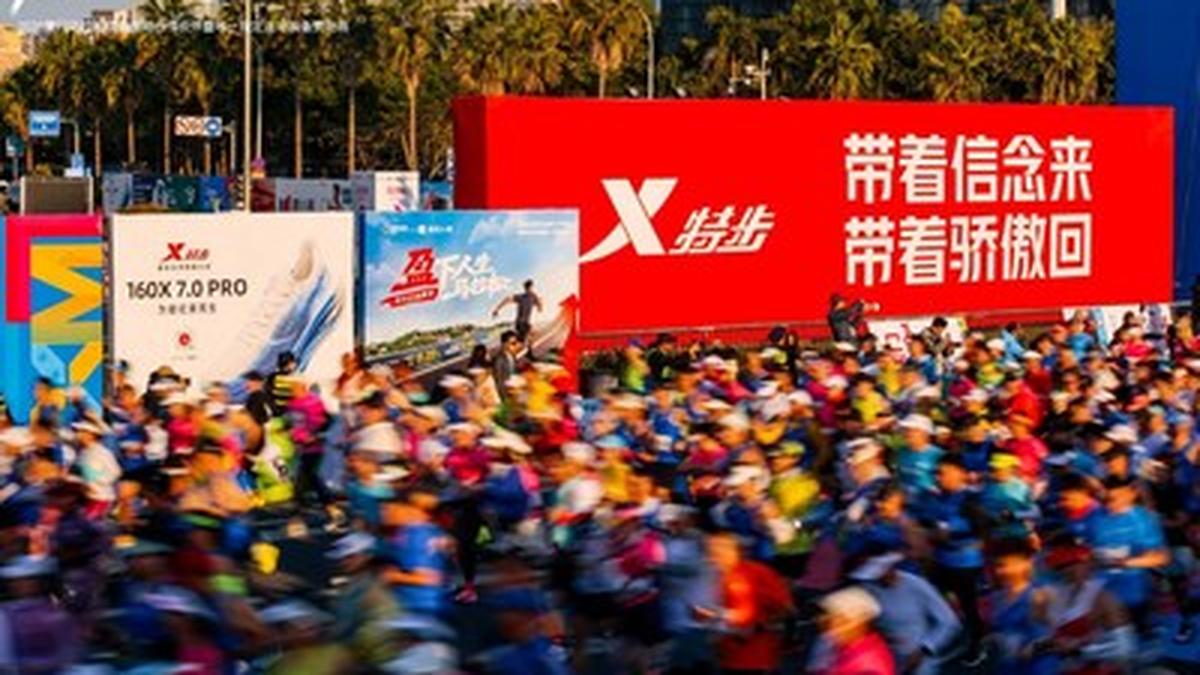
XIAMEN, China, May 29, 2026 /PRNewswire/ -- In recent years, the global athletic footwear market has maintained steady sales volume growth. This expansion is driven by the escalating consumer demand for superior comfort, advanced functionality, and everyday versatility, coupled with technological breakthroughs in midsole materials and manufacturing processes toward high performance, lightweight structures, and sustainability. Concretely, global athletic footwear sales volume has expanded from 4.57 billion pairs in 2021 to 5.30 billion pairs in 2025. In the Chinese market*, the growing popularity of marathons and road running events among the general public has further catalyzed the expansion of the professional racing shoes and related running gear segments. Against this backdrop, Xtep has distinguished itself with market leadership that has been independently validated.Based on independent market research conducted by Frost & Sullivan on the global and Chinese running shoes and sportswear industries, Xtep has been awarded three prestigious market leadership recognitions: “ Leading Position in global running shoes market based on sales volume in 2025.”; “ Ranked No.1 in China by Marathon Running Shoes Wearing Rate for 3 consecutive years(2023-2025)”; and “ Ranked Top 3 among Chinese Sportswear brands. (Measured by Sales value of 2025).” From the scale of event sponsorships and depth of runner services to on-track product performance, Xtep’s comprehensive cultivation in the running domain has received definitive validation from international authoritative research institutions and the global market. To understand how Xtep achieved these milestones, it is essential to first examine the broader running shoe industry—its product categories, evolution, and current market drivers.Running Shoe Market: An OverviewRunning shoes are purposefully designed athletic footwear engineered to deliver superior cushioning, support, stability, and breathability. Their core value proposition lies in joint protection, running efficiency enhancement, and multi-scenario adaptability. Categorized by function, the market comprises stability, racing, and cushioned running shoes; based on application scenarios, the product portfolio is divided into road running shoes, treadmill and indoor athletic shoes, and trail running shoes.The global running shoe industry has evolved through three distinct epochs: the Performance-Oriented Era (Pre-1980s–2000), during which products primarily served competitive sports with a core focus on functional enhancements; the Technological Iteration & Mass Expansion Era (2000–2015), characterized by major upgrades in core technologies such as cushioning, support, and lightweight engineering, alongside the popularization of running among the general fitness public; and the Segmented Scenarios & Brand Premiumization Era (2020–Present), where consumer preferences have shifted toward specialized niches and platform-based technological innovations, steering the industry toward high performance, multi-scenario utility, and strategic brand differentiation.Echoing global megatrends, China’s running shoe industry has undergone a parallel upgrade from rudimentary features to specialization, scenario-specific design, and robust brand positioning. Since 2000, international brands have accelerated their market entry into China, while domestic powerhouses such as Xtep, Anta, and Li-Ning have steadily risen, propelling the Chinese running shoe market into its own era of technological iteration and mass-market expansion.Market Drivers of the Running Shoe IndustryDriven by the widespread adoption of healthy lifestyles and the continuous momentum of marathons and road running events, market demand within the running shoe industry has been continuously unleashed. In 2024, a total of 749 road running races were hosted nationwide, drawing a cumulative total of over 7.04 million participants. In 2025, the racing landscape pivoted toward optimizing quality while rationalizing quantity, with 594 events held throughout the year, attracting 6.399 million participants. The mainstream popularization of these events has significantly expanded the runner baseline, thereby generating sustainable growth in demand for professional running shoes, functional apparel, and supporting gear.The competitive landscape of the running shoe industry is pivoting from basic functionalities to a holistic competition encompasses technological platforms, product matrices, and multi-scenario adaptability. As marathons serve as a crucial testing ground for the product capabilities of professional footwear, domestic running shoes have seen a continuous surge in their wearing rate, brand exposure, and word-of-mouth reputation on the race tracks in recent years. An increasing number of runners are opting for domestic professional running shoes for both daily training and competitive races, underscoring the growing market endorsement of domestic brands regarding racing performance, wearing experience, and product stability.
Xtep Recognized for Leading Position in the global running shoes market in 2025 as Industry Advances Toward Professionalization and Scenario Segmentation
Xtep Recognized for Leading Position in the global running shoes market in 2025 as Industry Advances Toward Professionalization and Scenario Segmentation
TL;DRAI
Xtep named global leader in running shoes sales volume and #1 in China for marathon wearing rate (3 years), amid 5.30B pairs market. Recognition validates premium positioning through localized R&D and data-driven ecosystem, shifting focus from cost to technology.
1,234 words~6 min read