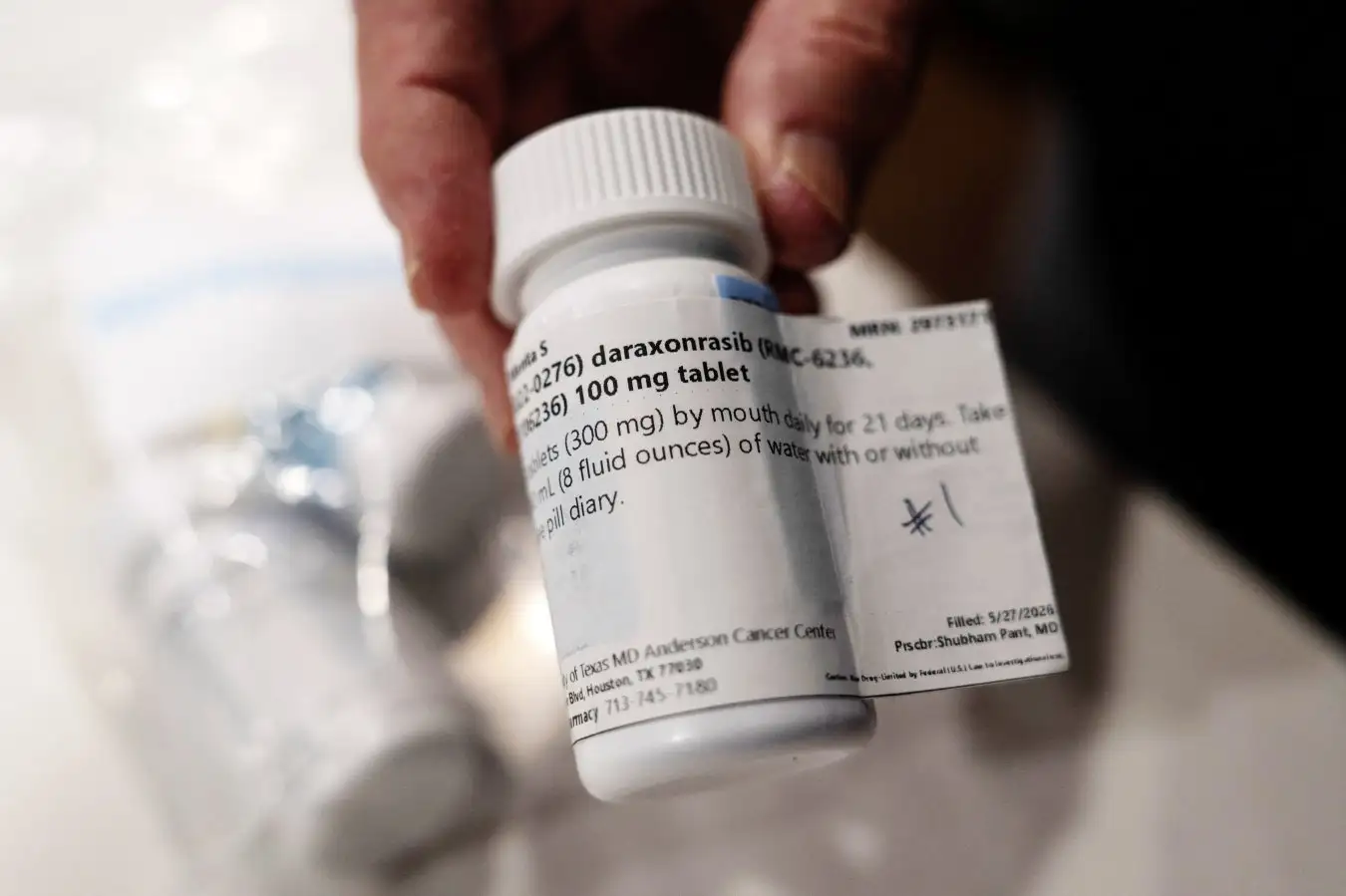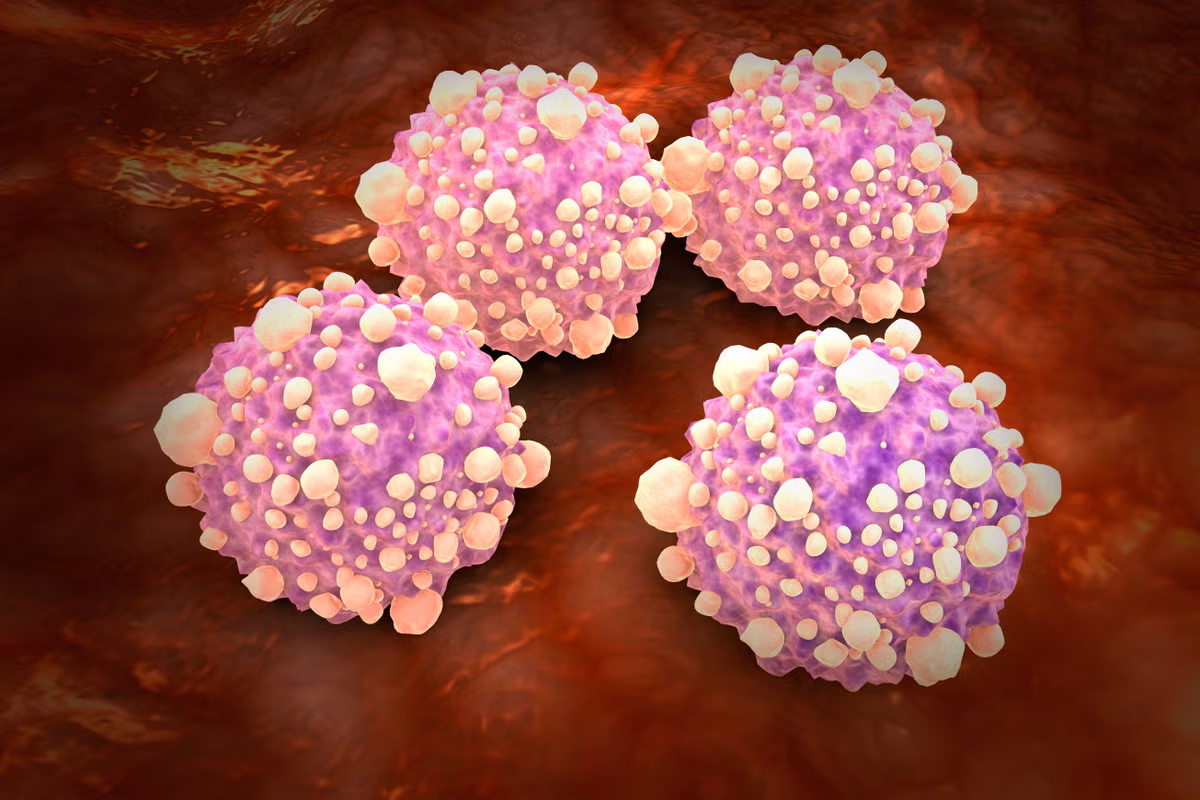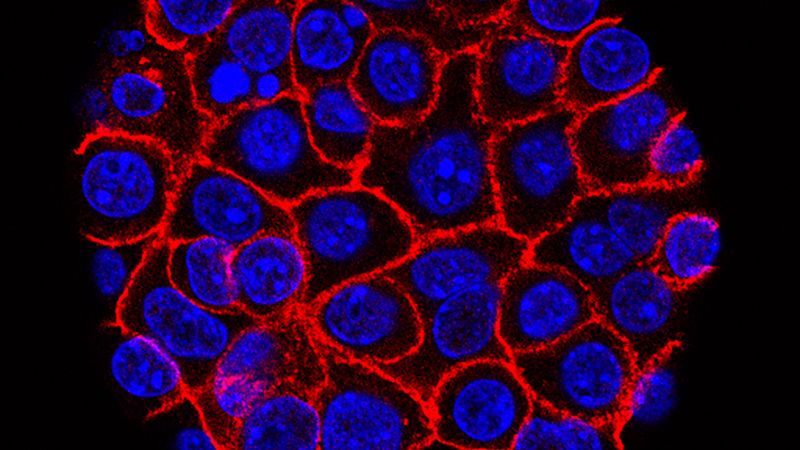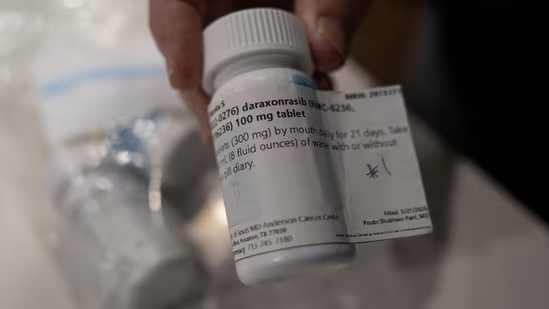
Pancreatic cancer has long been one of medicine’s bleakest diagnoses. It is often found late, resists treatment, and is driven in most cases by a molecular switch that cancer scientists could see but could not hit.A bottle of daraxonrasib, Revolution Medicine’s pancreatic cancer drug. (Reuters)Now a pill aimed at that switch has nearly doubled median survival in a large trial of patients whose disease had already progressed after earlier treatment.Some proteins seem almost designed to frustrate medicine. A few are too smooth or too slippery for a drug to grip. Others hide inside cells, where medicines reach them with difficulty. And some look so much like their healthy versions that targeting the diseased form without harming the normal one becomes a molecular version of threading a needle.For decades, a family of proteins called RAS belonged in this difficult category. They are among the most important targets in all of cancer biology, and also among the most stubborn. Scientists knew that mutations in RAS genes helped drive tumors. They knew that switching these proteins off could, in principle, slow down cancer. The trouble was that the principle kept colliding with chemistry.To see why, it helps to know what a drug actually does. Most drugs work by physically sticking to a target in the body, usually a protein. Proteins are tiny machines with shapes, grooves, pockets and moving parts, and a drug has to find somewhere to lodge and hold on tightly enough to change what the protein does. If a protein has no useful pocket, or clings to its natural partners more tightly than any lab-made molecule can, a drug has nothing to grab.RAS was exactly that kind of protein. Its job is to act as a switch that tells a cell when to grow and divide. In healthy tissue the switch turns on when growth is needed and off when the job is done. In many cancers, a mutation jams it in the on position. The cell keeps receiving the order to multiply, and a tumor forms. That made RAS an obvious target. It also made it a famous failure.The RAS family includes three close cousins, but one, KRAS, has been the best-known villain across many cancers, from the lung to the colon to the pancreas. Pancreatic cancer usually causes no symptoms until it has already spread, so most people learn they have it only when surgery is no longer an option. Once it has spread, the average patient lives less than a year. Across all pancreatic cancers, only about thirteen of every hundred people diagnosed are alive five years later, and for those whose cancer has already spread, that figure falls to roughly three in a hundred.Pancreatic cancer is also one of the diseases most tightly tied to RAS. More than nine in ten of these tumors carry a RAS mutation, and most of them involve a change at a single spot in KRAS. One tiny alteration in the genetic instructions leaves a powerful growth switch stuck on.For years, the word “undruggable” trailed RAS around like a curse. It never meant the protein was unimportant. RAS mattered so much that generations of scientists kept returning to it and kept failing.Those limits began to shift only recently. The first KRAS-targeting drugs to win approval went after one particular mutation, common in some lung cancers, that happened to carve a tiny new pocket into the protein, a foothold the healthy version does not have. A drug could slip into that pocket and lock the mutant switch off while leaving normal KRAS alone. But KRAS can break in several different ways, at different points along the protein, and a drug shaped for one of those breaks does nothing for others.Instead of wedging into a pocket on one specific mutant, the new drug daraxonrasib recruits a small protein the cell already makes and uses it as a partner to clamp onto KRAS while the switch is in its active, on state. Because it is designed around the active state of RAS rather than one narrow KRAS mutation, it has the potential to reach a wider set of broken switches. For a cancer whose mutations are scattered across several positions, that breadth is exactly the property that matters. This is not a single narrowly cut key. It is closer to a new way of holding the lock still. In the trial, the drug even helped the small number of patients whose tumours carried no detectable RAS mutation at all, a hint that these cancers may lean on RAS signaling even when no obvious mutation is there to find.Five hundred patients with advanced pancreatic cancer, drawn from sites across North America, Europe and Asia, with a median age of 66, all of whom had already seen their disease progress after earlier treatment, were randomly assigned to take either the new pill once a day or another course of chemotherapy chosen by their doctor.Among patients whose tumors carried the most common RAS mutations, those on daraxonrasib lived a median of 13.2 months, against 6.6 months for those on chemotherapy. The drug cuts the risk of dying by sixty percent. It also held the cancer in check for longer before it worsened, roughly seven months versus three and a half. Tumours actually shrank in about a third of the patients on daraxonrasib, against roughly one in nine on chemotherapy.The size of the effect moved even seasoned doctors. The results were at the annual meeting of the American Society of Clinical Oncology in Chicago and published in the New England Journal of Medicine. When the trial’s lead investigator put up the slide showing a sixty per cent reduction in the risk of death, the packed auditorium rose to give him a standing ovation, something that rarely happens in the middle of a scientific talk. Rachna Shroff, who heads the division of hematology and oncology at the University of Arizona Cancer Center, told a briefing at the meeting that after sixteen years of treating this disease, she started to cry when she saw the numbers.Patients on daraxonrasib went longer before their pain and overall quality of life deteriorated, which matters enormously in a disease where pain, weight loss, fatigue and the sheer burden of treatment can occupy daily life. Daraxonrasib most often causes skin rashes, diarrhea, mouth sores and nausea. Chemotherapy often brought fatigue, anemia, and dangerous drops in blood counts. Serious side effects still occurred, and one patient on the new drug died from treatment-related lung inflammation. Still, far fewer patients had to abandon daraxonrasib over side effects than abandoned chemotherapy.This is not a cure. The cancer still progresses for many patients, and a median of thirteen months remains a painful figure. But in previously treated, advanced pancreatic cancer, doubling survival against chemotherapy is no small matter.Anirban Mahapatra is a scientist and author. His most recent book is When the Drugs Don’t Work. The views expressed are personal.
Scientifically Speaking: A pill takes on pancreatic cancer
For decades, the molecular switch that drives most pancreatic cancers was ‘undruggable’. No longer. A new drug has now nearly doubled how long patients live.
1,150 words~5 min read