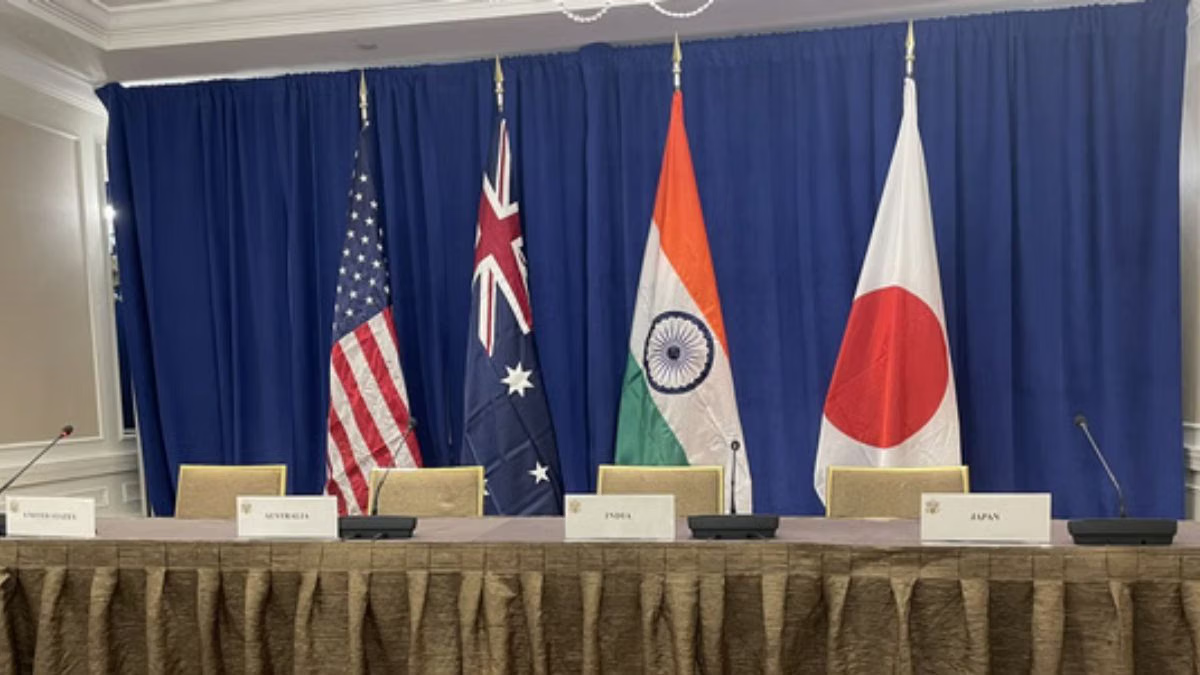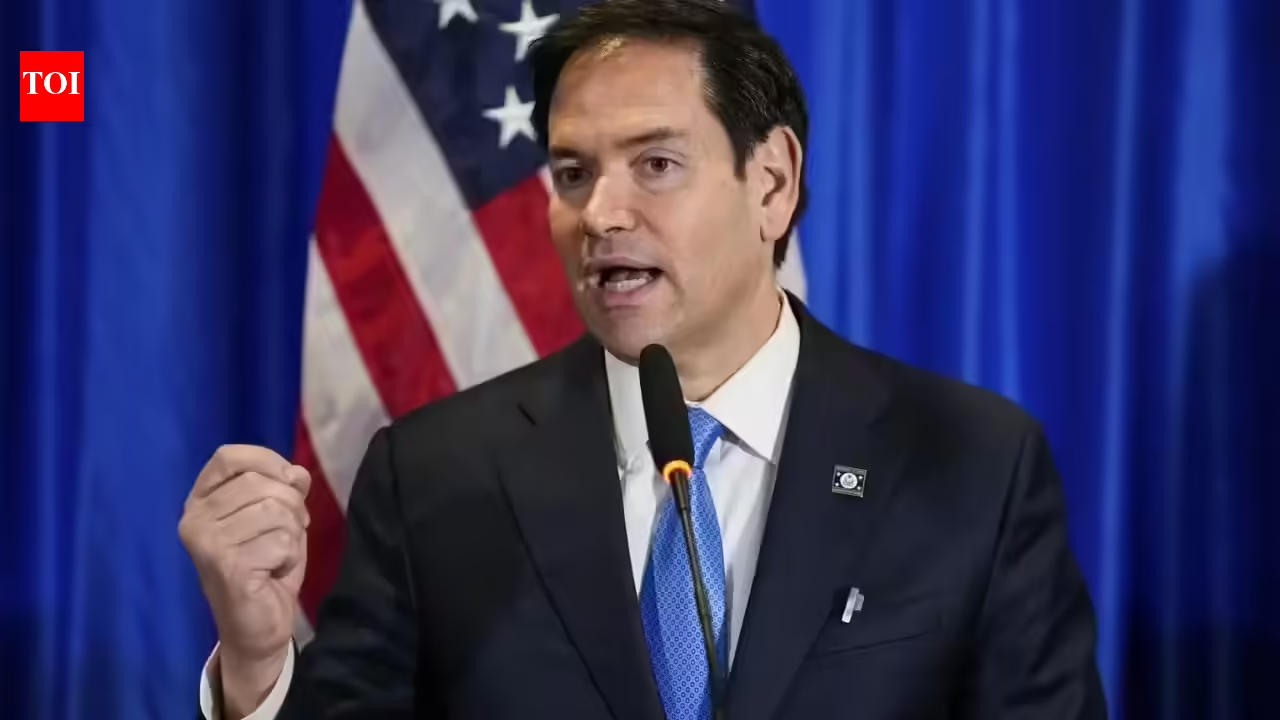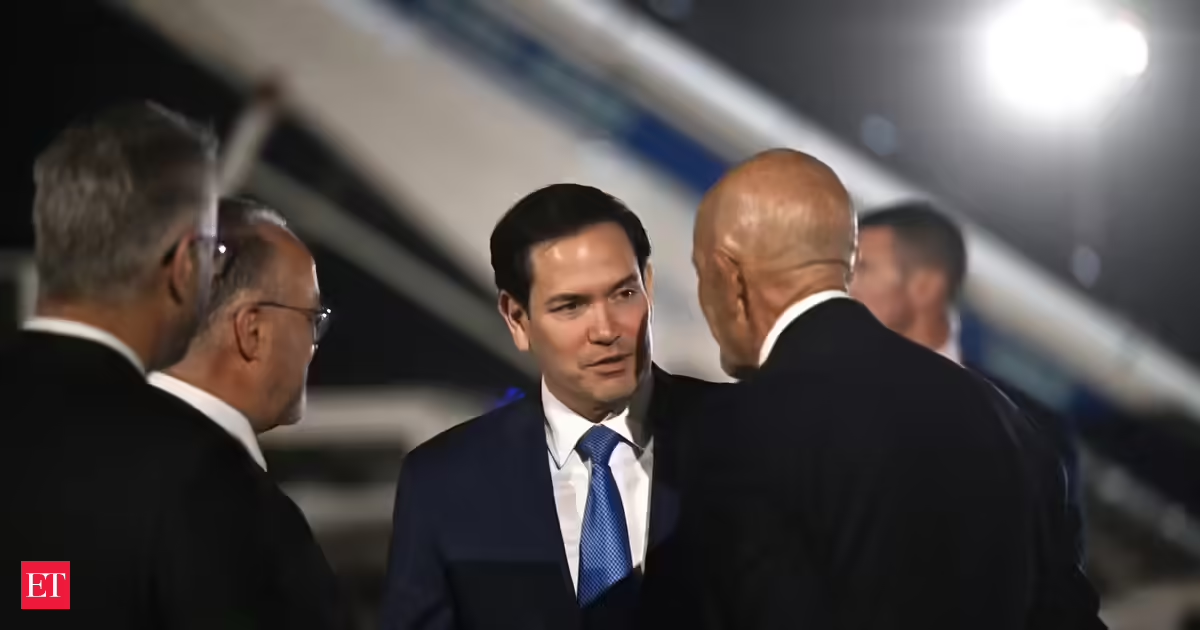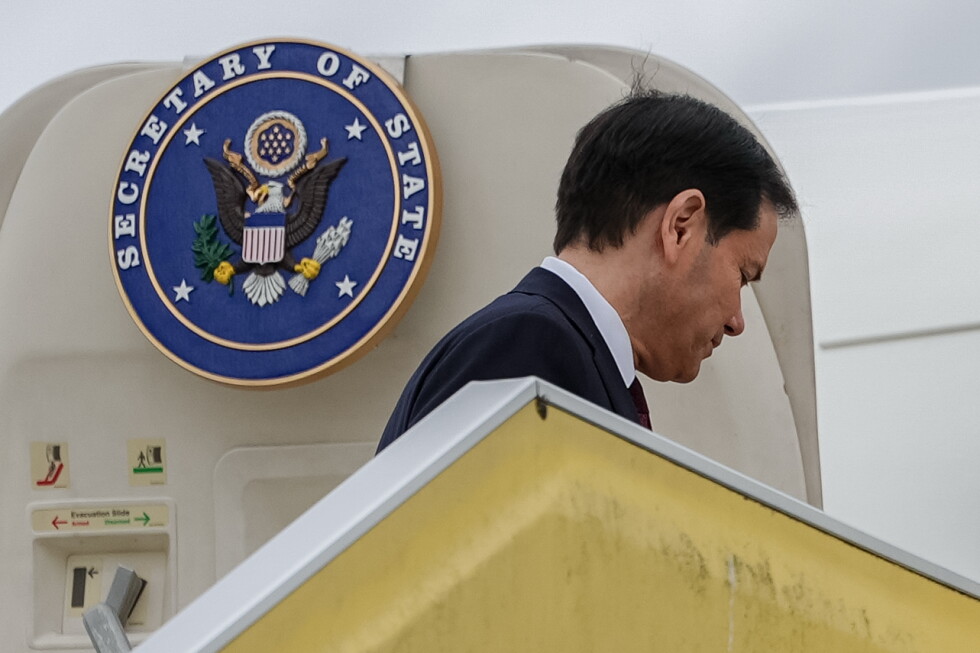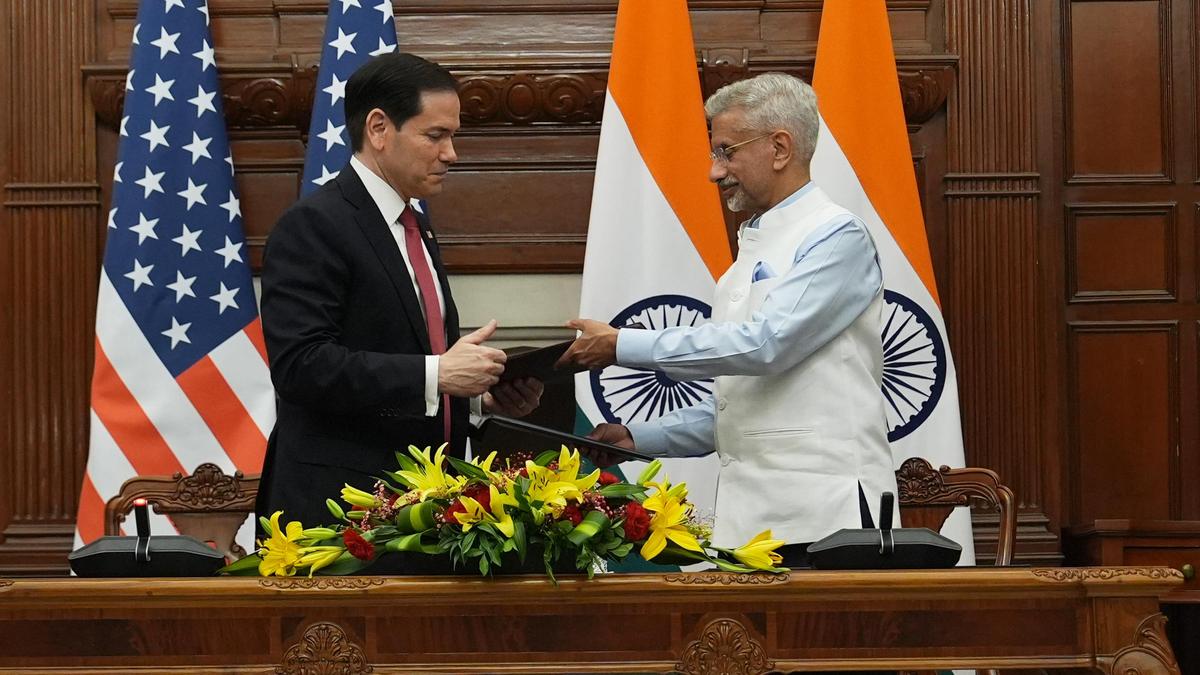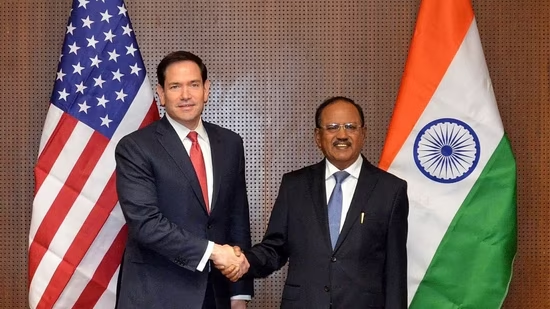
The May 23-26 visit of the US secretary of state, Marco Rubio, to India for bilateral discussions and for the Quad foreign ministers’ (India, US, Japan and Australia) meeting (May 26) brought the focus back on India’s role in the Indo-Pacific region in the ongoing geopolitical maelstrom. US Secretary of State Marco Rubio meeting with NSA Ajit Doval, in New Delhi on Sunday. (MEA on X)A perception had sprung from the current US National Security Strategy (White House) and the National Defence Strategy (Pentagon) that the global power structure is sought to be established between the three power centres, namely, Washington, Beijing and Moscow with other powers, big and small, finding their own locus – an expression of the MAGA outlook on global affairs with the concurrent objective of domestic economic rejuvenation. Whereas in the western strategic outlook, the Indo-Pacific construct combining the Indian and the Pacific Oceans is the most critical component of the global power structure with recognition essentially of India’s key role, it represents also a strategic turn in global geopolitics dated back to President Obama’s policy of the ‘pivot’ to Asia (US expression for the Pacific) and its qualitative strengthening during President Trump’s first administration.President Trump’s return to office, with an unprecedented electoral mandate, provided a wider scope for his characteristic transactional politics and diplomacy globally – to keep others second-guessing the objectives – without exception. The subsequent aggravation of the prevailing volatility and the US’s own domestic concerns, especially economic, inject uncertainty in the global scenario motivating all countries – again, without exception – to nurse their equities in all their bilateral relationships.Secretary Rubio’s visit, on the heels of President Trump’s visit to Beijing and coinciding with President Putin’s there, demonstrates US interest in the pursuit of both the stated objectives. His interactions in Delhi were not, quite manifestly, the same league as the President’s, notwithstanding the latter’s video appearance at a US Embassy gala, but they injected a system-driven momentum in diverse areas in bilateral relationship – officially designated as ‘comprehensive global strategic partnership covering almost all areas of human endeavour’ – as well as Quad. Whilst major bilateral divergences remain, these interactions indicate mutual efforts to stabilise them in an uncertain world.The Quad track – for a ‘free and open’ Indo-Pacific – is also an important pointer of the members’ strategic thinking. Essentially, it is aimed at preventing a precipitate change in power equilibrium in the Western Pacific either in hard power or in economic terms for its wider global implications; practically, all countries and regional organisations have adopted their own respective Indo- Pacific ‘outlooks’ because of the growing importance of this region. China’s coercive pursuit of its so-called ‘nine dash lines’ in the South China Sea – despite an adverse finding (2016) by the Arbitration Tribunal as violative of the UN Law of the Sea – for demarcation of exclusive maritime zones and the militarisation of its various land features has such implications. The tilting of economic equations in this region also requires some balancing through sustained development of Quad’s agenda in diverse spheres like maritime security (‘common operating picture’), emerging technologies, critical minerals, supply chains, connectivity, cybersecurity, energy security, the climate crisis and disaster response, health security, space, counter-terrorism and regional security – lest trade and economic distortions from China’s national growth strategy result in similar geopolitical and geo-economic ramifications. What is surprisingly being overlooked is that the Quad forum is mirrored in the self-same countries participating sans alliance in the annual Malabar Series of highly sophisticated interoperability naval exercises conducted alternately between the Bay of Bengal and the western Pacific.The increasing volatility being the defining characteristic of the current global geopolitics, is it any surprise that the Quad meeting was preceded by the BRICS foreign ministers’ meeting (May 14-15) attended by all members except the Chinese because the dates clashed with those of the US President’s visit China? A ‘non-West’ organisation born in the wake of the 2008 global financial crisis, which also saw the birth of the G20, its recently expanded membership includes India, Brazil, Russia, China, South Africa, Egypt, Ethiopia, Iran, UAE and Indonesia with several partner countries from different parts the world; according to media sources, there is expectation that its summit level meeting this year will be attended by both the Russian and Chinese presidents. Its New Delhi agenda was on the broad themes of ‘Resilience, Innovation, Cooperation and Sustainability’ and multilateral reforms, including finance and trade; amongst themselves, activities are inter alia geared towards currency stability and supply chain resilience. The bilateral relationship, officially described as ‘special and privileged partnership’, the Russian foreign minister’s discussions likewise with his Indian counterpart (May 13) covered a wide range of issues from economic to defence cooperation, energy and the Prime Minister’s visit to Russia as part of ongoing series of annual summits. That India is currently steering these processes speaks of its role in the global geopolitics. Volatility implies rapid shifts of policy in relevant relationships. System driven policy pursuits set the direction but sustaining their pace remains hostage to precipitate twists and turns in geopolitics. When every option is being exercised – and needs to be exercised – by all countries, it is the one with stronger institutional resilience and strength which is capable of navigating through turbulence. Options exist because of the growing mutual dependencies, despite their weaponisation, but their successful exercise is possible in a situation of national strength.A growing phenomenon of ‘middle power’ diplomacy aims to explore options for supply chain resilience in goods and services as also production patterns. That the US share the global trade is about 17% opens a large variety of possibilities to address national and global challenges. This possibility, however, cannot be overstated for obvious reasons and Indian diplomacy has its work cut out.(The views expressed are personal)This article is authored by Yogendra Kumar, former ambassador and author, New Delhi.
QUAD foreign ministers’ meeting & India’s global diplomacy
This article is authored by Yogendra Kumar, former ambassador and author, New Delhi.
981 words~4 min read