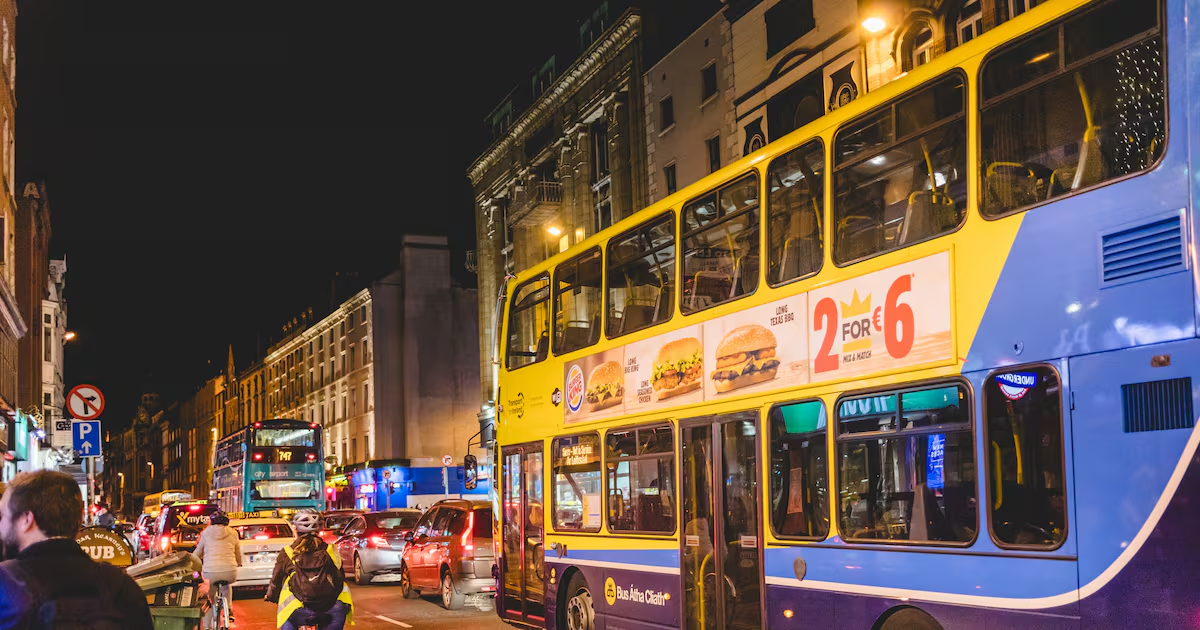
We have to stop the increasing carnage on our roads. More than 70 people have died so far this year, every single death being a deep family tragedy. On top of that, there has been a consistent increase in the number of people being seriously injured. Those incidents don’t make the news, but leave people maimed and scarred for life.The job of turning things around lies with the Department of Transport, the Road Safety Authority, An Garda Síochána and the transport agencies, but if we are to really tackle the root cause of the problem then our local authorities will have to take centre stage. The biggest increase in fatalities and injuries has been among pedestrians and cyclists being hit by vehicles. The solution to that problem has to come from better engineering of what is happening on our roads and not just more education or enforcement campaigns. We have designed our roads to suit the car and truck to the point where it is not safe to walk and cycle. That is what has to change.Local authorities have been given significant resources to make it happen. There is an annual budget of €350 million for active travel improvements and new design teams have been put in place in every council as well as in the National Transport Authority and Transport Infrastructure Ireland. Unfortunately, we are not yet seeing the scale and speed of delivery that should come from the deployment of those resources. It is one of the main reasons road deaths and injuries continue to rise. The problem lies with a procedural system that puts every cycle lane, greenway and pedestrian crossing into an endless naval-gazing, consultation and design process. The system keeps officials busy, but fails to deliver quick and profound change on the ground. The public spending code is adhered to, but everything becomes very expensive and only arrives in a disjointed fashion. We reward process management rather than giving an incentive to those who can act fast.Part of the problem is political because although every councillor will want to make our roads safer, many will baulk when it comes to making unpopular changes to do just that. In our car-dependent culture, taking space away from the car is almost always politically problematic. Perhaps the best way of clearing these hurdles is for the transport budget to be allocated most to those councils willing to build out transformative projects and cut for those less able to do so. Rather than the traditional “one for everyone in the audience” budget allocation, it is time to start picking winners and stop rewarding those who just tick the process box. It would be a way of returning power and responsibility to local government, which has been diminished for years and needs to be restored.We have examples of how things can work. The first greenway from Newport to Achill, Co Mayo, was built in record time and at a low cost because Brian Quinn, who worked with Fáilte Ireland, listened to the local community who wanted their children to be able to call into neighbours and avoid the busy main road. Mayo’s Great Western Greenway is 49km long and runs from Westport to Achill Sound via Newport and Mulranny Similarly during the Covid lockdown Robert Burns, a director of service in Dún Laoghaire-Rathdown Council, worked with local community groups and councillors to roll out an experimental coastal cycle route. Again it was built in record time and at a fraction of the typical cost. A lot of local people were no doubt put out, but five years on I don’t think anyone would want to go back. Traffic calming doesn’t just make places safer, it also makes them more beautiful, which brings its own reward.Burns has since been appointed as county manager in his native Monaghan and has not stopped his innovative ways. The council has just launched a new “quiet roads” project, which will turn a typical country road into a safe community space. Speeds are to be brought right down and everything will be done to encourage locals to walk or cycle rather than taking the car. Burns said of the proposal: “Innovation in rural mobility doesn’t always require major infrastructure projects. It can start simply with rethinking how existing road space is allocated and how road layouts can be designed to enhance safety for all users.”The public consultation on the proposal concludes at 5pm on Wednesday. I hope it gets over the line and gets priority for funding. That would be the best incentive to get neighbouring counties to do the same and, before you know, it the model could spread countrywide. If urban councils could create “quiet streets” in a similar way then we could start seeing a virtuous circle as accidents reduce and councils start competing for funding on the basis of who can build most in the least possible time, saving lives and limbs along every pathway.
Local authorities must take centre stage in fight against rising toll of road deaths
We have designed roads to suit cars and trucks to the point where it is not safe to walk or cycle
TL;DRAI
Over 70 road deaths in Ireland despite €350M local authority budget; bureaucratic delays block street redesign projects. Councils delivering fast, pedestrian-focused infrastructure changes should receive priority funding to reduce fatalities via traffic calming.
823 words~4 min read