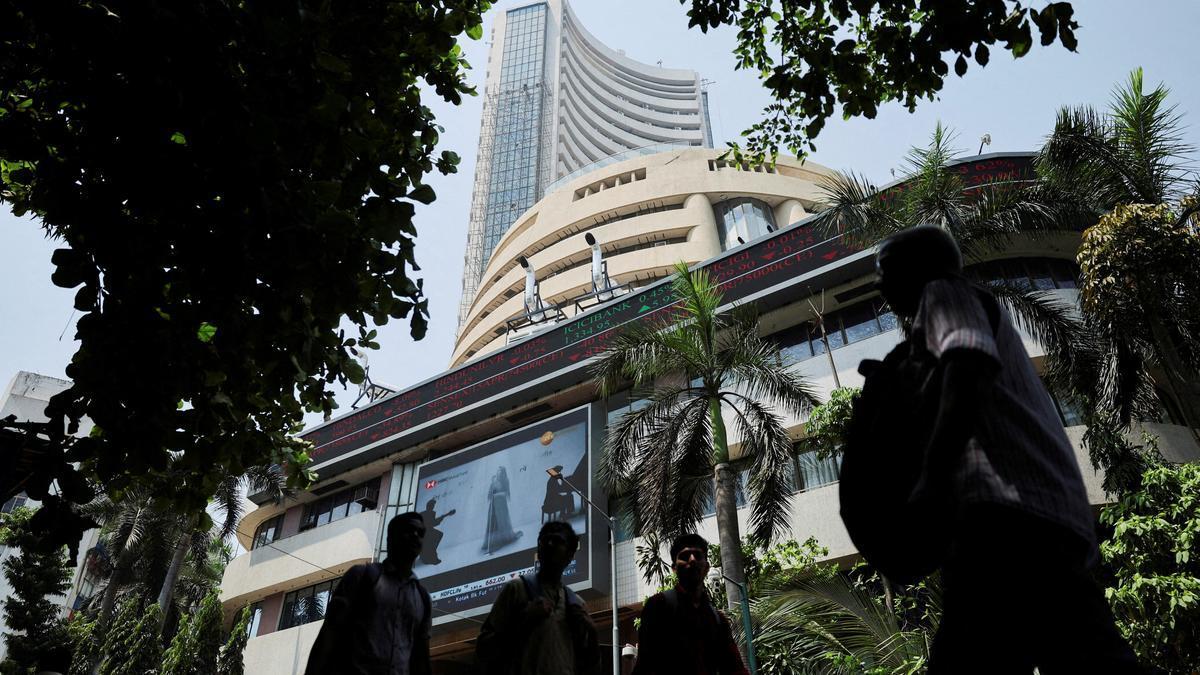
Markets opened in the red on Tuesday, June 2, extending a losing streak amid persistent foreign selling, rising crude oil prices and global geopolitical uncertainty. The BSE Sensex, which had closed at 74,267.34 on Monday, opened at 73,945.20 and was trading at 73,981.34, down 286 points or 0.39 per cent, as of 9:21 am. The NSE Nifty 50, which closed at 23,382.60 on Monday, opened at 23,229.15 and was trading at 23,278.35, down 104.25 points or 0.45 per cent, at the same time.The losses follow Monday's sell-off, where the Nifty had fallen 165 points and the Sensex had dropped 508 points. This marks the fourth consecutive session of decline for the Nifty 50. "The trend of sustained AI trade, new records for markets in US, South Korea and Taiwan, sustained FPI selling in India and India's underperformance are continuing with no immediate signs of reversal," said Dr. VK Vijayakumar, Chief Investment Strategist at Geojit Investments Limited.Information technology stocks were the standout gainers in an otherwise weak market. Infosys rose 3.50 per cent to ₹1,244.60, against a previous close of ₹1,202.50, with over 27.61 lakh shares changing hands worth ₹34,272.05 lakh. Tata Consultancy Services advanced 2.46 per cent to ₹2,354.00, compared to a previous close of ₹2,297.40, on volumes of 7.35 lakh shares valued at ₹17,209.62 lakh. Tech Mahindra gained 1.58 per cent to ₹1,567.60 against its previous close of ₹1,543.20, while HCL Technologies rose 1.48 per cent to ₹1,212.80 from its previous close of ₹1,195.10. Wipro edged up 0.63 per cent to ₹207.72 from ₹206.41. On Monday, the Nifty IT index had been the top-performing sectoral index, rising over 2.55 per cent.On the losing side, financial and healthcare stocks were under pressure. Bajaj Finance was the top loser, falling 2.65 per cent to ₹865.45 from its previous close of ₹889.05, with 12.24 lakh shares traded worth ₹10,612.63 lakh. Eternal declined 1.81 per cent to ₹243.60 against its previous close of ₹248.10. Apollo Hospitals dropped 1.53 per cent to ₹7,984.50 from ₹8,108.50, while defence and electronics major BEL fell an equal 1.53 per cent to ₹400.95 from its previous close of ₹407.20. Shriram Finance was down 1.44 per cent to ₹905.85 against a previous close of ₹919.05. The FMCG index had declined the most in the previous session, falling 2.25 per cent.The broader market weakness is being driven by multiple headwinds. Crude oil prices have rebounded above the $90 per barrel mark and are currently trading in the $91–93 range, raising concerns over India's import bill, inflation and corporate margins, particularly in oil-sensitive sectors. Foreign Institutional Investors (FIIs) have maintained a net selling stance in recent sessions, with Domestic Institutional Investors (DIIs) partially absorbing the outflows. Additionally, the India Meteorological Department's latest projection of monsoon rains at 90 per cent of the long-term average has added to concerns. "The energy shock has led to downward revision of India's GDP growth and upward revision of inflation this financial year," Vijayakumar noted, adding that the monsoon projection "will have negative implications for growth and inflation."Technical indicators reflect the cautious mood. The India VIX, the market's volatility gauge, rose 2.21 per cent to 16.54 on Monday after an 8 per cent surge in the prior session. The Nifty Put-Call Ratio fell to 0.69, its lowest since February 27, indicating increased call writing and defensive positioning. "A move above the 17 level could increase downside risks, while a decline below the 15 mark would be necessary for confidence to return," said Aakash Shah, Technical Research Analyst at Choice Equity Broking.Analysts at Kotak Securities identify 23,500 on the Nifty and 74,500 on the Sensex as the key trend-setting levels for the day. A sustained fall below 23,200 on the Nifty, they warn, could push the index toward 22,800. On the upside, a move above 23,500 could see a bounce toward 23,650–23,700. "In these tough times of huge uncertainty and challenges, the ideal strategy for investors is to stick to the basics — do proper asset allocation based on one's risk profile and financial goals and wait with patience," Vijayakumar said.Published on June 2, 2026
Markets open lower; IT stocks buck trend as selling pressure continues
Markets open lower amid selling pressure, with IT stocks gaining; analysts caution on geopolitical uncertainties and rising crude prices.
TL;DRAI
Indian equity markets declined 0.39-0.45% on June 2 amid FPI outflows and energy pressure, while IT stocks surged—Infosys +3.5%, TCS +2.46%, Tech Mahindra +1.58%. Sector divergence signals sustained investor conviction in India's AI/IT capabilities despite macro volatility, bullish for enterprise tech allocation.
678 words~3 min read