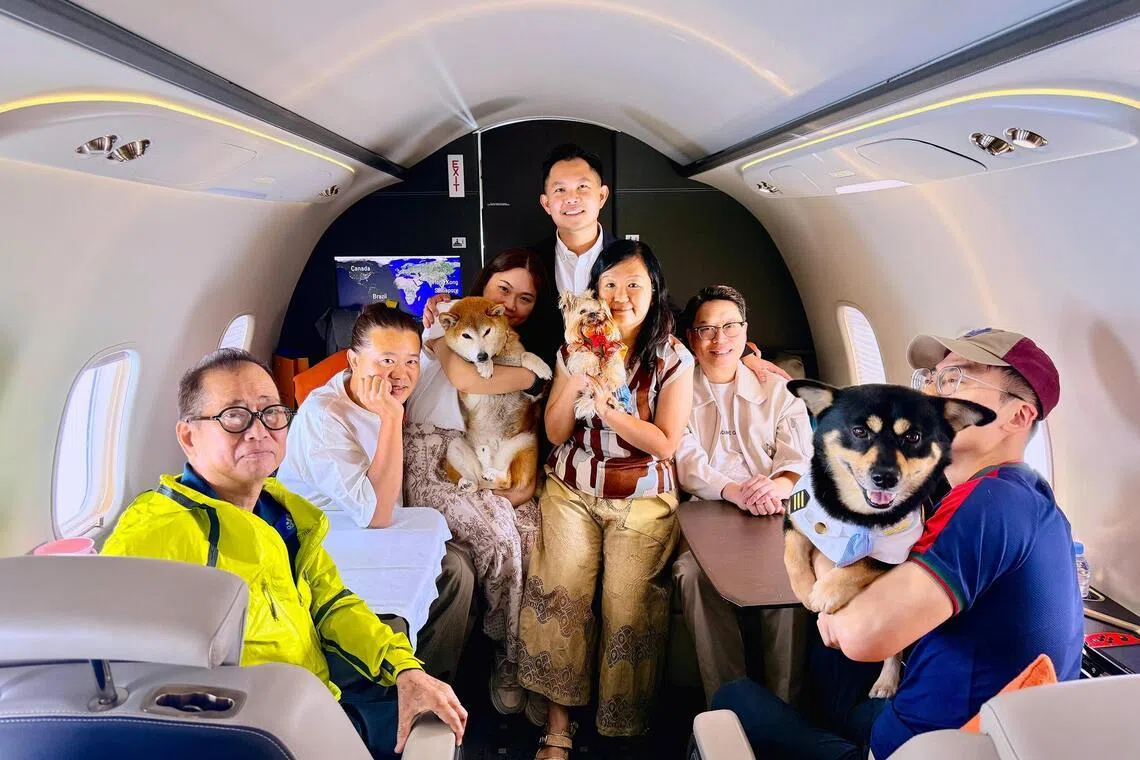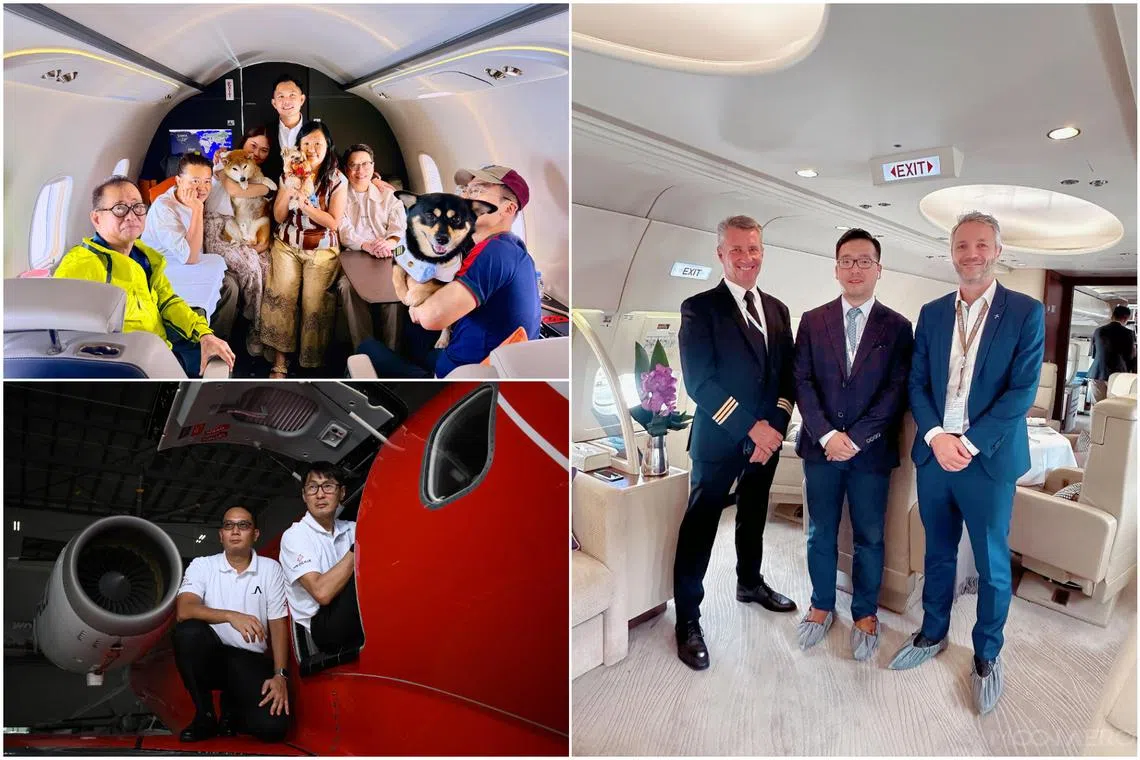
SINGAPORE – Jamie Wong, founder of pet-focused private jet service SingaPaw Air, used to charter light jets such as the Phenom 300 for trips carrying up to four passengers and two pets.But since the cost of jet fuel soared after the Middle East conflict broke out in late February, he has pivoted to chartering larger, ultra-long-range jets like the Gulfstream G650ER, which can carry up to 14 passengers and seven pets.By offering this “jetpooling” option – different groups of travellers sharing a jet – he is able to maintain the cost per passenger at about US$15,000 (S$19,200).The move has helped sustain booking demand and even attracted first-time customers drawn to the more affordable private travel option, Wong said.He added that the price of jet fuel, which typically accounts for 25 per cent to 35 per cent of private airlines’ operating costs, has surged significantly in recent months.Data from the International Air Transport Association (IATA) shows that jet fuel prices soared from under US$100 per barrel at end-February to over US$200 per barrel in March and April before falling to about US$160 as at June 1.Operators told The Straits Times that private airlines are often more exposed to fuel price volatility because, unlike larger commercial airlines, they do not hedge fuel costs as systematically.Fuel hedging allows airlines to lock in fuel prices in advance through financial contracts, said Lim Wen Bin, a partner for infrastructure advisory at KPMG in Singapore. This helps commercial carriers smooth out the impact of rising fuel costs and avoid fully passing the surcharge on to passengers in the short term.But for private airlines, which operate smaller aircraft with lower fuel consumption and see less predictable booking patterns, fuel hedging is not a common practice, said Calvin Cao, chief executive of private charter service Moon Aero.Private charters have become pricier as a result. Cao said a one-way flight from Singapore to Hangzhou on a Gulfstream G550 used to cost about US$80,000. Now, passengers have to cough up US$8,000 more for a fuel surcharge.Moon Aero chief executive Calvin Cao (centre) with partners at an air show in Macau.PHOTO: MOON AEROAt SingaPaw Air, Wong said, the fuel surcharges for light-to-midsize jets can range from US$8,000 to US$15,000 for a one-way flight from Singapore to Tokyo. For longer routes such as Singapore to San Francisco, passengers can expect to pay an additional US$25,000 to US$40,000 in surcharges.Singapore Air Charter’s director of experiences Stefan Wood said additional flight routing, which involves flying around the conflict zones, has pushed charter prices up by between 7.5 per cent and 15 per cent.Passengers also have to be prepared for fluctuations in charter prices, said Manuel Silva, charter services manager at Asian Sky Group, an aviation consultancy. “Nowadays we are told that the price is an estimate, subject to prevailing jet fuel prices and the political situation,” he said.While most private aviation operators say they can pass on the costs to clients, many still focus on fuel efficiency, such as flying at higher altitudes to reduce fuel burn and optimising route planning.Private jet charter service Avcair Singapore’s senior base captain Zaw Thi Ha and first officer Chua Kean Chaye.ST PHOTO: CHONG JUN LIANGZaw Thi Ha, senior base captain at private jet charter service Avcair Singapore, said the current environment has led to more detailed discussions with clients on flight planning and route selection.He said private jets can fly higher than commercial airlines, thanks to their structural efficiencies. Most modern business jets cruise between 41,000ft and 45,000ft, where the air is less dense and helps reduce drag.“Cruising higher also keeps the aircraft above most weather and traffic, which reduces deviations, vectoring and holding – all of which burn additional fuel.”The Gulfstream G650ER is typically used in business aviation.PHOTO: MOON AEROFor medical evacuation firm EMA Global, one way to help its clients manage costs is to repatriate patients with less severe conditions on commercial flights instead of air ambulances, said deputy chief executive Dexter Tan.He said a commercial business-class flight with a medical team monitoring the patient typically costs far less – just about 20 per cent of an air ambulance charter.Despite the fuel hike, some operators said they are absorbing the costs for high-value clients.Moon Aero’s Cao, for example, said some of his clients have paid for a jet card entitling them to 300 hours of flight per year. This means they are guaranteed a fixed rate even if fuel prices have increased. “Sometimes, if we have a buffer to balance the cost, we try not to pass the surcharges to clients.” But he is confident that “those who are on top of the pyramid” will keep travelling private to save time. “Their travel behaviour can’t change once they are used to this ‘time machine’.”Wong from SingaPaw Air absorbed the fuel surcharge for his client Peter Chen, a Hong Kong solicitor who recently holidayed in Singapore with his pet dog. His friends and their pet dogs tagged along.Peter Chen paid about HK$600,000 (S$97,800) to charter a jet between Hong Kong and Singapore. He took his friends and their pets along for the vacation.ST PHOTO: JASON QUAHChen’s round trip between Hong Kong and Singapore cost about HK$600,000 (S$97,800). The bill would have been 15 per cent higher with the fuel surcharge.But the extra cost would not have deterred him from flying.“A dog’s lifespan is short and my own theory is that I should take my dog to see the world as much as possible,” he said.
From ‘jetpooling’ to flying higher: Private jet operators adapt as fuel costs soar
Jet fuel typically accounts for up to 35 per cent of private airlines’ operating costs. Read more at straitstimes.com. Read more at straitstimes.com.
909 words~4 min read