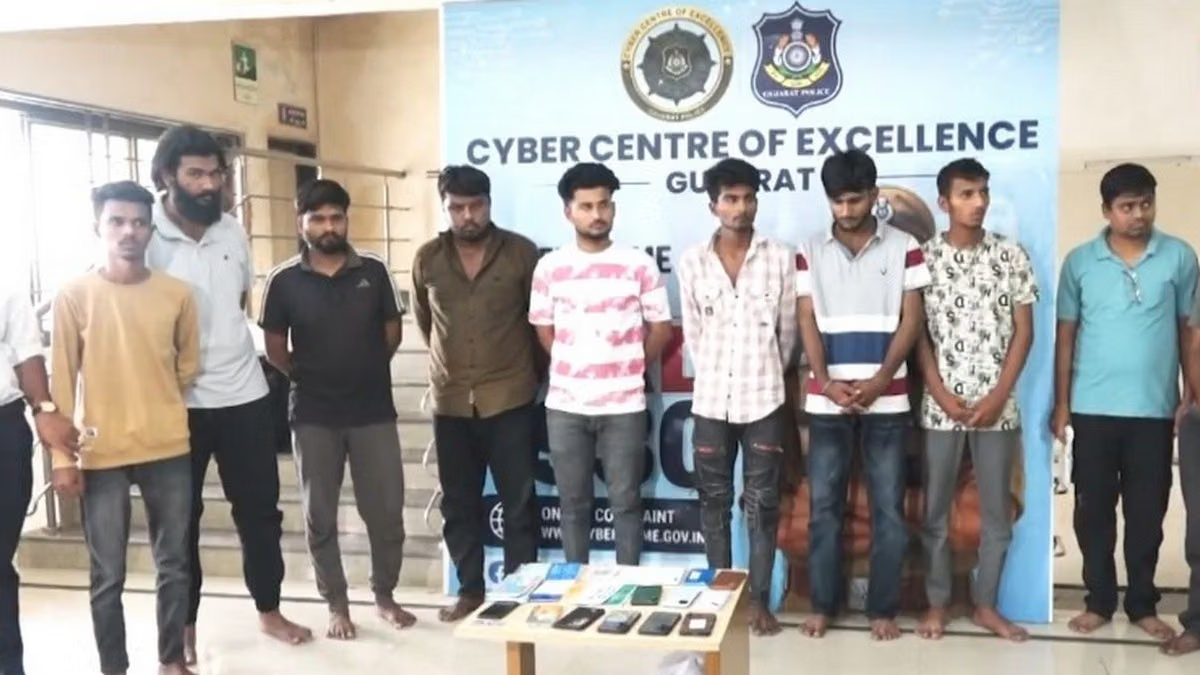
In one of Gujarat’s largest crackdowns on cybercrime-linked financial networks, the State police have uncovered cyber fraud worth ₹2,289 crore and taken action against 913 mule bank accounts during a special Statewide operation aimed at dismantling the financial infrastructure used by cybercriminals.The crackdown, titled Operation Mule Hunt 1.0, led to the registration of 565 FIRs and the arrest of 638 accused persons, according to details shared by the Gujarat government on Monday (June 1, 2026).The drive was conducted by the Gujarat Police and the Cyber Centre of Excellence (CCOE) under the supervision of Deputy Chief Minister and Home Minister Harsh Sanghavi as part of the State government’s broader effort to combat cybercrime, officials said.A mule account is a bank account used to receive, transfer or launder money obtained through online fraud. Such accounts are often operated by individuals who knowingly or unknowingly allow cybercriminals to route illicit funds through their accounts, making transactions difficult to trace.The police identified 4,052 cybercrime cases linked to mule accounts across the country, including 491 cases originating from Gujarat. Investigators analysed intelligence inputs received from the Indian Cybercrime Coordination Centre (I4C), the National Cybercrime Reporting Portal (NCRP), the Coordination Portal and the 1930 cybercrime helpline to trace the network.The operation involved police commissionerates, range offices, local crime branch units and cyber police stations across the State. Nodal officers were appointed in every district, while dedicated support teams were created to investigate complaints and coordinate with financial institutions. Banks were directed to share information in real time to facilitate investigations.Officials said the crackdown resulted in measurable disruptions to the movement of fraud proceeds through the banking system.Cheque withdrawals linked to suspicious transactions declined by 75%, while the monthly value of cheque withdrawals dropped from ₹126 crore to ₹25 crore, representing a reduction of nearly 80%.The police also reported a 30% decline in first-layer mule accounts—the accounts that initially receive money from victims—between August and December 2025. ATM withdrawals associated with such activities fell by 66% during the period from September to December 2025.The operation comes as law enforcement agencies across the country seek to tackle a surge in cyber fraud cases involving investment scams, digital arrest frauds, impersonation rackets and online financial crimes, they said.Similar efforts have been undertaken elsewhere in the country, including the Hyderabad Police’s Operation Octopus, under Commissioner V. C. Sajjanar, which gained national attention and prompted discussions among the Union Finance Ministry, the RBI and other stakeholders with police on tackling mule accounts and cyber fraud.“The operation is part of a broader national push on digital security. Internet users in India have grown from 250 million to over one billion in the past decade, with the BharatNet programme connecting more than two lakh gram panchayats. That scale of connectivity has expanded the attack surface for cybercriminals, making coordinated enforcement operations such as the Mule Hunt an increasingly regular feature of policing in the country,” officials said.In a parallel development, the Reserve Bank of India has introduced an artificial intelligence-based risk-scoring framework to identify and monitor mule accounts. The system, being implemented through the Indian Digital Payment Intelligence Corporation (IDPIC), will classify transactions as low, medium or high risk, enabling banks to take preventive action against suspicious accounts.Under the initiative, IDPIC has been designated as the nodal agency for information sharing among banks. Authorities have also created a central registry, MuleHunter.ai, to facilitate the exchange of data on suspected mule accounts.The Gujarat government said the operation aligns with the Centre’s broader push to strengthen cybersecurity and protect the rapidly expanding digital economy. India has witnessed a sharp increase in internet penetration and digital payments over the past decade, with Unified Payments Interface (UPI) transactions becoming a dominant mode of payment.Officials said cybercrime has emerged as a major challenge alongside the country’s digital transformation, necessitating closer coordination among law enforcement agencies, banks and technology platforms to prevent financial fraud and protect citizens.
‘Operation Mule Hunt’ exposes ₹2,289 crore cyber fraud network in Gujarat; 638 arrested
Gujarat's Operation Mule Hunt uncovers ₹2,289 crore cyber fraud, arrests 638, and targets mule bank accounts in a major crackdown.
648 words~3 min read