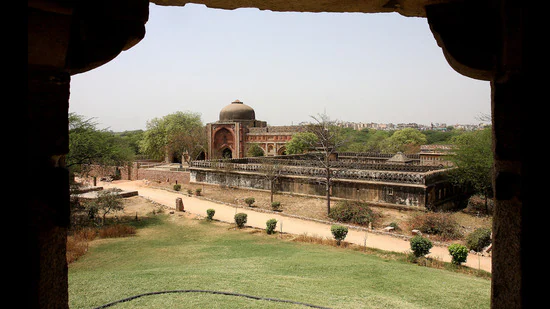
The incident I am about to narrate took place a long time ago. Every year, during the Durga Puja holidays, we three friends went on a trip. It was a tradition we had. I am speaking of a time when India was still under British rule, and Bengal had not yet been divided into East and West Bengal. People all over the country lived contented lives. There were no fierce riots, and only rare instances of murder or violence.Ordinary folk were not afraid to go out on the streets. The three of us bought tickets and boarded the Toofan Mail. Our destination was the city of Delhi. Old Delhi was a lot like Chitpur Road, with narrow lanes and bylanes forming a labyrinth of thoroughfares lined with old houses. Fatehpuri, where we stayed, was close to the Old Delhi railway station. Delhi was famous for its landmarks. In Old Delhi, the main places of interest included the Red Fort, Jama Masjid, Lahori Gate, Ajmeri Gate, Kashmiri Gate, and many more. We took a bus from Old Delhi to New Delhi and saw the Central Secretariat, the Viceroy’s House, and several other interesting places. One day, we took a bus to see the Qutub Minar. It was a historical monument unlike any other, and we were mesmerised by its majestic charm. After returning to our hotel, we were discussing our journey back to Howrah when the hotel manager asked us if we had all the major tourist attractions.We told him that we had seen everything there was to see in Agra, Mathura, and Delhi, including Emperor Akbar’s tomb in Sikandra, a place hardly visited by tourists. “Haven’t you been to Qutubpur?” the manager asked. We replied in the negative. He said that the tomb of the emperor of Qutubpur, on a full moon night, was a rare sight to behold and should not be missed. “How far is it from here?” we asked. “Not far,” said the manager. “It’s about 16 miles from here. You have to take a bus to Qutubpur from the station, and then walk a few miles to the emperor’s tomb.” “What’s the name of the emperor?” we asked. “After the death of Emperor Aurangzeb,” the manager said, “many kings ascended the throne of Delhi. However, within a few days, they were killed one after another. This emperor and his begum too were attacked and killed by conspirators. Their tombs are in Qutubpur.” After thinking for a while, the manager said, “The day after tomorrow is a full moon night. You can leave in the morning and return the following day.” We nodded in agreement. The prospect of witnessing the mausoleums of an obscure emperor and his queen seemed thrilling to us. We hired a guide from Qutubpur who accompanied us to the emperor’s tomb. Upon reaching our destination, we checked the time. It was seven in the evening. We sat in a grove a few yards away from the mausoleum. There were similar groves scattered around the monument. They were called Kunj. “Are there snakes around?” we asked the guide. “No,” he said. “This place is regularly swept and cleaned.” “Do you get visitors?” “A few, and that too only on full moon nights. You see, this place isn’t famous.”We sat in silence for a long time, not knowing what to expect. Eventually, the full moon rose in the sky. No sooner did the moonlight bathe the surrounding landscape than a strange sight unfolded before our eyes. It felt as though we were watching a historical drama. The emperor and his begum stepped out of their tombs. He clapped twice, and instantly, two attendants appeared with a magnificent throne, conjured as if from thin air. Next, they fetched a hubble-bubble with a long, coiling smoking tube and filled it with fragrant tobacco. The emperor sat on his throne, smoking the hookah with his begum beside him. The wonderful, sweet smell of tobacco filled the air. We had never thought tobacco could smell so sweet. We inhaled the fragrance with delight. “I am done smoking,” said the emperor in a robust voice. He clapped again, and immediately a white horse appeared. The emperor was wearing a silk kurta and pyjama that looked expensive, and a headdress studded with diamonds, precious gems, and pearls. His kurta too was decorated with diamonds, rubies, and emeralds. As the moonlight struck them, they began to dazzle with a rare brilliance. He mounted his horse. A sword hung at his waist, its hilt glinting faintly in the pale light. He signalled to the begum to remain seated on the throne, and then set out on horseback. The horse galloped away with a faint, rhythmic clinking sound, carrying the emperor into the darkness. After a while, both horse and rider disappeared from view. Soon, two maids appeared and began massaging the begum’s hands and feet. We watched all this in silent wonder, utterly transfixed. It felt as though we were witnessing a theatrical performance. About 20 minutes passed, and then we heard the clattering again. We realised the emperor was returning from his ride. Whatever was unfolding before our eyes was beyond belief. I even wondered whether it might be an elaborate illusion by a troupe of performers in royal costumes tricking gullible tourists. I had to find out. As the emperor approached, I sprang to my feet and bowed before him.He looked at me with silent disdain. His eyes were like those of the dead, silent and unblinking. Fixing me with that chilling gaze, he asked, “Who are you?” “I am a poor beggar,” I replied. “I beg for alms from the emperor.” The king reached into his pocket, took out some gold gooseberries, and tossed them toward me. They scattered over the ground. I hurriedly gathered them and slipped them into my pocket, thinking they must be worth several thousand rupees. Meanwhile, the figures of the emperor, his begum, their attendants and companions vanished into thin air. The guide said in a reprimanding tone, “Why did you do that?” “Do what?” I asked. “Show yourself to the emperor,” he said. “Had it not been for you, they wouldn’t have disappeared. You ruined our chance to witness a rare sight.” “I don’t think so,” I said. “What’s the point of watching illusions performed by the dead?” “People come from all over to witness this,” he said. I smirked and replied, “The golden gooseberries I received are far more valuable than that. At least they are real.” The guide gave a faint smile and walked away. After some time, we decided to leave. We spent the rest of the night sitting at a small tea shop by the roadside. The shop stayed open all through the night on every full moon. Finally, we returned to Delhi by bus the next morning. The hotel manager was excited to see us. “What happened?” he asked eagerly. We told him everything that had happened that night. “Can I see the golden gooseberries?” he asked. I slipped my hand into my pocket and froze in disbelief. There wasn’t a single golden gooseberry. Instead, what I drew out were fragments of clay, as if broken from a pot or pitcher. We stared at the shattered bits, stunned and speechless.Excerpted with permission from ‘The Emperor’s Tomb’ by Hemendra Kumar Roy in An Anthology of the Best Ghost Stories from Bengal Vol. II, selected and translated by Barnali Saha, Bee Books.
Horror fiction: Three friends meet the ghost of the emperor and his begum in Qutubpur
An excerpt from ‘An Anthology of the Best Ghost Stories from Bengal Vol. II’, selected and translated by Barnali Saha.
1,253 words~6 min read