There is a popular game in finance where people arrange their profession into a pyramid: private equity at the apex, then public-market fund managers, banks, venture capital, and investment banking at the base. The higher you sit, the more you combine independence over capital, depth of knowledge, and ownership of outcomes.It is tempting to build the same pyramid for computer science. Deep Tech and frontier research at the top, because it creates the capabilities everyone else consumes; then product technology that reaches the masses; then the enterprise software that is essential to the corporate world; then the IT services that work on a massive scale. The hot roles slot in neatly: the AI engineer industrialises, the data scientist straddles the middle, the application developer anchors the base. Read more: Is private equity really the pinnacle of finance?The pyramid is a good hook. It is also wrong, and the way it is wrong is the story.The pyramid hides a second axis Take two people. One is a mid-level researcher inside a frontier AI lab. The other is a brilliant software engineer. The pyramid says the first ranks higher, sitting closer to the apex of capability. But the engineer may be more skilled, more irreplaceable, more in command of their own outcomes. What the researcher has is not superior ability. It is proximity to scarce inputs: frontier compute, model weights, proprietary data, and the people who understand them.So which one is higher? The question is malformed, because two different things are being measured and the pyramid collapses them into one. There is the platform you sit on, meaning whether the institution around you controls scarce inputs. And there is your individual scarcity, meaning how replaceable you are inside it. These vary independently. A pyramid forces them onto a single rung; reality spreads them across a plane.This invites a fair objection. If a thousand engineers at a lab all hold the same access, access cannot be what separates them from each other. Too many people have it. True enough. Access is scarce between populations, not within them. A lab might have a thousand people with frontier access; the global pool of capable engineers is in the millions. So access is brutally scarce across the field and nearly worthless as a tiebreaker inside the building. What rescues the individual is that proximity is an option on becoming scarce: sitting next to frontier work, you absorb what is never published and build intuition that does not transfer. Treat the seat as a salary and you keep a comfortable floor. Treat it as a learning position and you convert platform into scarcity.The law underneathStep back and the model stops being clever. “Where you reach is your environment multiplied by your skill” is not an insight about computer science. It is the oldest structure there is. Structure and agency. Capital and labour. The terroir and the winemaker. Every enterprise and civilisation runs on a version of it.What varies is the ratio between the two terms. In subsistence farming, environment dominates and skill is a thin multiplier on soil and rain. In chess or pure mathematics, skill dominates and environment barely registers. In finance, environment dominates: the desk you sit on usually beats your individual edge. For any field the real question is how much weight environment carries, and whether that weight is shifting.The thirty-year anomalyFor three decades, computer science sat at an extreme no industry of its scale had ever occupied. Push the environment term toward zero, with no capital required, no institution, no permission, and the equation collapses into skill alone. Ability becomes very nearly destiny. That is the regime of chess and pure mathematics, fields with no capital and no gatekeeper, the opposite of where trillion-dollar businesses get built. Yet for a generation, building software lived there too. The anomaly was never that CS rewarded skill. It was that an entire industry behaved like a pure-skill game.The conditions were real. The tools were open source and free, the hardware commodity, the internet a distribution platform that cost nothing to stand on. A teenager in a bedroom could build something globally consequential without an institution, capital, or permission. Linux came from a student; the most valuable web companies from dorm rooms and garages; Bitcoin from a pseudonymous paper. The environment you needed could be assembled by anyone with a laptop and time, so skill carried almost the entire weight of the outcome.This is why technology believes in meritocracy more than any other industry. Programmers are no more idealistic than bankers; the structural conditions simply supported the belief for a while. The meritocratic self-image of tech is downstream of a temporary, unusual fact about its inputs.Why AI ends the exemptionThe obvious read on AI is that it deepens the exemption: it lets anyone code. Vibecoding lowers the barrier further, so surely the environment term shrinks toward zero for everyone.The opposite is closer to the truth. When AI can do the coding, coding skill stops being scarce. It decentralises until nearly everyone has it. And the equation does not reward what is abundant. As the skill term flattens across the population, the only variable left to separate outcomes is the environment term. Commoditise skill and you do not diminish environment; you hand it the deciding vote.The second force runs alongside the first. Frontier AI reconcentrates the central input of the field in a way open source cannot immediately route around. You can fork a repository in seconds; you cannot replicate a frontier training run in a garage. The compute, data, capital, and concentrated talent needed to sit at the frontier are, for the first time in the field’s history, nonsubstitutable by an individual. You can now be locked out by an organisational boundary, not merely an ability gap.So the field reverts to the mean from both ends. Skill commoditises downward; inputs concentrate upward. Both raise the weight of environment. The hierarchy was never a ladder of professions. It is a field that briefly escaped a universal law and is now being pulled from that extreme back toward the centre, where outcome is environment multiplied by skill and environment carries its historic share.StratificationOpen weights complicate the picture: frontier capability redemocratises on a lag, this year’s fortune becoming next year’s free download. But the floor and the frontier move in opposite directions at once. The floor rises. An independent developer today wields capabilities a funded lab could not buy five years ago. The frontier recedes faster, because the cost of being at the very edge keeps escalating. You can do more than ever and stand further than ever from the frontier at the same time. The exemption stratifies rather than ending.Where the professions actually sitThe single pyramid no longer fits, because the argument above split prestige into two axes. The ranking that survives is by leverage: how much scarce input your position gives you proximity to, multiplied by how hard you are to replace. Read it as role centroids rather than destinies; the spread inside roles is wide, and a person’s own coordinates usually matter more than the title.1. Deep Tech. The frontier. Advanced AI, semiconductors, robotics, aerospace, quantum computing, and scientific innovation. They create the underlying capabilities everyone else builds on. Highest scarcity, longest moats, and the greatest control over future technological trajectories.2. Product Technology. Platform and product builders. They transform foundational technologies into scalable products, ecosystems, and user experiences. Strong leverage through ownership of distribution, data, and customer networks. Less scarce than Deep Tech, but often the largest value capture layer.3. Enterprise Software. Business infrastructure at scale. ERP, CRM, cybersecurity, analytics, and industry-specific software. Deeply embedded in customer workflows, creating durable switching costs and recurring revenue. Their advantage comes from operational entrenchment rather than technological frontier leadership.4. IT Services & Consulting. Implementers, integrators, and advisors. They enable technology adoption and digital transformation but rarely own the underlying platforms. Scarcity is primarily human capital and execution expertise, making this layer exposed to automation, standardization, and AI-driven change.5. Generalist implementation and “vibecoding.” The stratum AI flattens most completely: near-zero scarcity, no platform. The widest population and the most exposed of all.Three things keep this from being a caste system. The ranking measures leverage, not worth or pay or how good the work feels, and a role low on it can be the better life. The tiers are clouds rather than points, so a staff engineer who owns critical infrastructure outranks a coasting researcher. And ownership is the move that jumps the plane: equity in what you build manufactures platform out of skill, which is why a founding engineer can outrank almost everyone above them. One thing the plane does not need is a third axis for AI. Replaceability is not separate from the picture; it is the current running through the scarcity line. The more of your core skill the models absorb, the lower your scarcity sinks, until platform alone is holding your leverage up.What it leaves you withThe pyramid asked the wrong question. What matters is which of two assets you are accumulating. One is platform: proximity to inputs you could never assemble alone. The other is individual scarcity: skill that travels and cannot be easily replaced. The strongest paths convert one into the other, using a platform to become scarce, or using scarcity to command a platform. The weakest sit still on a high floor and mistake it for a high position.Computer science spent a generation as the field where you could ignore the environment and let talent decide. That is ending, and the thing ending it is the development that looks like its opposite: AI putting a coder in everyone. Tech was never special. It was early, and briefly lucky.(Disclaimer: The opinions expressed in this column are that of the writer. The facts and opinions expressed here do not reflect the views of www.economictimes.com.)(Disclaimer: The opinions expressed in this column are that of the writer. The facts and opinions expressed here do not reflect the views of www.economictimes.com.)
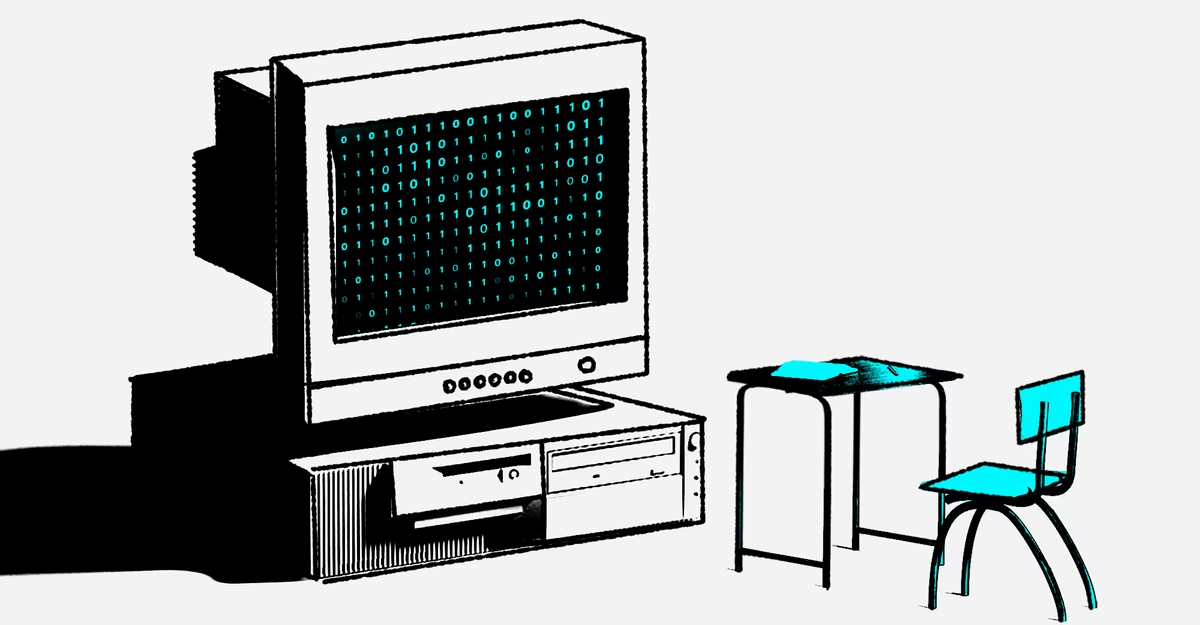
Computer science is losing its exemption: Everyone can code now, which is why the field is reverting to the civilisational mean
A popular pyramid model for computer science professions is flawed. For decades, skill alone determined success in tech. Now, Artificial Intelligence is changing this. AI is making coding skills common. At the same time, advanced AI requires massive resources. This means environment, not just individual talent, will increasingly shape outcomes in the tech world.
1,661 words~8 min read