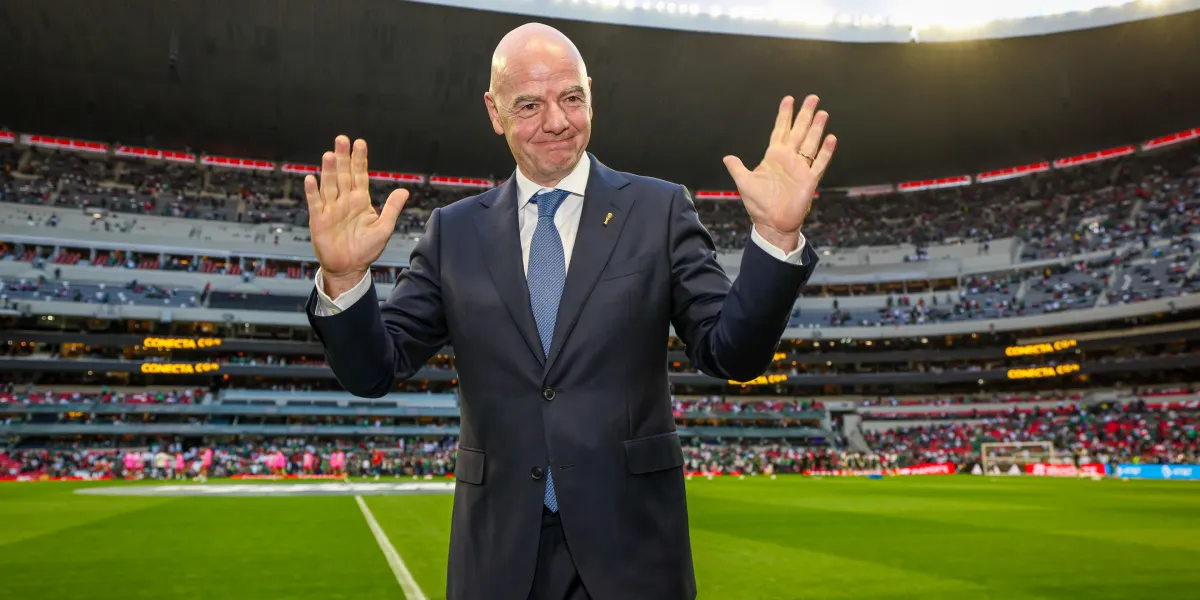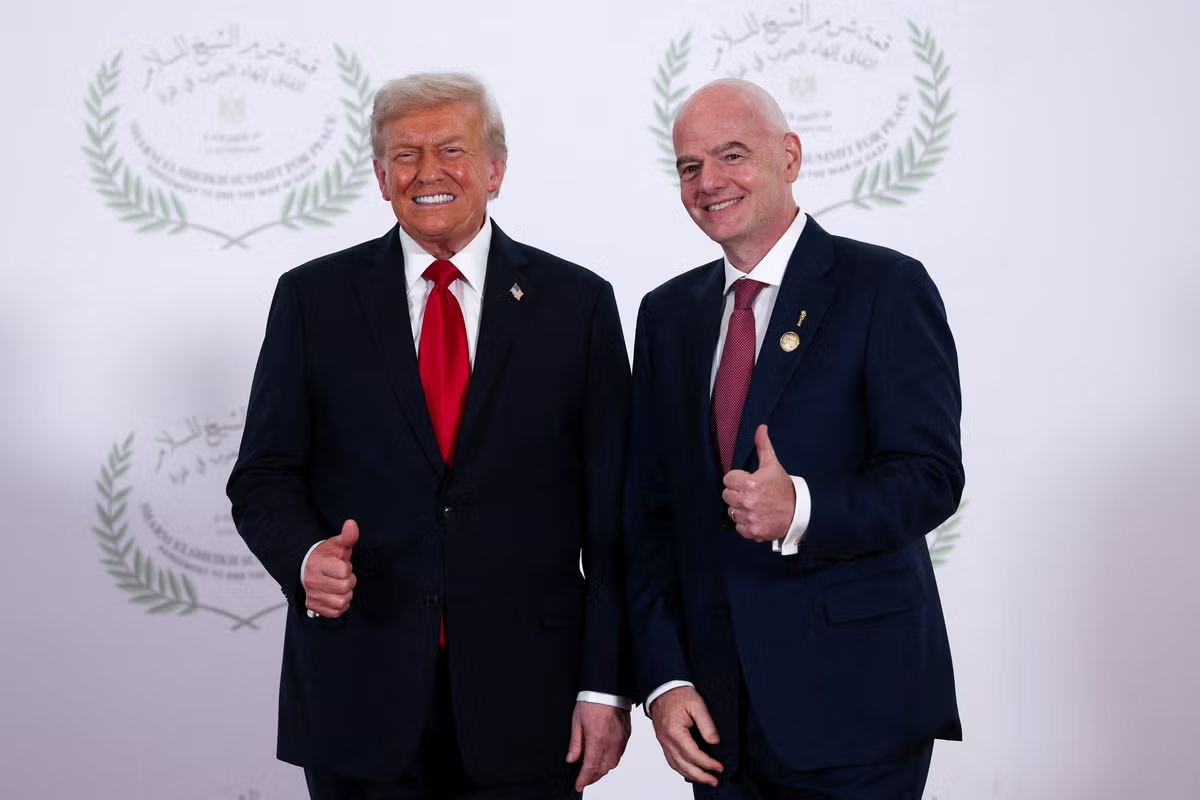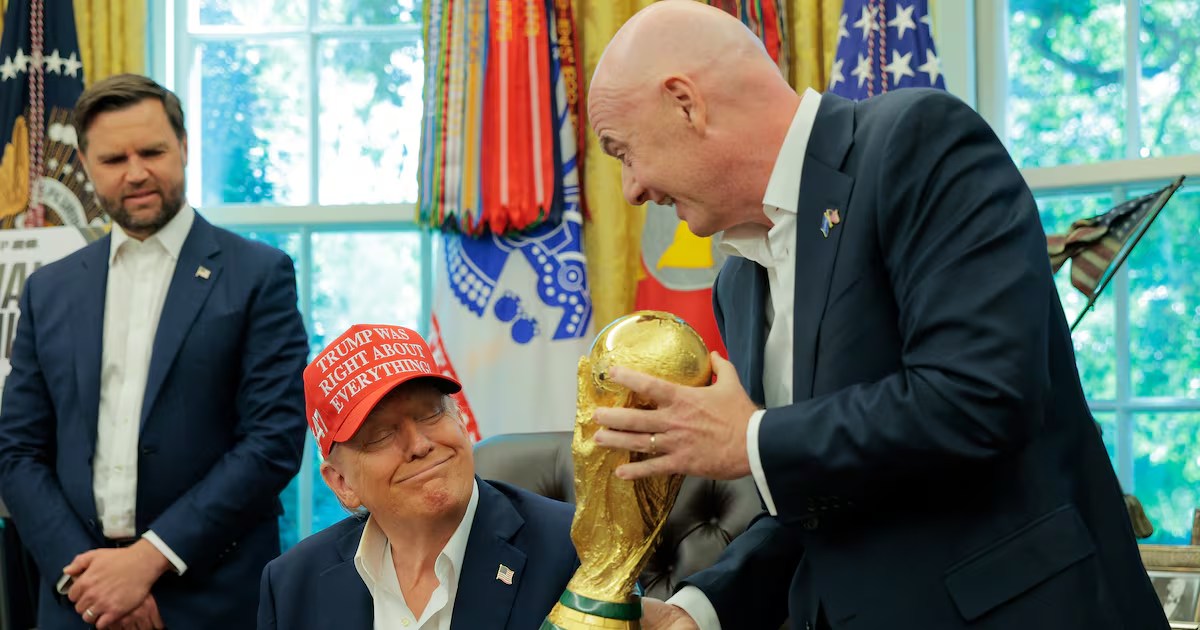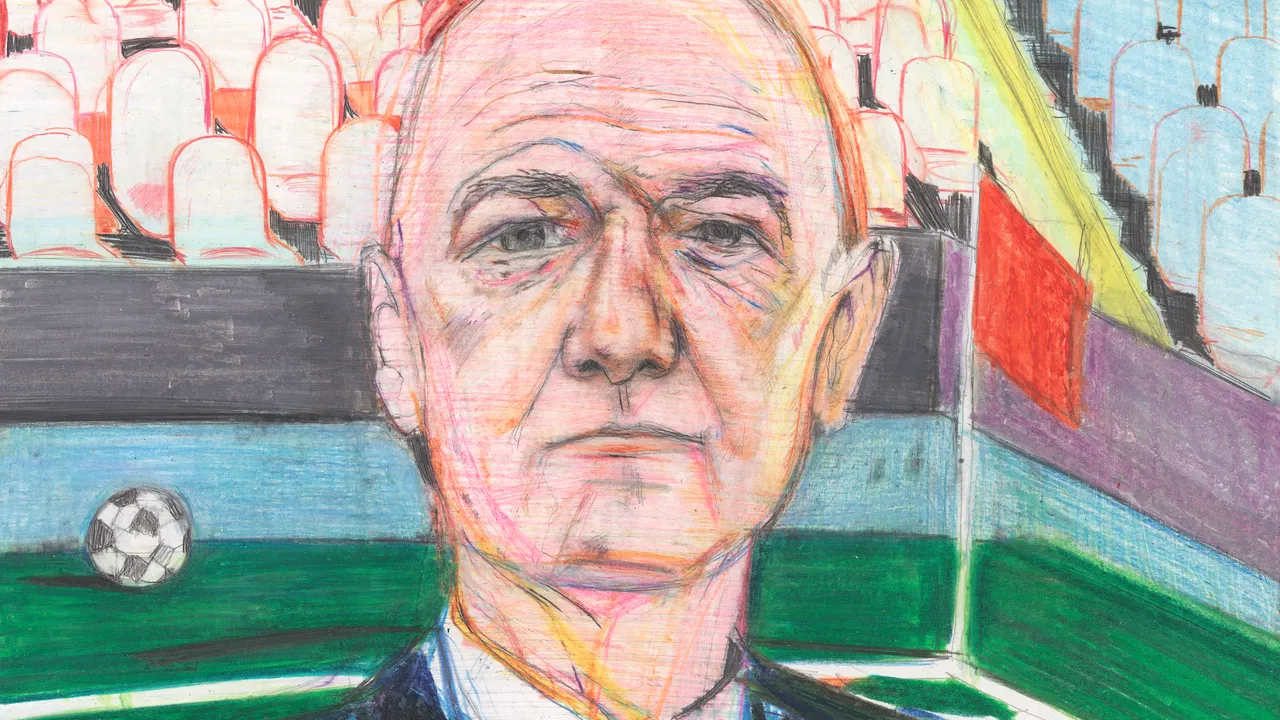
In English, it’s called the World Cup, but I prefer the stirring names by which it’s known in other European languages—Mundial, Mondiali, Weltmeisterschaft—and which better convey the idea that this is not a sports tournament but something closer to a cosmological event, heavy with meaning. For soccer people, it requires no effort to measure out your life in World Cups. Just a few seconds of footage, or even a photograph, is usually enough—the color of the turf, the haircuts, the uniforms, the exact shade of summer blue—to ascertain not only which year it was and who won but where you were and who you were with and why you were with them and what the preoccupations of that time were from which it was possible, however briefly, to escape.My earliest World Cup memory—a six-year-old’s spiral of indignation and despair—is of Diego Maradona’s dastardly Hand of God, which eliminated England in the quarterfinals of the 1986 edition, in Mexico. Twenty years later, I watched the final, an operatic affair between France and Italy, at a pub in East London. Zinedine Zidane, the great French playmaker, headbutted Marco Materazzi, a wily Italian defender who had made a passing remark about Zidane’s sister. Zidane was ejected and France lost. It was a London summer night, when the smell of dried-out parks and exhaust fumes never entirely clears from the air. I stood at the bar with my girlfriend, whom I was desperately in love with but who didn’t care about soccer at all, and I can still feel the conflicting parts of me—one part absorbed by the magnitude, the improbable aesthetic beauty, of Zidane’s gesture, the other by her—reaching in two unbridgeable directions at once. (We broke up soon afterward; she is now my wife.)So these are complicated, major occasions. And this summer’s World Cup, which runs from June 11th to July 19th, will be the same, or even more so. For the first time, the tournament will be played across three nations—the United States, Mexico, and Canada—with forty-eight teams (up from thirty-two, as in previous editions) and a total of a hundred and four matches. It will be longer, more climatically varied, and more revenue-generating than ever before. It will probably be fantastic. Perhaps something will go wrong. Either way, the World Cup will be wasted on most Americans. Although millions will marvel at the sheer scale and global character of the enterprise (the Democratic Republic of the Congo will play Uzbekistan on the evening of June 27th, in Atlanta), it is unlikely to graft onto their sense of time and shared memory the way that Italy’s victory did in 1982, for example.That summer, Gianni Infantino—now the president of the Fédération Internationale de Football Association, which governs global soccer and owns the World Cup—was twelve years old and living in Brig, a small town in the Swiss Alps. Infantino’s parents were Italian migrants: his father worked on the night trains that ran under the mountains and across Europe, and his mother managed a kiosk at the railway station. Working-class Italians suffered discrimination in Switzerland during Infantino’s childhood. But the triumph of the Azzurri, the Italian men’s national team, in the World Cup helped to change that. It “allowed us to grow,” Infantino said in a speech, in 2021. “For me personally, I think that the 1982 World Cup was definitely the moment when the football virus . . . became part of my life and my body.”Swiss Italians of Infantino’s generation have described the mounting euphoria of that summer as a feeling of riscatto—redemption and release. Brig is only a few miles from the Italian border. (Infantino calls his personality a combination of Italian creativity and Swiss precision.) After one match, he and his family crossed the border to the town of Domodossola to celebrate. There were no Italian flags on sale anywhere, so Infantino’s mother bought strips of red, white, and green fabric and sewed them together herself.Brig is in the Upper Valais, a gaunt and conservative place where the inhabitants speak Walliser German, an Alpine dialect that many Swiss people find unintelligible. Six miles along the valley is Visp, the birthplace of Sepp Blatter, Infantino’s predecessor at FIFA, who, until Infantino entered the picture, was the most infamous soccer administrator of all time.Blatter was a former P.R. man and wedding m.c. who became a pioneer of global sponsorship and broadcasting deals. He joined FIFA in 1975 and worked there for forty years. Under Blatter, FIFA became powerful and rich but also morbidly corrupt. The organization is made up of two hundred and eleven national soccer associations and their representatives. For decades, FIFA officials accepted bribes from sports-marketing companies in exchange for selling them the broadcast rights to valuable tournaments they controlled at preferential rates. At a news conference toward the end of Blatter’s reign, a prankster showered him with banknotes.Blatter ran the show but never quite took center stage. In “World Cup Fever,” a new history of the tournament, the writer Simon Kuper likens him to der portier, the manager of an expensive Swiss hotel who understands all his customers’ predilections and who has the cash to cover their bills. “Blatter’s genius lay in knowing who was bribing whom,” Patrick Oberli, a Swiss journalist and documentary filmmaker who has covered FIFA for years, told me. Since taking over, in 2016, Infantino has made Blatter seem small-time by comparison. He has sublimated FIFA into his own personhood, with astonishing success. His Instagram account, which has 4.2 million followers and a comments section that is strictly curtailed, is now the organization’s principal mouthpiece. He has transformed the role of the FIFA president into that of a prominent international politician (President Donald Trump calls Infantino “the king of soccer”) while dramatically increasing FIFA’s revenues and reach.Infantino will be unavoidable this summer. During the previous World Cup, in Qatar, directors of the official tournament feed were reportedly instructed to show him in the crowd once per match and not while he was looking at his phone. The geography of this year’s World Cup means that he won’t be physically omnipresent, but his imprint will be everywhere. “It’s safe to say that there’s no major decision that’s being made at this tournament without the direct involvement of Gianni,” a former high-ranking FIFA official told me. FIFA has staged two men’s World Cups under Infantino, but the 2026 edition is the first to be awarded and delivered during his tenure, and thus fully shaped in his image. He has already declared it to be the greatest of all time. Infantino’s messaging is as relentless as a 3-D printer’s. He is fond of the number eleven, which is the number of players on a soccer team. Most things are iconic. He likes to describe FIFA as “the official happiness provider to humanity.”Infantino is both absolutely in control and strangely ill at ease. “He doesn’t trust many people,” the former official said. “His circle is very small.” Oberli, the Swiss journalist, has interviewed him four times. (Infantino declined to speak with me.) “In every case, I was faced with someone who was fearful,” Oberli said. “It was a peculiar feeling. It was as if he were sitting an exam.” In 2023, when Infantino was reëlected, unopposed, for a second full term as president, he opened a rare news conference with a rebuke for the waiting reporters. “I don’t understand why some of you are so mean,” he said. “Why? Why? I don’t get it.”The modern history of FIFA begins at dawn eleven years ago, when Swiss police officers entered the Baur au Lac, a luxurious nineteenth-century hotel in Zurich, and started arresting the organization’s delegates, who had gathered for an annual congress. The raid, on May 27, 2015, followed years of investigation by the U.S. Department of Justice and the F.B.I. (More than forty FIFA officials and associates were ultimately indicted on various fraud charges; twenty-seven pleaded guilty.) As the delegates were marched out of their hotel rooms, investigators also arrived at the Home of FIFA, the organization’s global headquarters, which has six underground levels dug into a hillside on the edge of Zurich. According to a Swiss search warrant, the police spent from 7:50 A.M. to 9:30 P.M. in the building, removing hundreds of boxes of bidding documents, World Cup contracts, and USB drives.Six days later, Blatter announced that he would step down. For years, his presumptive heir had been Michel Platini, a former captain of the French national team and the president of UEFA, Europe’s soccer governing body. (FIFA’s national associations are organized into six powerful continental blocs.) Where Blatter was a political operator, Platini was bluff and down-to-earth—an actual soccer guy. In the eighties, Platini had won the Ballon d’Or, the prize for the world’s best player, three years in a row. “Everything is set up for Michel Platini to be president,” the former official recalled.But a single invoice changed that. On the afternoon of September 25th, some four months after the raids, Olivier Thormann, the head of the Swiss economic-crime division, returned to the Home of FIFA to question Blatter and Platini about a payment of two million Swiss francs (roughly two million dollars) that his officers had discovered. Although the alleged purpose of the payment (for consulting work that Platini had done for Blatter in the late nineties) and its timing (just before Blatter’s reëlection in 2011) were definitely questionable, they weren’t obviously illegal—unlike the bribery and money laundering that the F.B.I. had uncovered. But Swiss prosecutors didn’t see it that way. The two most important administrators in global soccer were taken to separate rooms. According to a former employee at the organization, as the FIFA president was led away, Thormann asked a receptionist, “Do you have a defibrillator for Mr. Blatter?”The criminal investigation ended Blatter’s and Platini’s careers in soccer. (Both men were charged with forgery and fraud, but later acquitted of any wrongdoing.) It also threw open the succession question at FIFA: Who would run instead of Platini? For years, he had been assisted at UEFA by Infantino, its forty-five-year-old general secretary and the former head of its legal department. Platini had star quality, but Infantino was an energetic administrator with a noticeable gift for languages. “It was a bit like ‘Pinky and the Brain,’ ” a former FIFA executive told me, referring to a nineties cartoon about two genetically engineered mice. (In each episode, the Brain would come up with a plot to take over the world.) “Infantino was the brains. Platini was the fun.”“If you’re going to abduct me, I need my sweats, neck pillow, and a big bottle of water.”Cartoon by Bruce Eric KaplanAmong fans, Infantino was best known for overseeing the draws for UEFA’s competitions, like the Champions League, where a former player would take balls out of a glass bowl and then open them to disclose which teams were playing each other. Infantino presided over the events with jocular asides and instant recall of previous matches and scores. “He was extremely competent and hardworking,” a former colleague at UEFA said. “He knew all the rules, read all the regulations.”When UEFA adopted Infantino as its presidential candidate, some observers wondered whether he was merely a placeholder until Platini could clear his name. But “Gianni’s campaign was very slick,” Philippe Auclair, a veteran French journalist and soccer writer, recalled. “He travelled everywhere. He met absolutely everybody.” With UEFA’s funding, Infantino toured the world, courting soccer bureaucrats from Montserrat to Papua New Guinea. (Each FIFA member has equal voting power.) “He was like a juggernaut, basically, which surprised a lot of us,” Auclair said.Infantino’s chief rival was Sheikh Salman bin Ebrahim al-Khalifa, of Bahrain, the president of the Asian Football Confederation and a longtime dealmaker within FIFA. But on election day, in Zurich, Infantino gave a thirteen-minute speech that was crisp and commanding. Beginning in English, he switched effortlessly among Italian, German, French, Spanish, and Portuguese. He acknowledged the arrests and the need for reform. “We have been speaking in the last months about many, many things: corruption, courts, tribunals, lawyers, whatever,” he said. “Police.” But Infantino’s central—and audacious—pitch to the delegates was that, as president, he would give them more riches than ever before. “When I propose figures, I know what I’m speaking about,” he said. His plan was to double the amount of FIFA revenues that were paid out to members to help develop soccer in their countries—a total of $1.2 billion. “The money of FIFA is your money,” he said. “It’s not the money of the FIFA president. It’s your money.” The room broke into a loud applause. A former FIFA employee who was watching the proceedings realized that the election was over. “Like, why even vote?” the employee said. “He just promised them more money.”If Infantino has an operating philosophy, it is “More.” For the first seventy-three years of FIFA’s history, the organization arranged just two competitions: the men’s World Cup and the soccer tournament at the Olympic Games. Now it oversees twenty, ranging from the FIFA Beach Soccer World Cup to FIFAe, its e-sports division. Infantino sees FIFA’s expansion in ethical, as well as commercial, terms. He talks about soccer the way that other people talk about clean water or universal basic income.“Immediately you have a ball, you smile,” he said, at last year’s America Business Forum, in Miami. “This is a magic object which transforms children or people into happy people or happy children.” In 2022, at a meeting of the Council of Europe, a human-rights organization, Infantino suggested that holding the World Cup more often might prevent so many African refugees from drowning in the Mediterranean.The effects on FIFA’s bottom line have been tremendous. Since Infantino took over, its revenues, which are calculated on a four-year cycle, have more than doubled. During the next cycle, which will run until 2030, FIFA is projected to have fourteen billion dollars to spend—of which $2.7 billion, some twenty per cent, will be handed back to its national associations, under a program known as FIFA Forward. Blatter championed “football development” in the nineteen-seventies, to translate profits from FIFA’s ticket sales, sponsors, and broadcasters into fields and shoes and soccer programs around the world.But skeptics have long argued that such funding, which has increased eightfold under Infantino, is really just a mechanism for patronage and control. Brazil—which has a population of two hundred and thirteen million people, of whom around a quarter live in poverty—has won the men’s World Cup five times. Between 2023 and 2025, it received $6.35 million from FIFA Forward. The wealthy republic of San Marino (population thirty-four thousand), which is the bottom-ranked soccer nation in the world, received ninety-four thousand dollars more.The president holds the purse strings. “The concentration of so much money at the top creates two fundamental problems,” Miguel Maduro, a Portuguese governance scholar, told me, of FIFA. The first is that it gives any incumbent extraordinary leverage over the delegates who elect him. “That’s why no president of a football association dares to publicly challenge the president,” Maduro said. The second is what Maduro called “a systemic conflict of interest” between FIFA’s missions of regulating and monetizing soccer.In May, 2016, Maduro was appointed as the chairman of a new governance-and-review committee at FIFA, to oversee elections and senior appointments at the organization. Maduro was one of several high-profile figures—including Navi Pillay, a former United Nations High Commissioner for Human Rights—who were recruited to reform FIFA and recast its public image in the wake of the corruption scandal. But, a year later, Maduro and Pillay were gone, along with Joseph Weiler, a professor at New York University, after the committee refused to appoint Vitaly Mutko, Russia’s Deputy Prime Minister, to FIFA’s ruling council, because he was a serving government official.“The moment we started to do some things that could put into risk Infantino’s structure of power, he had to decide whether to stay faithful to the reform process or to stay in power,” Maduro told me. “He didn’t hesitate.”People who have worked at FIFA describe it as an intoxicating place. “O.K., you work at a massive investment bank. Is there one global investment bank?” Mark Goddard, who worked at FIFA for thirteen years, asked me. “There is only one FIFA. There will only ever be one FIFA, by intention and design.”The former executive observed how rapidly new hires could fall under its spell. “Within six to twelve months, you see a huge personality shift,” he said. “You see people who suddenly have this massive sense of entitlement, who get angry about the smallest things, like, Why has this person got match tickets? Why is this person seated here? Why did this person get this watch?”FIFA describes itself as a nonprofit, but its staff and delegates live well. Members of the FIFA Council and many chairmen of its committees are paid hundreds of thousands of dollars (plus expenses and per diems) to attend a handful of meetings a year. Under Infantino, the number of FIFA committees has increased from seven to thirty-five. “No one is saying to be humble, at any point. You go to tournament events in exotic locations. You’re flown business class. You stay in five-star hotels on Copacabana Beach,” the former executive went on. Maduro added, “It’s very easy to get co-opted or captured. You just need not to take very seriously your function.”FIFA has had other presidents who channelled the spirit of their era. Jules Rimet, who created the World Cup, was the son of grocers and grew up in fin-de-siècle Paris. Rimet believed, beyond all reason, in soccer’s ability to reconcile warring nations. According to “World Cup Fever,” he volunteered to serve in the trenches of the First World War, at the age of forty-one, where he was bombarded for four years and awarded the Croix de Guerre three times. Throughout his service, he wrote letters, hands shivering from the cold, to organize future international soccer competitions.Blatter and his predecessor, João Havelange, a Brazilian businessman, were twentieth-century pioneers of branding and marketing deals—agents of globalization. Infantino is a creature of our post-liberal moment: simultaneously banal and hard to read. “His vision for the game is to expand FIFA’s power and his own power, by definition, basically using the logic that anything that is good for me and FIFA is good for football,” the former UEFA colleague said. “It’s very simple.” Earlier this year, Infantino’s tenth anniversary at FIFA was branded “INFANTIN10” on the organization’s social-media channels and marked by a thirty-minute adulatory film, of which more than five minutes were taken up by congratulatory cellphone video messages sent by the great and the good of soccer.Infantino could not be more European, and yet he often chastises the historic and economic center of the sport that he governs. (More than seventy per cent of the players at the previous World Cup played in the European leagues.) “Europe has to do much more,” he said during his election speech, imploring the Continent to share its footballing wealth and expertise with other countries. He is troubling to many Europeans because he suggests that both their power and their preoccupations—with democracy, human rights, the rule of law—are somehow quaint and fading. “It’s easy in our part of the world to paint with a dark paint everything that comes from the East, from Russia, or from the Arab world,” Infantino said at a news conference in Moscow, six months before the 2018 World Cup, in Russia. (He was later awarded the Order of Friendship by Vladimir Putin.)FIFA’s statutes describe the organization as “neutral in matters of politics and religion.” But neutral is not the same as disinterested. During the 1934 World Cup, in Italy, Rimet sat in silence next to Benito Mussolini during matches in Rome. Il Duce liked to watch “with sustained attention, without distractions,” Rimet later wrote. In 1978, FIFA allowed the World Cup to be staged by Argentina’s military junta. Brave ground staff painted the base of the goalposts black, to remind the world of the victims of the regime. The governments that Infantino has worked most closely with as FIFA president have been Putin’s, the Emir of Qatar’s, the Trump Administration, and the Kingdom of Saudi Arabia.On the one hand, it is a self-selecting group. FIFA has to deal with rulers who have the wealth, and the disposition, to put on the largest events. “A lot of the sucking up is exactly as a multinational corporation will do,” a former FIFA committee member told me. “It’s the behavior of Coca-Cola, of Siemens, of Mercedes.” In 2024, Aramco, the Saudi state-owned oil company, became an official FIFA sponsor. On the other hand, Infantino’s fascination with autocracy seems to be more than just a matter of the people whom he does business with. In 2021, he and his family lived in Qatar, which hosted the following year’s World Cup. On the eve of the tournament, Infantino gave what is known as his “Today I Feel” speech, in which he said that he felt as if he were Qatari, Arab, African, gay, disabled, and a migrant worker all at the same time, in response to criticism of the labor and human-rights conditions in the Gulf state. The sound bite was widely ridiculed, but it was only a fragment of a much longer address in which Infantino questioned the superiority of Western values and claimed that soccer was an irreducible good, immune to the human context in which it was played. “If we could organize an event in any country of the world, in North Korea, I would be the first to go,” he said.Infantino likes to remind people that FIFA has more members than the United Nations. Earlier this year, the organization announced a partnership with Trump’s Board of Peace at its launch, in Washington, D.C. Infantino presented what appeared to be an A.I.-generated video of a new seventy-five-million-dollar “football ecosystem” that would rebuild “people, emotion, hope, and trust” in Gaza, and rocked out while Javier Milei, the President of Argentina, sang along to an Elvis song. Then, in March, Infantino was among a handful of spectators at the Mardan Sports Complex, in southern Turkey, to watch the Iranian men’s team play a friendly match and to insist on the team’s appearance at the World Cup this summer. “We have to bring people together. It is my responsibility,” he said recently. “It is our responsibility.”It is a form of politics in which choices—even Infantino’s—do not really exist. Last year, he delayed the start of the FIFA Congress, in Paraguay, by three hours because he was tied up with Trump and Mohammed bin Salman, the Saudi crown prince, in Doha. A group of UEFA delegates walked out in protest, accusing Infantino of putting his political ambitions ahead of soccer’s. Infantino can’t stand that kind of dissent. He does not believe in boycotts or what he refers to, disapprovingly, as “pressure” on FIFA’s members or corporate sponsors. At the America Business Forum, he said that he is surprised whenever he reads negative coverage about Trump: “He’s just implementing what he said he would do. So I think we should all support what he’s doing, because I think he’s doing pretty good, right?”A month later, at the ceremony for the World Cup draw, in Washington, D.C., Infantino awarded Trump FIFA’s inaugural Peace Prize. “This is what we want from a leader,” Infantino said, as he bestowed a miniature version of “Thoughts and Desires,” a statue that stands outside the U.N.’s offices in Geneva, upon the President. Only one FIFA member, Lise Klaveness, the president of the Norwegian Football Federation, has had the temerity to speak out against Infantino’s political freelancing. “I sat in Washington, in a room full of football presidents, and felt the painful feeling of being hostage to something that is clearly wrong,” she said in a speech, two months later. “The feeling that the emperor is not only walking without clothes—but that he is leading us in a dangerous direction, and that, at the same time, I can’t stop it.”Everyone else, for the most part, takes the magic ball and smiles. After the prize ceremony, Trump and Infantino returned to the stage with the leaders of the other host countries for this summer’s World Cup—Claudia Sheinbaum, the President of Mexico, and Mark Carney, the Prime Minister of Canada—to begin the draw for the tournament. Carney pulled out the first ball, which he unscrewed to reveal the first team assigned to the group stages. “Uh-oh!” he said, chuckling. It was Canada. Sheinbaum pulled out the next. “Viva Mexico!” she whooped. Trump, at least, had the naturalness, or the insouciance, to show that he knew the thing was rigged. “This is shocking,” he deadpanned, after taking out a ball for the U.S.A. But Infantino didn’t mind. He had his own podium, for FIFA, alongside the host nations. He marshalled the politicians like a concierge you might easily mistake for a guest. Then he took out his phone for a group selfie.Infantino’s most notable intervention at FIFA has been his foray into club soccer, which was once the preserve of national and regional associations. FIFA’s élite club competition—the Club World Cup—used to be little more than a set of glorified friendlies between the continental champions, usually held in the Middle East or Japan. But, in 2022, Infantino changed the format dramatically. The tournament would now take place every four years, like the World Cup proper, and include thirty-two teams rather than seven. There would be a prize pot of a billion dollars and a new trophy, made by Tiffany & Co.Not long ago, I stopped by FIFA’s museum, in Zurich, where the new Club World Cup was on display. It is a large concave disk, made of gold vermeil, which opens, with a key, to reveal what looks like an astronomical model. Almost every surface is laser-engraved with text, in thirteen languages. Infantino’s favorite slogan, “Football Unites the World,” is rendered, in Latin, as “Pediludus Coniungit Mundum.” Elsewhere on the trophy, there are the original rules to soccer, from 1863, which include a proscription on players having nails, iron plates, or gutta-percha—a Malaysian rubberlike material, now used in root canals—protruding from their boots. Infantino’s name is inscribed twice, as the competition’s “founding president” and visionary, in the trophy’s heavily punctuated prose: “The pinnacle of all club competitions. Inspired by FIFA President Gianni Infantino, the tournament, first staged in 2025, eclipses any precedent.”Infantino’s first revamped Club World Cup took place in the U.S. last summer and presented an uneven spectacle. There were mismatches: Bayern Munich, the perennial German champions, thumped Auckland City 10–0. At a match in Orlando, only three thousand people turned up to watch Ulsan H.D., of South Korea, lose 1–0 to Mamelodi Sundowns, of South Africa. There can be such a thing as too much soccer. Games were dulled by the heat. Players from the top European teams, like Real Madrid and Paris Saint-Germain, had already played sixty matches during their regular seasons, before taking to pitches in heat-dome temperatures of ninety-seven degrees and stifling humidity. “It’s impossible,” Marcos Llorente, of Atlético Madrid, complained after a match in Pasadena. “Even my toenails were hurting.”Ahead of the tournament, the European members of Fifpro—a players’ union—filed a legal complaint against FIFA, alleging “abuse of dominance” over the soccer calendar, which forces some players to compete virtually all year round. Fans at the Club World Cup also suffered from the heat, thunderstorms, and the vagaries of FIFA’s dynamic ticket pricing, whereby prices rise and fall according to demand. Shortly before the semifinal between Chelsea and Fluminense, a Brazilian club, at MetLife Stadium, in New Jersey, ticket prices went from four hundred and seventy-three dollars to thirteen. As if reading from the trophy, Infantino described the tournament as “the most successful club competition in the world.” The winning team, Chelsea, earned more than a hundred million dollars in prize money.The Club World Cup was a rehearsal for the big one this summer. There will be sixty per cent more matches at the 2026 World Cup than at any previous edition. According to research published in the journal Sports Medicine in March, “Never has one tournament presented such a combination of extreme environmental factors,” with players encountering high altitude for matches in Guadalajara and Mexico City; elevated pollution risk, from ozone and possible wildfire smoke, on the West Coast; and the danger of exertional heat illness, or stroke, when forced to play in the midday sun.During the tournament, more than half of the sixteen participating venues are expected to exceed safe temperature levels for high-activity sports, as determined by Fifpro and the American College of Sports Medicine. FIFA’s own safety threshold is a few degrees higher. Last December, FIFA announced that there would be two cooling breaks per match, regardless of the weather, which led to speculation that the organization was more interested in creating regular interruptions—for broadcasters and sponsors—than in player welfare.“We’re perfect for each other—you’re an emotional-support dog, and my life is in shambles.”Cartoon by Amy HwangThe Champions League final, the climax of the European soccer season, takes place twelve days before the World Cup starts. “It’s no secret that there’s not enough time,” Lee Taylor, a sports scientist at Loughborough University and a co-author of the Sports Medicine paper, said. “They won’t be prepared in the gold-standard way. . . . The players are bloody knackered.”The ticketing environment has also been extreme. At the World Cup in Qatar, in 2022, the most expensive seats for the final cost about sixteen hundred dollars. In April, equivalent tickets for this year’s final, at MetLife, went on sale for $10,990. A month later, the price tripled, to almost thirty-three thousand dollars. For the first time at a World Cup, FIFA has experimented with both dynamic pricing and its own proprietary resale platform, on which it earns an additional thirty-per-cent commission. The organization is forecast to make about two and a half billion dollars from ticket sales. “A big issue in the past was to make sure it was accessible to everyone, or to most people,” the former senior official said. “This one is obviously different.”In early April, I visited FIFA’s resale site to see what I could find. A few months earlier, in response to complaints about high prices, the organization had released thousands of sixty-dollar tickets for “hardcore” fans. I found one of those, at the back of the upper deck of A.T. & T. stadium, in Arlington, Texas, for England’s game against Croatia, on June 17th, for two thousand dollars. For the quarterfinal that will be played in Miami, on July 11th, there were seats high above the corner flag available for five thousand dollars. But for virtually the same spot, one row down, the price rose to thirty-five thousand dollars. (Last week, prosecutors in New York and New Jersey subpoenaed FIFA for information about its ticketing strategy. Jennifer Davenport, the New Jersey attorney general, called the process “a gauntlet of confusion, fake scarcity and impossibly high prices.”)“This is a tournament without rules,” Ronan Evain, the executive director of Football Supporters Europe, a network of fan groups, told me one morning this spring. I asked Evain what he was most concerned about. “It is rather the things I am not concerned about,” he replied. Immigration control was at the top of the list of concerns. Citizens from four countries that have qualified for the World Cup—Senegal, Haiti, Iran, and Côte d’Ivoire—currently face restrictions travelling to the U.S. “What is going to be the security doctrine of the tournament?” Evain asked. “Can you show an L.G.B.T.+ flag? Can you show a flag of Greenland?”FIFA’s permanent workforce has almost doubled in size during Infantino’s presidency, and another thousand staff have been hired to put on the World Cup, many working from the organization’s offices in Miami. According to Evain, one of the major challenges ahead of the tournament has simply been to obtain information: about visas, or ticketing for disabled fans, or parking. Even small decisions within FIFA are thought to require Infantino’s personal approval—“He decides everything by himself,” a former council member told me—an arrangement that has contributed to an atmosphere of opacity and delay. (FIFA denies this.) Evain told me that FIFA staff sometimes message him to find out what is going on. “The boss is all-powerful, but he’s largely absent,” Evain said. “It looks like people are left with two options: either not doing anything or trying to guess what he wants.” When I texted Evain’s comment to a former FIFA employee who’d spent years working for Infantino, he replied, “Decisions = risks = fear.”The discord around FIFA contrasts sharply with Infantino’s absolute control over the organization. Blatter often had to yield to lesser chiefs, such as the heads of the continental confederations, in order to maintain his grip on power. But Infantino faces no such resistance. “Blatter was afraid of the big federations,” the former colleague said. “Infantino doesn’t take them seriously. They are just co-opted into the system.” Infantino is unlikely to be challenged when he runs for another four-year term, in 2027.Mark Pieth is a Swiss professor of criminal law who investigated the U.N.’s oil-for-food scandal, in which corrupt officials paid kickbacks to Saddam Hussein’s regime, in Iraq. In the twenty-tens, Pieth was one of the reputable figures enlisted by FIFA to help reform the organization. He gave up after falling out with Blatter. “It’s a bit like if you wanted to reform the Vatican,” Pieth told me, when we met at his office, in Basel. “FIFA never wanted to be really reformed.”Pieth observed that Infantino’s FIFA seems like a model of governance, with an independent ethics committee, a top-dollar human-rights policy, and a global democratic assembly. “The thing looks kind of good on the surface,” Pieth said. “But it’s empty. It’s an empty shell.” He was struck by how Infantino had begun to bypass FIFA’s membership—in fact, anybody involved in the running of soccer at all—in order to deal with the world’s richest governments directly. “To be frank, I think the organization is shifting into a different mode,” Pieth said.After the simultaneous awarding of the Russian and Qatari World Cups, in 2010, a process that was riddled with vote-buying, FIFA updated its statutes to make sure that such a thing would never happen again. At the fifa Congress in May, 2024, however, delegates relaxed the rules. That December, Infantino convened an extraordinary virtual meeting of all two hundred and eleven members to approve—as a single agenda item—the hosting rights for the 2030 and 2034 World Cups: a three-continent plan for the 2030 edition, shared between Spain, Portugal, and Morocco with three matches in South America, to mark the competition’s centenary; and Saudi Arabia, in 2034.“We hear ‘corruption,’ we always think about bribery and an individual person receiving a brown envelope,” Pieth said. “This is a totally different kind of thing. They buy the entire world organization.” After we spoke, I watched a recording of the vote. Infantino stood in front of a wall of screens—the world of soccer on Microsoft Teams—and asked for delegates to approve the hosts of the next two World Cups with a round of applause. “If you agree, please? Acclamation,” Infantino said, and raised his hands. He stood and began to clap while the screens clapped back at him.Earlier this year, I took a train to Brig, where Infantino grew up. For centuries, the town was the gateway to the Simplon Pass, a vital trading route across the Alps to the wealthy states of Venice and Milan. Wordsworth walked out from Brig on a gloomy day in August, 1790. “Tumult and peace, the darkness and the light— / Were all like workings of one mind, the features / Of the same face,” he wrote. I found my way to the small stadium of the town’s soccer team, which plays in the sixth tier of the Swiss league. There was snow on the pitch, which was closed for the winter. Infantino likes to tell the story of how he became the president of F.C. Brig-Glis as a young man, after promising that his mother would wash the team’s shirts for free. In 2017, as FIFA president, he brought a team full of famous former players, including Diego Maradona, to Brig to play what the Swiss media called “Gianni’s Game,” a match in his honor.Before the game, the players gathered at Brig’s most arresting building, the Stockalper Palace, which at the time of its construction was the largest private building in Switzerland. It was the headquarters of Kaspar Stockalper, a seventeenth-century merchant and an Alpine politician who parlayed his control of the Simplon Pass and a local salt monopoly into becoming one of the most powerful men in Europe. At Stockalper’s zenith, when he travelled between Milan and Lyon, he could spend every night at a property that he owned. His fortune was once estimated to be worth 122,233 cows.The palace is a fantasia, with a courtyard that does not lead to any rooms and three towers topped by onion domes—the tallest of which was dedicated to Stockalper’s namesake, Kaspar, of the Three Magi, and adorned by symbols of the sun. Stockalper’s motto was “Sospes Lucra Carpat,” an anagram of his name that is loosely translated as “God’s favorite shall take the profits.” Almost every major family and merchant in the Valais owed Stockalper money, even the bishops. But, in 1679, to his surprise, Stockalper was brought down by his enemies and stripped of his power. “Ut ombra corpus sic gloriam sequitur invidia,” he wrote in his accounts ledger, according to a recent biography by the Swiss historian Helmut Stalder. “As the shadow follows the body, so envy follows glory.” Stockalper went into exile across the mountains, to Domodossola, the town where Infantino celebrated during the World Cup as a boy.“It’s mainly opportunity costs,” Infantino’s former colleague said, assessing his impact on soccer. “It’s what you could have done with all your power and money versus what’s actually happened.” The colleague lamented FIFA’s heedless growth and the increasing state capture of the game: “It didn’t have to be like that.” Soccer and money have always intermingled. Rimet, the instigator of the World Cup, was an enthusiastic supporter of professional soccer at a time when amateur sport was considered superior. “Is perfection of this world?” he wrote in a challenge to Baron Pierre de Coubertin, the squeaky-clean founder of the modern Olympic Games. But Infantino has moved FIFA into a new era of gigantism and top-down compliance, in which the game’s chief administrator is better known than many of the players whom he oversees. Unassailable, unloved, and corrosive to the sport that he adores.The World Cup this summer will be Infantino’s masterpiece. It might also be his folly. “I think that’s the biggest problem he’s got,” Auclair, the French journalist, said. “He has overreached so much.” At this year’s FIFA Congress, in Vancouver, Infantino invited Palestinian and Israeli delegates to the front to show that, in the world of soccer, all people get along. But the president of the Palestinian football federation, Jibril Rajoub, refused to shake his counterpart’s hand. Infantino wasn’t down for long. During his address, he returned to his favorite theme. “If nobody tries to unite, what will happen to our world?” Infantino asked. “We have to do it, and we have this opportunity,” he said. “Because, together, we are unbeatable.” ♦
The World Cup According to Gianni Infantino
FIFA’s powerful president is remaking global soccer in his own image. Can the sport survive him?
6,576 words~30 min read