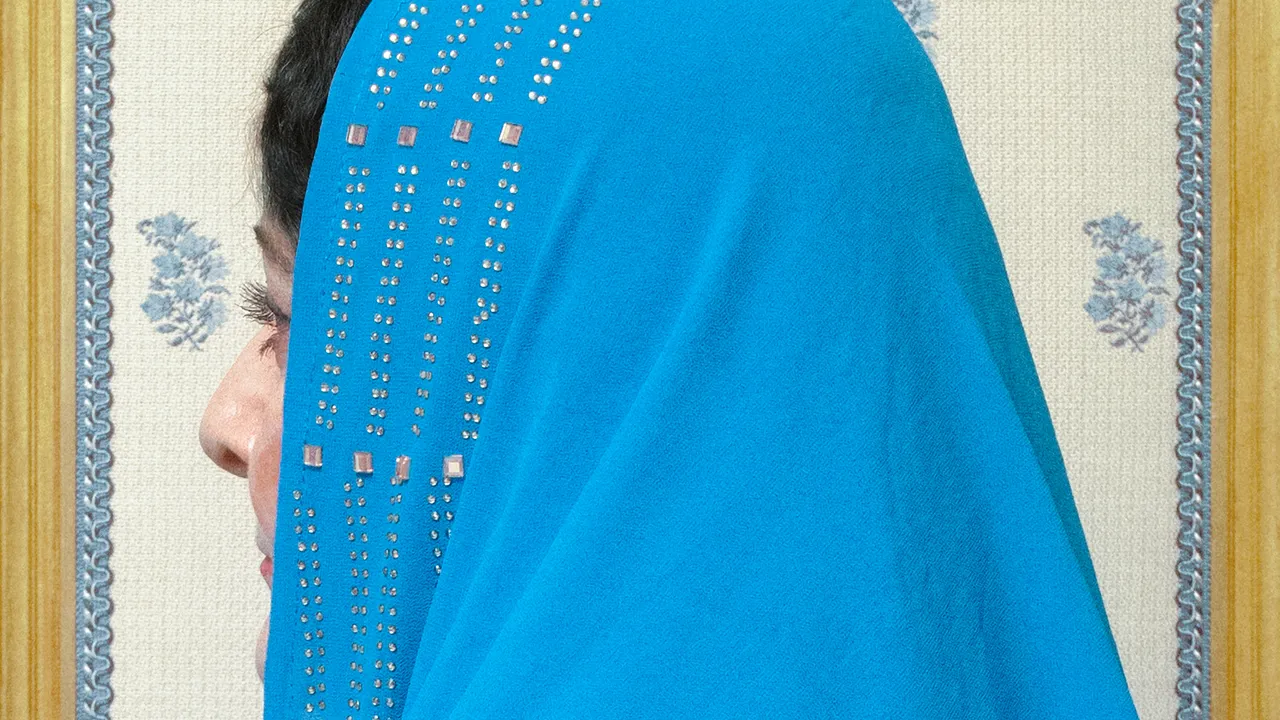
We were two hours late (but on time), and our husbands had been pacing since six, in the kitchen and in the living room and out on the porch, and, even as they drove, quietly fuming, past rivers or fields or stoplights, we noticed them pacing inside their own heads, back and forth and back and forth, half here, half there (in that other time), their eyes scanning street lights and road signs and cul-de-sacs and the salvaged Honda Civics parked in front of Marijan’s house, where, breathlessly, in our heels or slippers, we hiked up the driveway, through the garage, past the bathroom (already occupied), and into a living room immediately bustling with a dozen conversations at once. On the other side of the house, our men were already complaining—“Oh, well, you should see how much my wife . . .”—behind a golden curtain meant to partition us in case, we joked, we glanced their way and fell in love again.In the living room, we tiptoed over the plastic tubes for Bibi Rangeena’s oxygen tank and the Kandari girls all scrolling on their phones, huddled behind the worn sectional, which Marijan must have rearranged just for tonight, one end facing the TV above the fake fireplace while the other looked out onto a back garden that was more of a jungle, fruit trees and vegetable plots scattered about with no apparent logic, so that even the stone pathway led into a circle, like a trap, like an ambush on the village roads or in the alleyways back home.We said our salaams quickly, from a distance, or with much relish, cheek to cheek, beginning, of course, with the Bibi Hajjis, huddled in their corner of Marijan’s old sectional, reunited, finally, with Khala Helai, who, three months earlier, shortly after her husband’s death—poor Rasul had succumbed to lung cancer after a lifetime of scorching pizzas in an illegal coal oven—had suddenly up and left for Afghanistan. Her daughters claimed that she had gone to visit Rasul’s family, to pay her respects, but everyone knew, or soon learned, that Rasul had almost no family left in Afghanistan, just a second cousin or two, and that his nearest relation, a half sister stricken with Alzheimer’s, lived in Australia, of all places. We hovered near the bibis for longer than usual, questioning Helai, but every time we got her to say something about her trip one of the other bibis would interrupt to make some vague complaint about nothing, until, exasperated, we took our seats.By the fake fireplace, Ariana seesawed between Halima and Mastoora—who ran competing fabric shops in South Sacramento—asking how much they would pay for handsewn dresses brought wholesale from Kabul. “Fifty?” Ariana said to Halima. “Per dress? Fifty? As in five and zero? As in five times ten? Fifty? Halima Jan, I’m all for bargaining, but for the love of God let’s be serious here. . . .”Across from Ariana, Khala Gulapa and Mina were already pressed together in their matching Punjabi outfits, having become so inseparable in the wake of their husbands’ deaths that they had sold their homes and moved into a small apartment complex in Arden, which, apparently, had been overrun by new Afghan arrivals on Special Immigrant Visas, who gathered every evening to chatter like chickens deep into the night, reminding Mina of the good old days before their husbands died, before their children went away, before they had money and passports and houses so big you could hear your own thoughts bouncing off the walls. “It’s like they’re living out our lives again,” Mina said. “But they’re still in the good part.”Several seats over, Rafia, a recent arrival, was explaining to friends, “Our apartment is a fourth of the size. My husband works twice the hours. My eldest gives us all his paychecks. And we still can’t afford our rent, not really, because it goes up every six months on the dot, no matter how many cockroaches or shootings or gas leaks there are.”By the window overlooking the garden, Lawyer Muska offered free immigration advice (“The visa has more steps,” she said, “but the green card takes longer”), and Dr. Nasiri offered physical exams, pulling a stethoscope from her purse and shining her phone light in our ears, and Professor Kakar offered history lessons (“It’s stupidly simple,” she said. “Every terrible thing that has happened will happen again. The unimaginably rich will murder millions and die of old age, and the desperately poor will be ravaged by hunger and disease and secret police, and the rest of us will sit in our homes and drink green tea and try not to rot too quickly”).Meanwhile, nestled in their corner, our Bibi Hajjis offered up their miseries: Bibi Rangeena shackled to an oxygen tank in her downstairs bedroom, and Bibi Shirini on the phone listening to her sister slowly die in Peshawar, and Khala Helai dreaming of her husband, her first husband, who, we learned, had disappeared during the Soviet War.Khala Helai was the youngest of our bibis and had been reluctant, at first, to join the others. She preferred the company of youth—the newly married and the mothers. A Bay Area transplant, she’d been among us only a few years but had quickly become a favorite. She was one of those sprightly old women—still plucked her eyebrows and stayed up late for parties—who are incapable of aging gracefully. She always wore too much blush, folded a delicate white hijab over her jet-black hair, and talked constantly of anything, everything. And yet, to the best of our knowledge, Helai had never once mentioned her first husband.“We were married for two years before the war,” Khala Helai recounted, sort of abruptly, speaking over Bibi Shirini, who had been repeating the same story about her sister’s cancer diagnosis for so long that we could recite the first phone call by heart, “and we never had any children—thank God—but, of course, his mother blamed me for our childlessness. Called me barren and used up and all that. Years later—after I married Rasul and had Khatara and her brothers and they all turned out to be healthy and strong—I was so tempted to call my mother-in-law and give her an update. Some days, despite everything, I wanted to make up with her just so I could gloat.” She began to laugh but thought better of it and let Shirini finish her story.“And the whole time,” Bibi Shirini was saying, “she kept pulling the speaker away from her mouth, so she could gasp for breath, and I tried to hint at the fact that I knew she was not at home, that she didn’t need to hide her illness. But then I realized that maybe the pretending helped her, that maybe, while lying to me, she was lying to herself, and was able to forget, for even a few seconds, the state of her hopeless body.”In the kitchen, Marijan stirred and scooped rice with such focus that she hardly noticed us entering, and though she was still a handsome woman, she had lost the impossible grace of her youth, when we would doubt her age and the number of her children. Now, on her haunches, on the linoleum floor, she was sweating so profusely that we offered our salaams and our assistance, which she promptly refused, of course. Still, it wasn’t until her husband appeared, with a platter of teacups, muttering, “Burhan is going to be late again,” that we retreated into the living room and heard Khala Zarghoona being accosted by three of Kokogul’s eight daughters, who had gone up to her unprompted and asked, in English, what had happened to her face. Before Zarghoona could explain away the bruise sprouting beneath her right eye, Khwaga, a policewoman, offered to murder Zarghoona’s husband for cheap—which we thought was a joke at first, but, when a few of us chuckled awkwardly, Khwaga turned and asked what was so funny, and why shouldn’t she kill him, and how many more times could Zarghoona lie about the bruises and the broken bones before he hit her too hard or in the wrong spot?Fortunately, just then, Marijan entered the living room, with her hair smoothed down and her makeup reapplied, wearing a hand-stitched abaya from Mecca. She circled the room and greeted each of her guests again, beginning, of course, with the Bibi Hajjis, who had been arguing for a while about which one of them would have the most trouble staying alive until Ramadan. Bibi Rangeena claimed that she couldn’t take more than a few steps before she started gasping for air, as she had on the day that a Soviet bomb had buried her in a cocoon of rubble held together by such an impossible arrangement of dirt and wood and stone that Rangeena could not help but feel that God must love her, and that He had kept her alive for a reason, but Khala Helai argued that God having kept her alive was no sign of His favor, because God most esteemed those whom He returned to Himself through martyrdom, which was why she, after years of waiting for her first husband, years of watching the red iron gate through which he would return home, years of listening for his pattering knock at her bedroom door, had finally stopped praying for him to return and instead prayed to God that her first husband was dead, that he had died long ago (shot in a cell, perhaps, and buried in some mass grave), but Bibi Rangeena resented the suggestion that her survival had merely been a matter of chance and argued that she had experienced a bona-fide miracle in the perfect arrangement of the rubble that should have crushed her, and, although she seemed to have more to say, she was out of breath again. “In and hold and out,” Dr. Nasiri told her, pressing Bibi Rangeena’s wrist and counting her breaths. “Through your nose, yes, very good, and purse your lips for me, that’s right, as if you’re blowing out a candle.”“I’m looking for someone with incredible upper-body strength.”Cartoon by Sophie Lucido Johnson and Sammi SkolmoskiBy the fake fireplace, Ariana explained to Mastoora that all her dresses were handsewn by young widows in Kabul, who had been mending clothes for pennies since they were children. “They call me Mother,” she said, “and I give them half the profit from every sale.”“Why half?” Mastoora asked (as in, we thought, Why only half).“Why not?” Ariana replied. “I like to spoil my girls.”“Every other day,” Rafia was still complaining to her friends, “I leave two of my kids with one neighbor and the other two with a different neighbor, and I take the bus to wash dishes for six hours at Mahdia’s, who docks my check for every plate I break, even though the busboys stack dishes so high that it’s practically impossible not to topple them.”“I actually used to work in a garment factory,” Khala Helai told the other bibis. “The Khalqi got me the job in Kabul after I fled Logar. For three years, I lived in a tiny, run-down apartment subsidized by some Communist women’s program, and, even though two of my roommates had also been widowed by KhAD, we all told the program organizers that our husbands (faithful Communists!) had been killed in mujahideen car bombings or ambushes, and so, as honorable widows, we were granted housing and employment and baggy gray outfits stinking of turpentine. We spent seven-hour days mending the uniforms of dead soldiers, and that left us with so much free time in the evenings that I joined a women’s embroidery club. At first, I would ask the other women if they had any idea what had happened to our men, but even those with abducted brothers or fathers or husbands always replied—”“God, where’s the food?” Bibi Rangeena interrupted, and we were so hungry by then that we couldn’t fault her. In fact, we carried her question along from guest to guest, from couch to kitchen, until it reached Marijan, who tiptoed past the Kandari girls (who were still scrolling on their phones, not even texting or posting, just watching thirty-second clips of car crashes and makeup tutorials and Israeli snipers shooting Palestinian children, on mute) and told Rangeena that the food was ready but that they were still waiting on Sheikh Burhan.“Call his wife,” Bibi Rangeena said.“I don’t think his wife is coming,” Marijan replied.“Of course Marena is coming,” Bibi Rangeena said. “That woman lives for free food.”But half an hour later, when Burhan arrived, with an uninvited entourage of former Taliban and translators and convicts and Communists and mujahideen guerrillas, we realized that he really had left Marena at home, that he’d punished her—or us—for spreading the news about him taking a second wife in Karachi.“How many are with him?” Marijan shouted from the kitchen, already tearing off her good hijab, and, after we told her that there were nine, maybe ten, new guests, her face filled with such grief that a few of us joined her by the kitchen counter, where, without waiting for permission, we redistributed the chicken and the kebabs to feed the extra men, but, still short, Marijan called for her husband—once, twice, three or four times—“Husband, I need you, husband!”When he finally burst into the kitchen, red-faced and furious, he pulled Marijan aside and mumbled a few stale phrases about respect and dignity and very quickly worked himself up into a fervor, lecturing louder and louder, until, to prove some point he hadn’t made, he recalled for Marijan their wedding day, when, on her way to the bridal stage, she’d collapsed to the floor and sobbed so wretchedly that he’d nearly called the whole thing off, and would have, had it not been for his soon-to-be mother-in-law, who, after a few minutes of consoling her daughter, pulled him aside and explained that, when Marijan was eight years old, she had got into a terrible rock fight with her neighbor in Logar, a little girl named Somya, which had left both of them bloodied and bruised and wishing death upon the other, but, when Death really came, in the night, nestled in the belly of a Soviet bomber, Marijan woke up to find that Somya’s entire compound had been demolished, and, in the haze of the lamplights floating back and forth across the wreckage, she watched as Somya’s body was pulled from the rubble by a skinny teen-ager she hadn’t recognized until, a whole decade later, she’d found that same boy, worn and bearded and lathered in white flowers, standing on her bridal stage.But, before he had a chance to explain why he was telling this story, how it related to Marijan’s current predicament with the food, the doorbell chirped again, calling him back to the men’s side of the khatam.In the end, Marijan didn’t eat. After the men got their share, we tried our best to save Marijan and her daughters a plate or two, but she caught on to our plans and wound up redistributing her food to the Bibi Hajjis. Rangeena took her chicken. Shirini accepted shola. But Helai refused a second helping of spinach (which was all she had eaten) and assured Marijan that there was nothing to be ashamed of.“We ran out of food at my own wedding,” Khala Helai recalled from the couch, her plate on a tray table. “You see, my father had been offered such a large dowry by my first husband’s family—after he had denied them six or seven times in a row—that he felt compelled to accept, but, in punishment for their having ‘strong-armed’ him, my father bled my in-laws dry, demanding gold and livestock and extravagant dresses for all my aunts and cousins. He invited so many guests to the wedding that my in-laws had to slaughter ten sheep and three steers and a hundred and fifty chickens. But, even then, as the courtyard kept overflowing with new neighbors and distant relatives, food began to dwindle, and the more it dwindled the more panicked everyone became. Our guests started shoving in line, and suddenly my wedding had turned into a brawl, and I remember crying and crying,” she said, laughing and laughing. “But now it seems so funny, because when the brawl got really bad and reached my husband and me in our arbor, he pushed away anyone who came near us, until someone knocked him in the mouth, and he fell backward into my arms, and when he saw that he’d bled onto my dress he apologized, and it was his apology, as much as anything, that made me realize that I would be one of those lucky girls everyone hates because she has what everyone wants, and I was one of those girls—for a few years and a few months, until God disappeared my husband, and my brother-in-law started coming by my room after dark, intending to force me into marrying him, but, bless her soul, every night my mother-in-law, Bubugul, would sleep by my side to protect me, her son’s wife. You see, she never believed that he was dead. And, even years after he disappeared, a decade, nearly, when she learned of my engagement to Rasul, she told me to my face that her son was still alive, and that I was committing adultery by remarrying, and that my life would be cursed by God. But, you know, the funny thing is . . . my life has gone relatively well since the day Bubugul cursed me. My second husband was a good man, a hard worker, and a loving father, and none of my children have died or gone mad . . . and so I can’t help but think that my mother-in-law was wrong about her son, that he had died long before, and that her faith in his life was . . .”—and here Khala Helai raised a hand to her lips, as the rest of us just stared, hardly eating, until she continued, not looking at anyone—“On the night of my first wedding, I remember I was so afraid of the act of consummation, I stumbled on my great skirt while climbing the stairs to my husband’s bedroom, and I tore my dress and wept shamelessly, because I thought these were such bad omens for our marriage, and even the wildflowers he had scattered on our bed made me break out in hives, so that my poor husband had to rush out into the night to find me an ointment, and by the time he returned I was such a mess of snot and tears that he let me sleep in his bed on my own, and in the morning, at fajr, I found him writing at his desk by the window, and he looked so focussed, so immersed in his poems, that I went to distract him, and the whole time, through his little window, I could see his brothers and sisters in the courtyard, I could see their red iron gate and a dirt road leading away from the red iron gate, I could see a donkey-drawn cart stacked with dead fish, I could see songbirds flittering from the trees to our window, and I could see his mother, Bubugul, kneeling in the tanoor khana, with all this smoke billowing up around her, as she muttered prayers or incantations and tossed God knows what into the fire. Maybe my hair.” We laughed, startling her for a moment, but she kept going. “From then on, I spent more time with Bubugul than I did with my husband, who woke up every fajr for the long bus ride to Kabul and returned only after Maghrib, his corduroy suit and tie stinking of the city, but even when he was home Bubugul would invent some task to keep me away from her son, and I used to tease my husband that, if it wasn’t a sin, his mother would’ve just married him herself, and he would laugh a little but then get quiet and say, ‘She has suffered very much in life, and I am the only one who treats her well,’ which was true, to be honest, because her husband was taking a second wife, and her other sons were strange, heartless men, and her daughters were all dying to leave her. Whereas my husband would bring her fruits or flowers from Kabul, or he would escort her to the clinic when she complained of fatigue, or he would rub her feet at night before I asked him to stop, and I knew she knew it was me who stopped him, because one day, out of the blue, she told me that Heaven lies beneath a mother’s feet, and that no one, that nothing, could come between them, and I realize now that she always doubted my love, and that the news of my second marriage must have been like a confirmation of all her doubts, and as upset as she was she must also have been, secretly, satisfied. . . . But what could she say to me now? In death, what doesn’t she know? Fifty years and I dream of him still, fifty years and every story, every joke, every bit of news or gossip leads back to him still. But the funny thing is . . . as much as I think of him, I think of her, and, now that I’m approaching the age she was when we parted, I remember the fights we had in those days, and I find myself siding with her more and more, and I try to resist it, and I try to keep hating her, but it’s been so long I can hardly feel the pain of those years anymore, and it distresses me, you know, because I think, How is it that, after all these years, God makes it so that—on top of everything else—I must long for the pain of another time? How is it that, even now, near the end, God finds new ways to surprise me with His miseries?”Toward the end of the khatam, after eating and praying and rising for our last goodbyes, a few of us caught up with Khala Helai on the front lawn, where, while sitting on her walker, atop a bed of wet grass, mist clouding her bare feet, she waited for her daughter. “She’s already on her way,” she said when we offered a ride. Three or four times, Marijan urged her to come back out of the cold, but Helai insisted on taking in the cool night air. So we waited with her, and, as a reward, maybe, for waiting, she told us about her trip to Kabul.It happened that, during Rasul’s funeral, Khala Helai had run into her first husband’s youngest sister, who had arrived in the U.S. shortly after the fall of Kabul and, only a week prior, had learned that Helai lived so close by. They chatted for a few minutes in the graveyard, as the guests were all flocking to Burhan’s mosque for the fatiha, and Helai learned then that Bubugul was still alive, that she lived with her son at the Macroyan apartments in Kabul, and that she had been asking about Helai for years.Cartoon by Ellis RosenA month or so later, as soon as guests had stopped visiting every other day to offer food and prayers, Helai booked a flight to Kabul, without telling her children, and, when she got to the Macroyan apartments, she spent an entire day wandering through shops and courtyards, asking strangers for directions, until, near Asr, she found Bubugul’s own granddaughter coming home from school.It turned out that Bubugul now lived with the same son who had attempted to rape Khala Helai all those years ago. He was the only one of her husband’s brothers who was still alive. His youngest daughter, a thirteen-year-old chatterbox named Saba, led Khala Helai through the old, Soviet apartment block, asking a hundred questions about her past life.“We keep a photo of Uncle in the prayer room,” Saba said, guiding Helai up the stairway to their apartment. “I’ve heard so many stories about Uncle, I feel like I know him. Everyone says he was very smart and very kind, with hardly an enemy in the world. Father mourns him to this day.”Helai stopped just short of the apartment door—red iron, just like in Logar—and, while Saba fumbled with her keys, she said, “You know, after my husband disappeared, your grandmother slept by my side every night for a year.”“You two must have been very close,” Saba said.“Not at all,” Helai replied. “We hated each other.”Inside the apartment, Khala Helai found her old mother-in-law lying in a pitch-dark room with the Quran playing on tape. An oxygen tank thrummed in some corner, and, although Bubugul had gone blind years ago, as soon as Helai walked in and closed the door behind her, she called out, “Is that you, Helai?,” and, after hearing her voice and touching her face, Bubugul told Helai to come close and whispered, “You know, Helai, it’s not fair. Whenever my son, your husband, comes to visit me, all he asks about is you, and, even after I explained to him that you had not been faithful, that you had remarried, that you’d run off to America with another man, he wasn’t upset. Just curious. He had all these questions about your new life. Your home. The names of your children. Your second husband. Your daily routines. Even the color of your hair. But it had been so long since you and I had spoken, and we had parted on such bad terms, I didn’t know what to say to him.”And so, in the dark, the twice-widowed Khala Helai spent the rest of the night answering her husband’s questions.On our way home, driving along empty highways or back roads, our husbands recounted for us the unexpected arrival of Engineer Fahim, who had shown up to the khatam uninvited, started a few fights for nothing, but then ended the evening with a dua so beautiful that it had almost restored in them their lost faith in God. But the whole time they spoke to us—excitedly, urgently, more to themselves or to the dark roads sprawled out in front of them—we could hardly focus because of Khala Helai, and when they had finished telling us about Fahim they fell quiet, waiting for us, we knew, to trade stories, to explain what had happened to Helai, why she had fled and then returned. A few of us didn’t say a word, while others tried once or twice to explain, and some spent the entire car ride failing to retell Helai’s story, and, at home, in bed, while our husbands slept or pretended to sleep, their eyelids twitching, their fingers perpetually curled, we thought back to Helai sitting in the wet grass, a cloud of mist hovering by her feet, then rising, throughout her story, rising, until it was as if she were vanishing right there in front of us, and yet we all stayed at a distance from her, and, even as her story neared its end, as she recalled the dark room in Macroyan, the word of God on tape, the ghost of her husband speaking through his mother, we felt more and more apart, not just from her but from ourselves, our own bodies on the grass (and in bed that night), and the souls within these bodies, which, we had once been told, belonged only to us. ♦
“The Twice-Widowed Khala Helai,” by Jamil Jan Kochai
Fifty years and I dream of him still, fifty years and every story, every joke, every bit of news or gossip leads back to him still.
4,605 words~21 min read