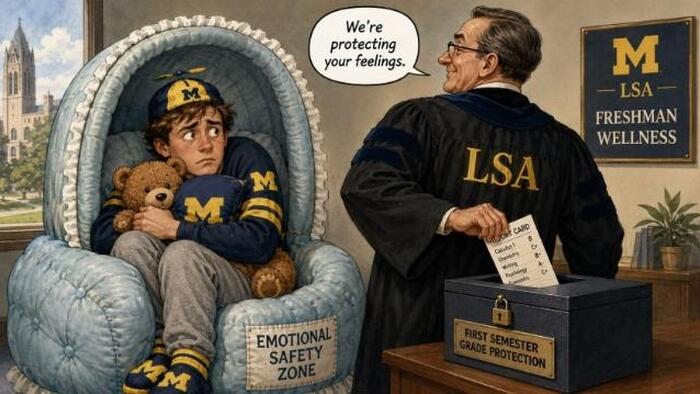
One of my high school senior clients — dressed like she was heading to a party — knelt in the middle of her carefully staged bed, every inch covered in University of Michigan merchandise. It looked like the M Den had exploded in her bedroom. She was pretending to drink from a champagne bottle bedazzled in blue and maize, surrounded by so many Michigan-branded sneakers, sweatshirts, hats, pillows, blankets, posters and stuffed animals that the gear spilled onto her walls and nightstands.A screenshot of the scene captures what college admissions looks like in 2026.This particular version of the college choice reveal — known as a “bed party” — has become a familiar part of admissions season. It’s one of many carefully curated announcements, from reaction videos (which I enjoy receiving from clients) to commitment posts on high schools’ unofficial Instagram accounts. Sharing good news is fun, and it’s important to celebrate milestones with friends and family. But it almost feels like the pomp and circumstance is driving decision-making rather than how well the four-year experience will fit each student’s needs. It’s like choosing a spouse based on how they’ll show up in the engagement photos.To some extent, college admissions have always been about status. Yet, concern about what bumper sticker adorns the family car has moved to a much grander scale. Though the 2010s were not so long ago, the previous decade feels almost quaint now. Back then, close friends knew your post-secondary plans. Most people didn’t. And that was fine. The hype was largely confined to a single day. People noticed what shirt you wore to school on May 1 (National College Decision Day) — and forgot about it on May 2.So, what changed? Perhaps the pandemic is responsible for fueling the frenzy — at least in part.In the days of social distancing, social media stepped in to fill the gap. The spring of 2020 is when my own kids’ high school stopped publishing its printed map showing the post-secondary plans of the entire senior class. It was fun to look at that map and see where students were headed — once they had quietly chosen. Now, every part of the decision is on full display throughout senior year. In many ways, college announcement events still feel like harmless fun — they’re basically the school newspaper map with better lighting.But there’s a critical difference: the newspaper was announcing a decision. Today’s reveals are shaping them.Students now spend their entire senior year anticipating these performative moments, and increasingly, that performance doesn’t just follow the decision — it influences it.I’ve had students hesitate to accept a waitlist spot or later acceptance because they’ve already posted that they’re attending another school. Others are reluctant to share early-decision acceptances in December because they worry it will look like they took the “easy” way out.Students aren’t just choosing where to go — they’re choosing what that choice will say about them.In this environment, it’s not surprising that smaller, lesser-known colleges are struggling to stay afloat. There are many factors — demographics, finances, enrollment trends — that have led to the demise of schools like Hampshire College, among the most recent to announce its permanent closure. But perception undoubtedly plays a role as well. My team and I work with students every year who won’t consider schools they haven’t “heard of” or that don’t have big sports programs or a recognizable name. Colleges without a clear “vibe,” or one that translates easily online, often don’t make students’ lists at all.The genie isn’t going back in the bottle. We live in an age in which key life milestones are increasingly staged for public consumption, from elaborately staged marriage proposals to over-the-top baby showers.But the glorification of college admissions is particularly problematic because it involves teenagers whose frontal lobes are still developing and who are biologically wired to care about their image. They are facing one of the first major decisions of their lives — one that will shape four formative years. Rather than focusing on which colleges are the best academic, social and financial fits, students are increasingly filtering their decisions through the lens of image: recognition, perception and brand.Again, there’s nothing inherently wrong with celebrating meaningful milestones. But it’s worth examining what happens when the emphasis shifts from the experience itself to how it’s packaged for public consumption.The big reveals are fun, but they’re also fleeting. The concern is what happens when the decorations come down and the Instagram post gets pushed deeper into the feed.Students still have to show up on campus in the fall. They have to live there, learn there, and build a life there over four years. And it’s not always seamless. They might find a class particularly challenging, face a difficult living situation, or struggle socially. Learning to navigate those moments independently is a critical part of the college experience.While our celebratory culture is here to stay, parents choose how they mark these milestones. Around the same time I received the screenshot from my newly minted Wolverine, I got one from another student bound for cross-state rival Michigan State. The excited new Spartan stood in her living room wearing a green-and-white T-shirt with a bouquet of green-and-white balloons in one hand and a decorated cookie cake in the other. Despite her comparatively understated celebration, she seemed just as proud as her Wolverine counterpart.High schools, too, could try to retake some control over the messaging. While they probably can’t fully police student-run Instagram accounts, they could standardize how and when decisions are shared. It may be unrealistic to expect schools to bring back printed newspapers, but part of the value was that everyone’s decision was announced at the same time.Students aren’t just choosing a college. They’re choosing where they’ll live, learn, and grow.That decision deserves more weight than the moment used to announce it.Beth Kraemer leads in College Consulting (iCC), where she and her team advise students and families navigating college admissions. Writing about the college admissions process and its real-world impact brings her back to her undergraduate days at Northwestern’s Medill School of Journalism. Her work has appeared in The Chronicle of Higher Education.Do you have a compelling personal story you’d like to see published on HuffPost? Find out what we’re looking for here and send us a pitch at pitch@huffpost.com.
I Work With High School Seniors Applying To College. This New Trend Is Taking Over And It Concerns Me.
"Students now spend their entire senior year anticipating these performative moments, and increasingly, that performance doesn’t just follow the decision — it influences it."
1,051 words~5 min read