The ‘Big River’ captured Mark Twain’s imagination. Now it serves as a tourist destination, a superhighway for commerce and a battlefield in the fight against invasive Asian carp.Show Caption
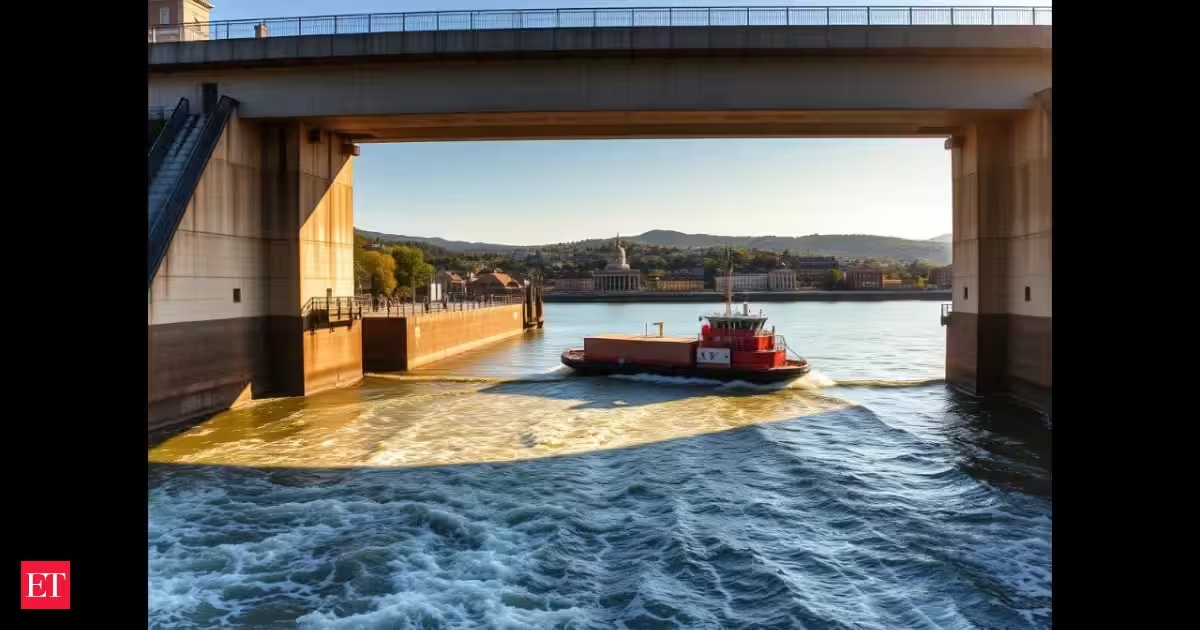
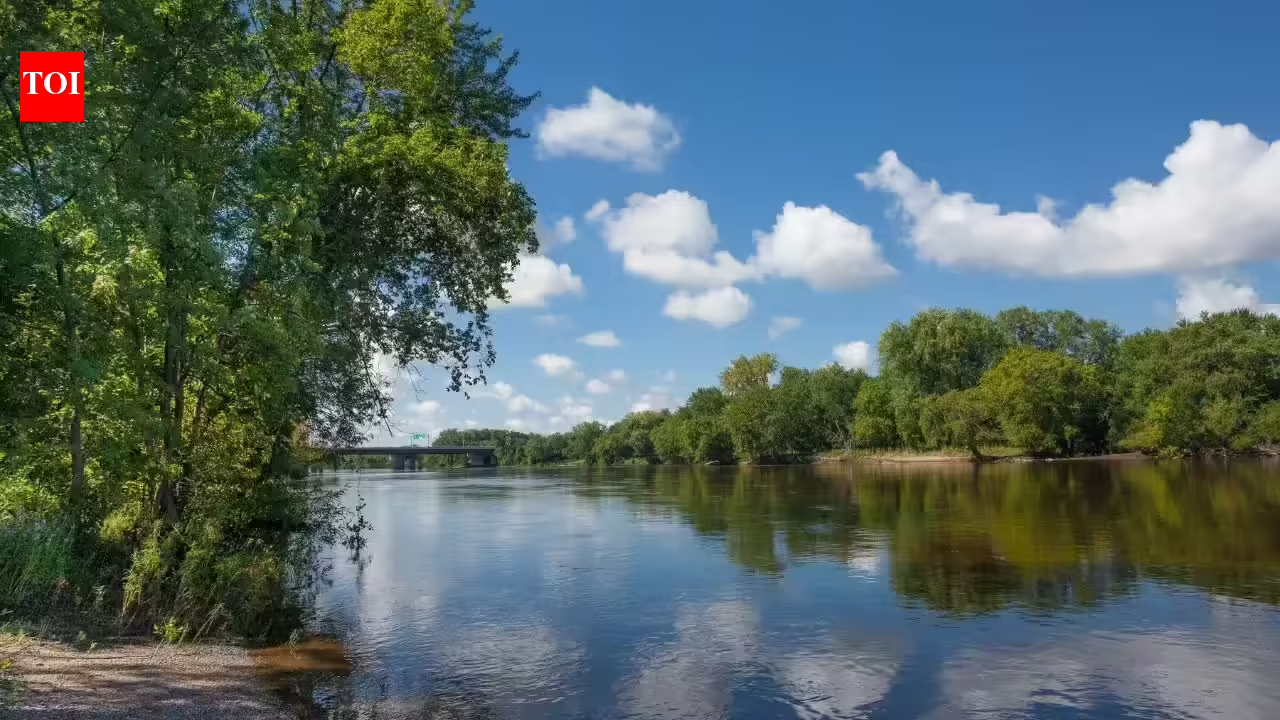
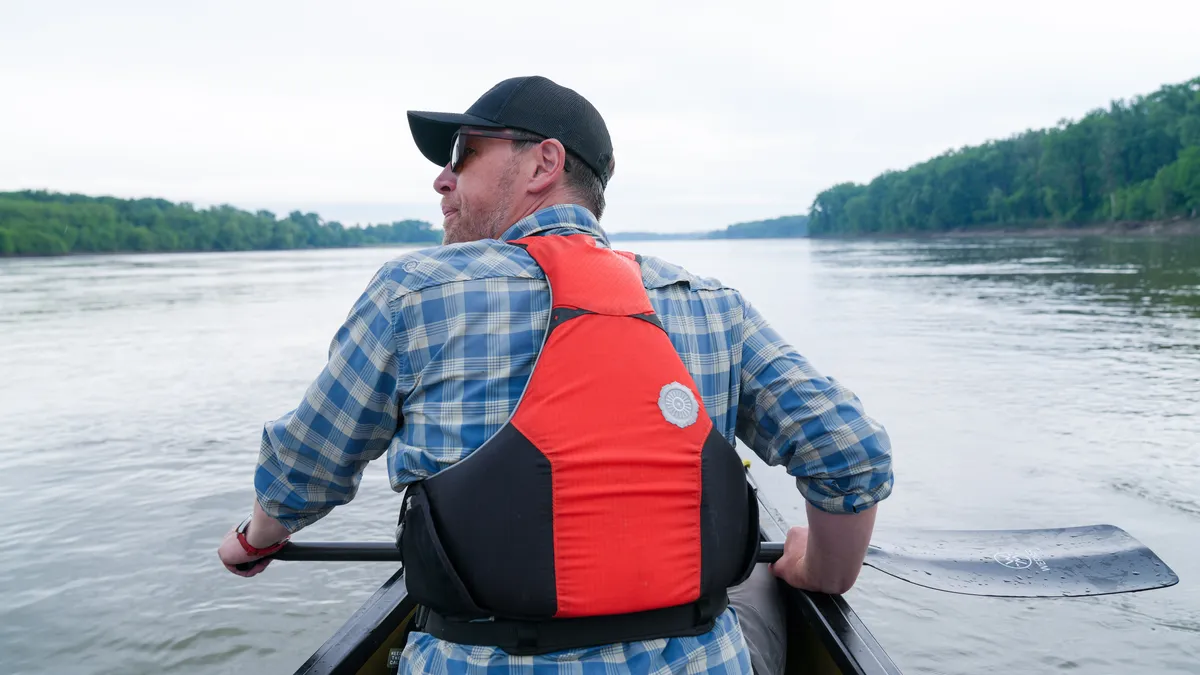
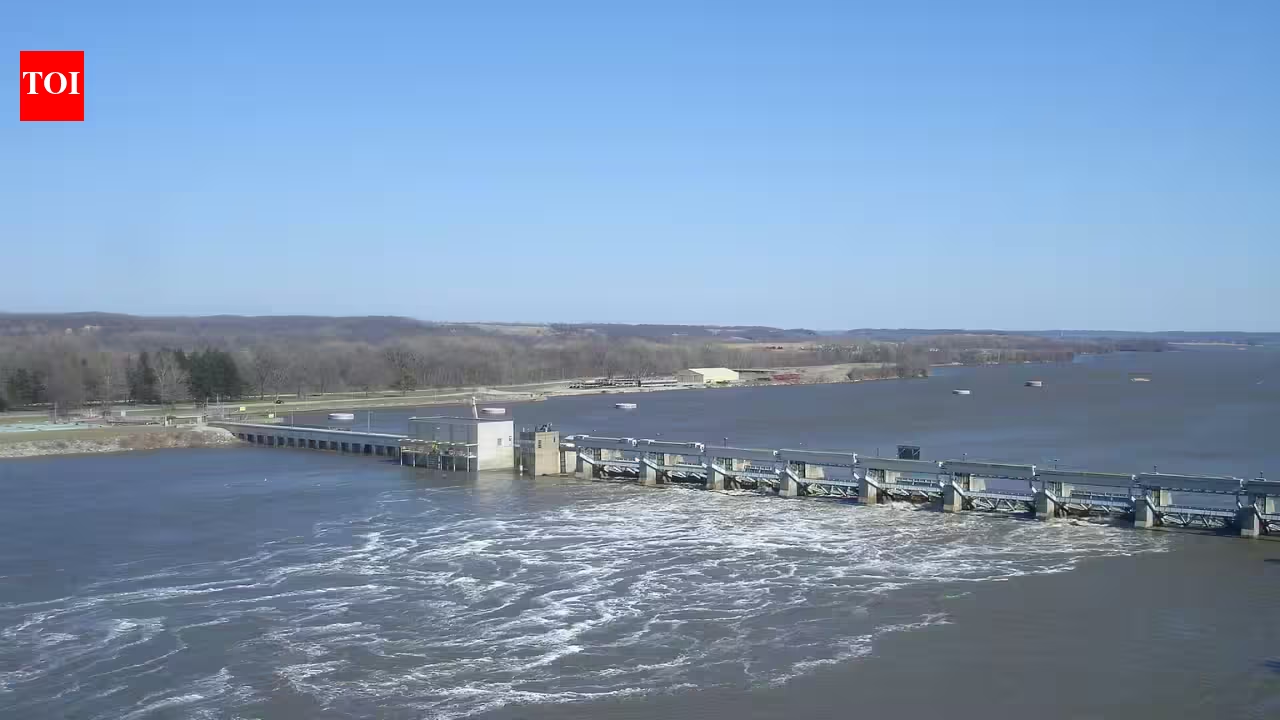
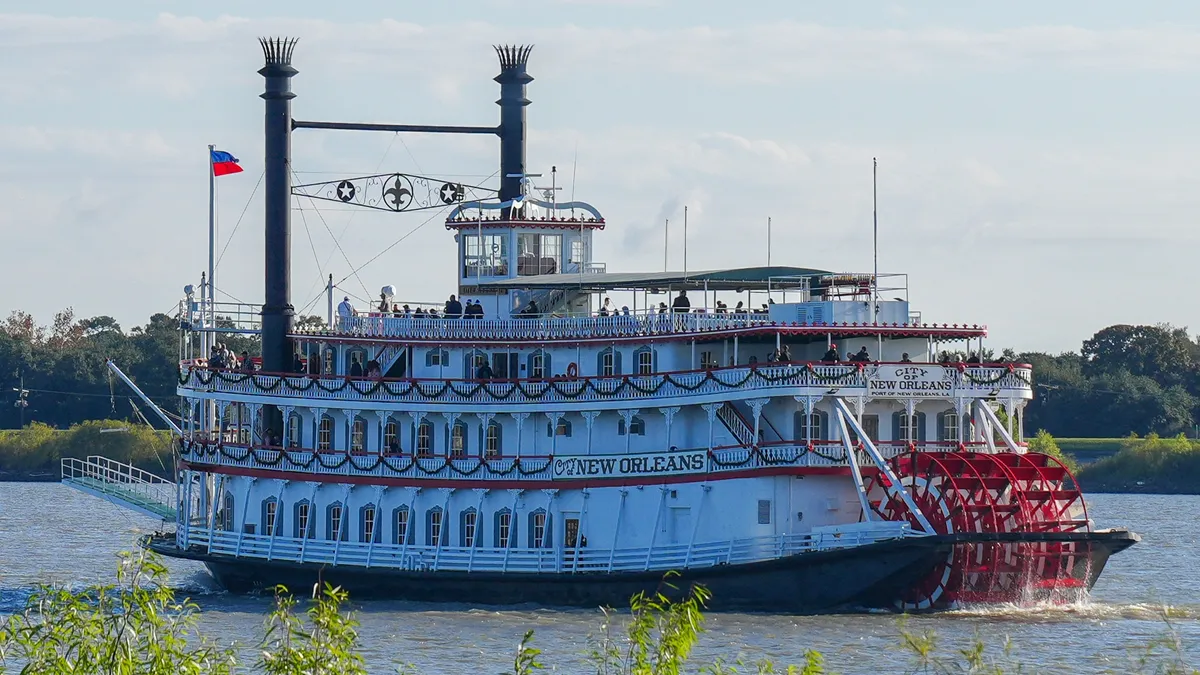
HANNIBAL, MO – From his wheelhouse 25 feet above the water, Capt. Steve Terry has watched the muddy Mississippi River roll beneath the flat bottom of his riverboat Mark Twain for nearly 50 years.He's watched it through floods and droughts. Seen how trade deals alter the flow of barges downstream, and how international conflicts alter fertilizer shipments coming back up, including during the war with Iran. Been there as communities have tried to tame the mighty waters with levees and embankments, and battled 100-pound invasive fish. Watched the ebb and flow of tourists, including those who come to pay homage to Samuel Clemens, the writer better known as Mark Twain.Terry still loves every second of the days he spends on the river aboard his 350-passenger boat, which resembles one of the steam-powered paddle wheelers Clemens once piloted along the river."Once it’s in your system, it's kind of hard to get it out," he said as the Mississippi rolled past.To mark the 250th anniversary of the United States, USA TODAY dispatched reporters to follow iconic American journeys and retrace pathways that helped define us as a country and a people. Some are happy. Some are tragic. But all are part of what has shaped the United States.Aboard his 120-foot-long riverboat, Terry is among those who've shaped the country, even as he himself has been shaped by the Mississippi. His decades on the river mean tens of thousands of schoolchildren have heard his stories – kids who now bring their own children aboard."I love running the boat. I love telling the stories," he said. "Sam Clemens and I are alike in many ways. He likes to tell stories. I like to tell stories. And somebody’s gotta tell stories. It’s important."A travel route, a border, a superhighway for commerceFlowing roughly 2,350 miles from its start in Lake Itasca, Minnesota, into the Gulf of America in Louisiana, the Mississippi River borders 10 states and drains an area stretching from western New York to most of Wyoming.Before colonization, Native Americans called it the "Misi-ziibi," which means "Big River" or "Father of Waters," according to the Louisiana-based Great River Road Museum. Near modern-day St. Louis, the Cahokia Mounds reflect the river's importance for more than a millennium: At its height of power around 1100, the settlement was home to about 20,000 people – bigger than London at the time, according to Illinois state officials.As Europeans moved into what would become the United States, they moved up and down the river. In 1539, Spanish conquistador Hernando de Soto led an expedition from Florida that reached the river several bloody years later. A century later, France claimed the region in the name of King Louis XIV.Spain briefly took control of the river, then gave it back to the French, who sold the river and its key port city of New Orleans to the newly formed United States as part of the 1803 Louisiana Purchase.At the time, the river generally marked the western boundary of the United States, although the 1795 Treaty of San Lorenzo had previously guaranteed the rights of Americans to use the river. Neither the French nor the Spanish ever invested significantly in colonizing the land west of the upper Mississippi, and Americans were champing at the bit.The British, however, had not given up their claims on the rapidly growing United States, and in late 1814 launched an attack on New Orleans, hoping to control both the port and its control of the Mississippi River traffic. American forces defeated the British in January 1815 at the Battle of New Orleans, which was fought in part with gunboats on the Mississippi River."We think of today the Mississippi River being in the middle of the country. But for a long period, especially around the time of the American Revolution, it really was the borderland," said Sean Rost, the assistant director of research for the State Historical Society of Missouri.After the 1815 fight with the British in New Orleans, U.S. control of the river was never again in question – opening up a vast portion of the country for colonization, shipping and travel. As cargo and giant rafts of lumber flowed downstream on the Mississippi's current, newly invented paddle wheelers carried hundreds of thousands of immigrants upstream from New Orleans to settle the Midwest.Call out 'Mark Twain'There is perhaps no one person more closely associated with the Mississippi River than Mark Twain, the pen name of Samuel Clemens. Born in 1835 in what was then still the new state of Missouri, about 30 miles west of the river, Clemens was raised in Hannibal and set some of his best-known stories there.But before he became famous for writing "The Adventures of Tom Sawyer" and "Adventures of Huckleberry Finn," among others, it was the Mississippi River's constantly changing course that shaped Clemens.Unlike those of many other rivers, the Mississippi's course changes constantly as flowing water from spring rains and summer storms reshapes the banks and muddy islands. It used to change more dramatically before federal engineers began restricting its flow.A little more than 20 years before Clemens' birth, steam-powered paddle wheelers had begun plying the river, fundamentally altering commerce. No longer did the majority of goods flow downstream on the current – now ships could haul cargo up from New Orleans or St. Louis. Clemens served as a steamship pilot for several years, navigating boats along 1,200 twisting, meandering miles.During that time, steamships also carried enslaved people south down the river to work on plantations, a practice that's credited with giving rise to the betrayal phrase "sold down the river." During those times, enslaved people risked their lives to swim across the Mississippi, seeking freedom in western states where slavery was illegal or not practiced. Thousands of enslaved people also worked on steamships until the Civil War.Clemens took the pen name Mark Twain to reflect his time on the river. Crew members measuring the depth of the river would take what are known as soundings in 6-foot increments called fathoms. To "mark twain" meant to measure two fathoms, or safely deep water.And if Mark Twain is eternally linked to the Mississippi River, it's Twain impersonator Jim Waddell who is eternally linked to Clemens – at least around Hannibal. Like boat captain Terry, Waddell has spent decades entertaining, enlightening and engaging tourists and locals alike, drawing upon Clemens' writing for his one-man shows.Waddell spends most summer days inhabiting Clemens' mind, mannerisms and white suit as he performs at the very cave complex where Clemens set one of Tom Sawyer's biggest adventures. From there, it's just a short walk to the river's edge, where two other of Twain's best-known characters – Huck Finn and his friend Jim, an enslaved man – fled aboard a raft and floating house torn loose by a flood."In many ways, the Mississippi River was one of my professors in terms of literature," said Waddell, speaking in his Twain persona. "I had to start keeping notebooks and writing descriptions of the river, 1,200 miles of it back and forth. And I did that for years. So in a lot of ways, the river taught me how to be an author. It taught me how to capture the appearance of something on a page."In "Adventures of Huckleberry Finn," Huck and Jim journey downriver in hopes of reaching Illinois, where slavery was illegal. Huck was fleeing his abusive alcoholic father, and Jim was seeking freedom. At the time the book was set, slavery was legal in many Southern states.When the South seceded from the United States in order to maintain slavery as a legal practice, Clemens left behind Hannibal and the steamships. But he never left behind the river."The river's like an old friend, you know?" said Waddell, speaking again as Twain. "In some ways, you take an old friend for granted, but if you're not around them, they're sorely missed. So it's always comforting to have the river there. And it's different every day."Feats of engineering now shape the riverWhile Clemens would have recognized the cargo barges that today plow up and down the river, he would likely be astounded by the sheer volume and diversity. Barges on the Mississippi River move more than 700 million tons of commodities annually, according to the U.S. Army Corps of Engineers. A single 15-barge "tow" can move as much as 1,050 semitrailers.Clemens might also be staggered by the feats of civil engineering that keep the river open for navigation: Above St. Louis, 29 locks and dams control the river's flow.According to the National Park Service, 92% of the nation's agricultural exports are produced in the Mississippi River Basin, from Kansas wheat to Iowa corn and Illinois soybeans, along with beef, pork and chicken. Oil and coal head up from Texas, Louisiana, Illinois and western Kentucky to power Midwestern industry and homes."In an era before cars and planes and trains, the ability to traverse those rivers made it the first major superhighway of the United States, and even before that in colonial times," said Rost, the historian.It's no exaggeration to say the Mississippi literally shaped the United States, from marking the country's boundary in colonial times to creating the vast fertile farmlands of the Midwest. It also helped shape the government itself, said Samuel Muñoz, a geoscientist and associate professor at Northeastern University in Boston.In spring 1927, following months of wet weather, the Mississippi burst its banks during a series of intense rainstorms. Although levees had previously limited flooding, the river overtopped them and inundated vast portions of the basin. An estimated 1% of the population of the entire country was flooded out of their homes, and likely more than 500 people died, according to historians.The man appointed to run recovery efforts – then-Commerce Secretary Herbert Hoover – rode his newfound fame into the White House. The flooding also prompted Congress to charge the U.S. Army Corps of Engineers with building a comprehensive system of locks, dams, reservoirs and levees to protect Americans from another catastrophic flood.Muñoz, who studies how geology and geography shape societies, has been investigating how climate change will alter the Mississippi River over the coming decades. Predictions suggest an overall increase in water flowing downstream, which has implications for flooding, sediment flows and even drinking water in New Orleans. Because the locks and dams have slowed water flows, especially in dry years, saltwater from the Gulf of America has been creeping upstream along the riverbed, threatening to contaminate New Orleans' water.But higher flows also raise questions about the river's path through Louisiana. Lower flows mean less sediment flushing downstream, accelerating the sinking of the Louisiana delta.Muñoz said he doesn't envy the Army Corps of Engineers, which must balance significant competing needs, from flood protection and navigability to saltwater intrusion and invasive Asian carp, which have been slowly expanding their upstream range. President Donald Trump has also grown concerned about the possibility carp will migrate from the Mississippi River into the Great Lakes, posting on social media about the "rather violent and destructive" fish.The carp have already shifted Mississippi River ecosystems by crowding out native fish, devastating some areas. Muñoz said the carp are just one challenge facing the river."It's such a vital component of the country because it connects this agricultural heartland to the rest of the country and the world," Muñoz said. "Today, people drive over it, they fly over it, and they don't appreciate how important it is for the economy and the entire country. It's vital but underappreciated."Childhood memories made aboard the Mark TwainOn a recent spring morning, Donna and Bill Ryan marked their 43rd wedding anniversary with a riverfront stroll in Hannibal. The couple are farmers who live a few miles inland but decided the fields were still too wet to work and took a rare day off to visit town.Walking along the river, Donna Ryan, 64, watched as the Mark Twain boat pulled away from the dock, pushing upstream against the current. She reminisced aloud about how they'd taken their kids on a school trip aboard the boat, with the same Capt. Terry at the wheel.Behind her loomed 34-foot-high floodwalls installed 30 years ago to help protect downtown Hannibal from spring flooding.Bill Ryan said his father grew up on the river's banks near Hannibal, loading the hogs and cattle they'd raised onto cargo barges. But after deploying during World War II, Ryan's father returned to Missouri and declared he never wanted to deal with another spring flood, likely a reference to the devastating 1937 flood that killed an estimated 350 people.At Hannibal, the river is about 2,200 feet wide, although the flood-protection barriers hint at how much bigger the river grows during floods.A year after their wedding, Donna Ryan recalled, they traveled far upstream to visit the headwaters of the Mississippi on a fishing trip. There, near Lake Itasca, Minnesota, they gleefully stepped back and forth across the tiny stream that would eventually grow to become the river they know so well."That was the amazing part for us," Donna Ryan said. "You could just step across it, and it was clear. Now look at it here – so big and wide and muddy."The river still has stories to tellAboard the Mark Twain, Terry watched as his young crew members prepared to cast off lines for their daily sightseeing trip both up- and downstream from Hannibal. Long gone are the steam-powered paddle wheels that once powered this kind of boat; the Twain has a diesel engine and a traditional propeller system, although it draws only 5 feet of water beneath its hull.Terry, a self-proclaimed river rat, said he can tell how American soybean farmers are doing based purely on the number of grain barges motoring downstream: More barges mean profits for his fellow Americans. Fewer barges, as has been the case recently, reflect China's decision to buy soybeans elsewhere. Corn exports reflect demand for ethanol. More recently, the war with Iran has dramatically raised the prices of fertilizer and diesel fuel paid by American farmers. And Trump's social media post has brought new focus on the invasive carp.Aboard the boat, Terry regales his passengers with tales of the river, from namesake Twain to tragic Lovers' Leap just downstream of Hannibal. After nearly 50 years on the river, Terry said he still has stories to tell – and so does the river.