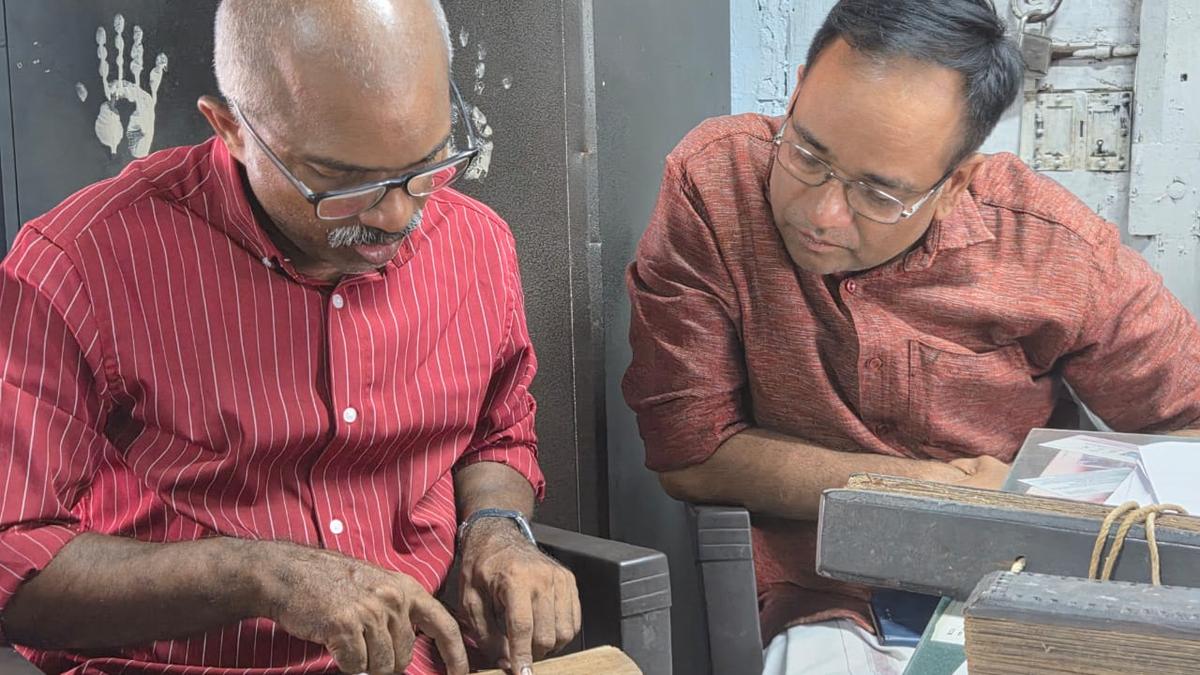
Prof. K. Rajan (left) reading the palm leaf manuscript at Thiruvilwamala temple.
A team of history enthusiasts led by K. Rajan, Professor of history at Government College, Pattambi, has uncovered records that could shed new light on Kerala’s medieval and early modern history during an examination of rare palm leaf manuscripts at the Vilwadrinatha temple at Thiruvilwamala.The palm leaf documents, preserved as Granthavaris, had remained largely unread in recent memory and were traditionally brought out only for occasional ritual purposes. In a recent search for historical records of the Thiruvilwamala region, the researchers identified four rare bundles of manuscripts in the temple.“The manuscripts are an invaluable find. They throw a lot of light on our late medieval and early modern history,” said Prof. Rajan.He said the records dated back to the late 17th century. Three bundles are linked to 18th-century temple renovation activities, while another contains a detailed chronicle of the temple’s history from the early 14th to the late 18th century. The chronicle, compiled in 1822, is based on earlier records that are no longer available, Prof. Rajan said.Written in Sanskrit using Malayalam script, the text begins with a narrative on the incarnation of Vishnu as the deity of Vilwadrinatha. A large portion of the document details temple administration, offering insights into medieval temple society, including the roles of Samudayam, Uralars, Karalars, Manushyam and various Swaroopams.The records highlight strict administrative customs and penalties for violations, reflecting the strong role of tradition in temple governance. They also show that while the temple was under the erstwhile princely state of Cochin, significant revenue was derived from lands underother royal houses, particularly the Tharur Swaroopam.The manuscripts also mention visits by the then rulers of the Perumpadappu, Nediyirippu, Tharur and Arangottu Swaroopams, including a reference to the visit of Ramavarma, ruler of Cochin, in 1363, during which he is said to have performed penance following internal temple conflicts.Prof. Rajan said the documents also provided details of periodic temple maintenance up to the late 19th century, including accounts of structural decay due to natural causes and incidents of fire, pointing to the long and complex history of the temple institution.Those who accompanied Prof. Rajan on the study include Kiran Vasudev, Ramkumar Nambiyath and Suresh Kumar K.A. Published - May 31, 2026 08:00 pm IST