Agent Memory: Short-Term, Long-Term, and Episodic
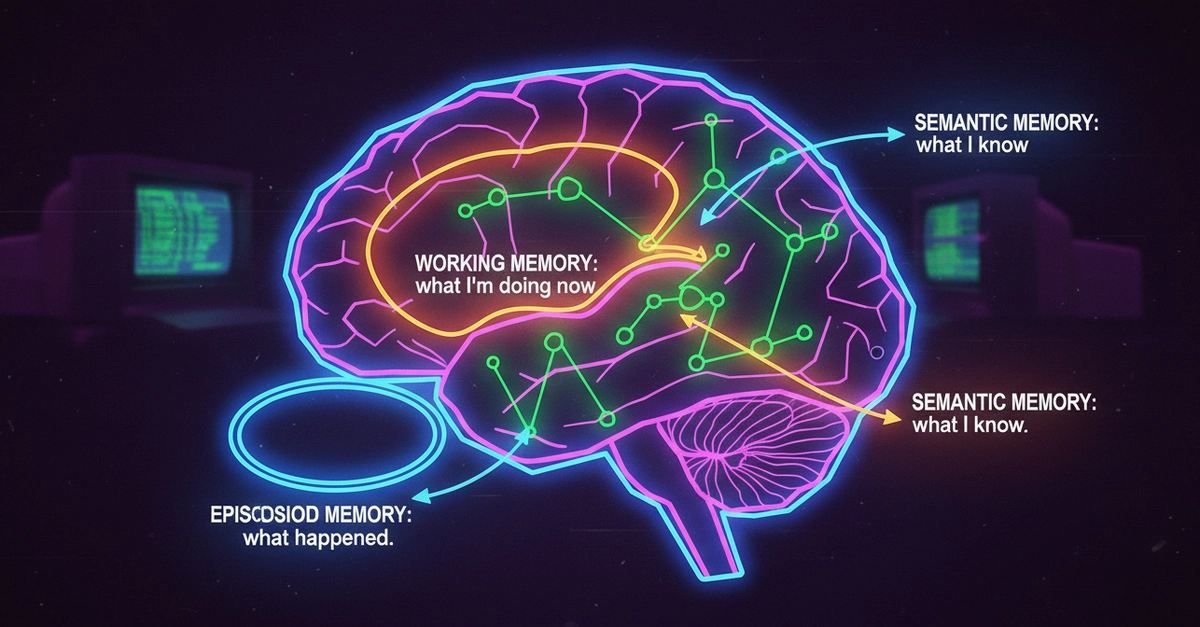
Main Thumbnail Image Prompt: A human brain cross-section illustration in neon tones on dark background. Three regions clearly demarcated and labeled. The hippocampus region glows blue, labeled "Episodic Memory: what happened." The prefrontal cortex glows orange, labeled "Working Memory: what I'm doing now." A network of distributed nodes glows green, labeled "Semantic Memory: what I know." Arrows show information flowing between regions. Scientific but accessible, the memory architecture made neural and visual.
Memory Architecture Diagram Image Prompt: Four storage boxes arranged vertically on dark background. Top: "In-Context Window (Working Memory)" — fastest, smallest, temporary, shown as RAM chip icon. Second: "External Vector Store (Semantic Memory)" — fast retrieval, persistent, shown as cylinder with search icon. Third: "Key-Value Store (Episodic Memory)" — structured facts, shown as database icon. Bottom: "Fine-Tuned Weights (Procedural Memory)" — slowest to update, most permanent, shown as brain with lock. Arrows showing read/write speeds between boxes. Clean, technical, the hierarchy is the insight.
Memory Retrieval Flow Image Prompt: A query arrives at an agent on the left. Four parallel arrows go right to four memory sources: conversation history (short chat bubbles), vector database (semantic search visualization), structured database (table icon), model weights (brain icon). Each source returns relevant items. A "Memory Fusion" box on the right combines the results. The agent sees an enriched context. The retrieval from multiple stores is the architecture.