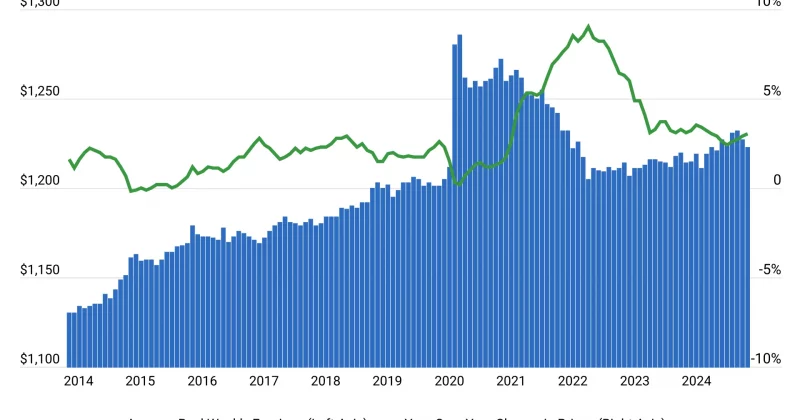
(Bloomberg) --US consumer spending merely edged up in April as war-driven inflation pressures sapped incomes and pushed the saving rate to an almost four-year low.Disposable incomes, after adjusting for price changes, slid for a third straight month and suggested household demand may stay subdued without some relief from inflation.Price pressures also mounted in France, Italy and Spain. Next week’s inflation figure for the 21-nation euro zone as a whole is set to push further beyond the 3% level it reached in April.Here are some of the charts that appeared on Bloomberg this week on the latest developments in the global economy, markets and geopolitics:USBloombergInflation-adjusted consumer spending increased just 0.1% last month, while the personal consumption expenditures price index rose 3.8% from a year earlier, the most since 2023. The figures suggested consumers are facing increasing pressures as uneven hiring trends and the rising cost of living erodes incomes and savings.BloombergA combination of factors including bad weather, tariffs and a dwindling cattle herd are already pushing up grocery prices at an above-average pace. In April, they rose by the most in nearly four years, and economists say the impact of the Iran war and a potential El Niño weather pattern will only add to pressures into 2027.EuropeBloombergInflation jumped in France, Italy and Spain, backing the case for the European Central Bank to raise interest rates for the first time since 2023. Propelled by the war-induced surge in energy costs, consumer prices rose 2.8% from a year ago in May in France, 3.3% in Italy and 3.6% in Spain.BloombergFrench consumer confidence fell more than expected in May, underscoring risks to the euro area’s second-largest economy as the effects of the Iran war spread. France is under mounting pressure from the fallout of the Iran war, with businesses losing confidence and increasingly planning to raise prices.BloombergFinland’s economy clocked in broad-based growth in the first quarter, providing some relief to a country that has struggled with rising public debt after years of low growth. Output in the Nordic nation is growing for the second consecutive quarter in a turnaround for what’s been Europe’s worst performing economy since 2020.BloombergNorway’s economy expanded somewhat less than expected last quarter owing mainly to slowing car sales and lower power production, reducing the odds that the nation’s central bank will extend tightening already next month.AsiaBloombergChina let the interest rate on a one-year policy loan to banks decline to a record low, according to people familiar with the matter, a sign Beijing is stepping up efforts to support an economy that’s losing momentum.BloombergJapan slipped behind China to become the world’s third largest creditor nation in 2025, despite setting a fresh record for its tally of overseas assets.BloombergRecord investment in data centers in Australia is providing much-needed support for the economy that’s feeling the strain from the global energy crunch and higher interest rates. Companies spent A$8.7 billion ($6.2 billion) on building data centers and buying the servers to fill them in the first three months of this year, almost double the level in the final quarter of 2025.Emerging MarketsBloombergSouth Africa’s central bank raised borrowing costs for the first time since 2023 and suggested more policy tightening may be needed if the Iran war drags on, as policymakers sought to contain higher inflation sparked by the conflict.BloombergZambia’s corn harvest will increase 28% in 2026 to a record high, the government said, helping cool inflation fueled by the Iran war. Prices for corn meal used to make Zambia’s staple food fell 17.5% in April from a year earlier, contributing to annual inflation slowing to 6.8%, the lowest level in more than eight years.BloombergPeru has extended a halt on anchovy fishing due to a warming of the Pacific waters off the country’s coast, as the threat of a weather-roiling El Niño looms. Prices of the animal feed have rallied to a record this year, and could surge further if El Niño upends the industry, driving up costs for importers such as China.WorldBloombergThe central banks of South Korea, New Zealand, Uruguay, Hungary, Guatemala, Eswatini, Kyrgyzstan and Mozambique kept interest rates unchanged, while South Africa, Sri Lanka, Lesotho raised them. Central bankers in Israel lowered borrowing costs.
Charting the global economy: Inflation hits incomes and spending
Global economies face rising inflation and slowing consumer spending. In the US, incomes are squeezed, pushing savings rates down. Europe sees price pressures in France, Italy, and Spain, prompting rate hike considerations. China attempts to boost its economy with lower interest rates. Meanwhile, Zambia's corn harvest offers some relief from inflation.
692 words~3 min read