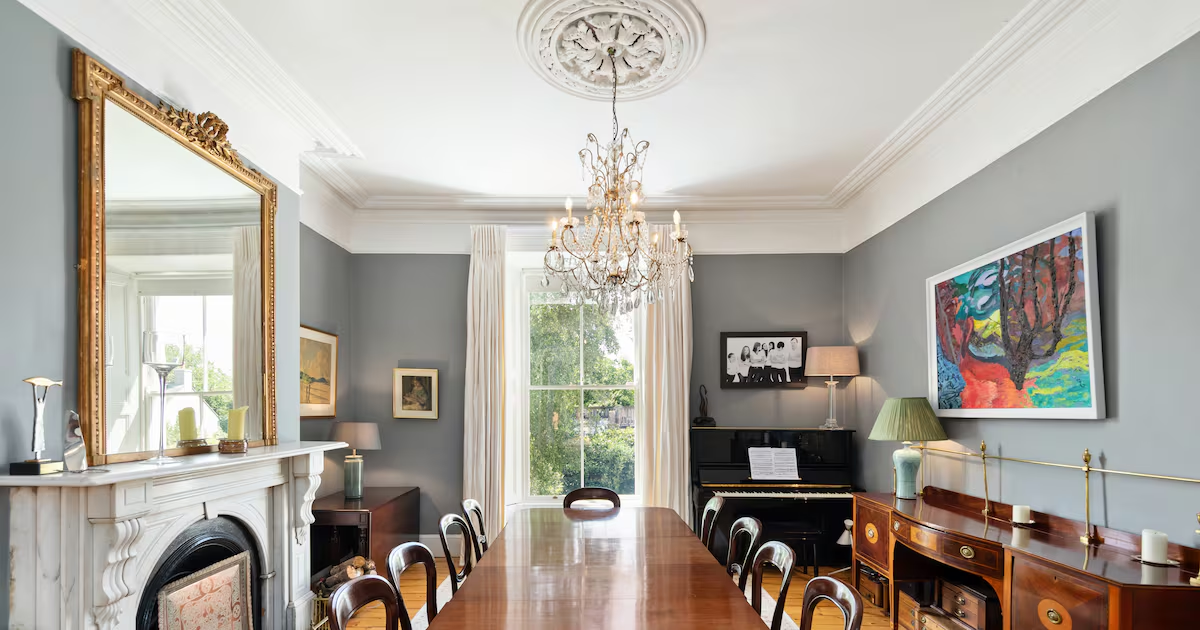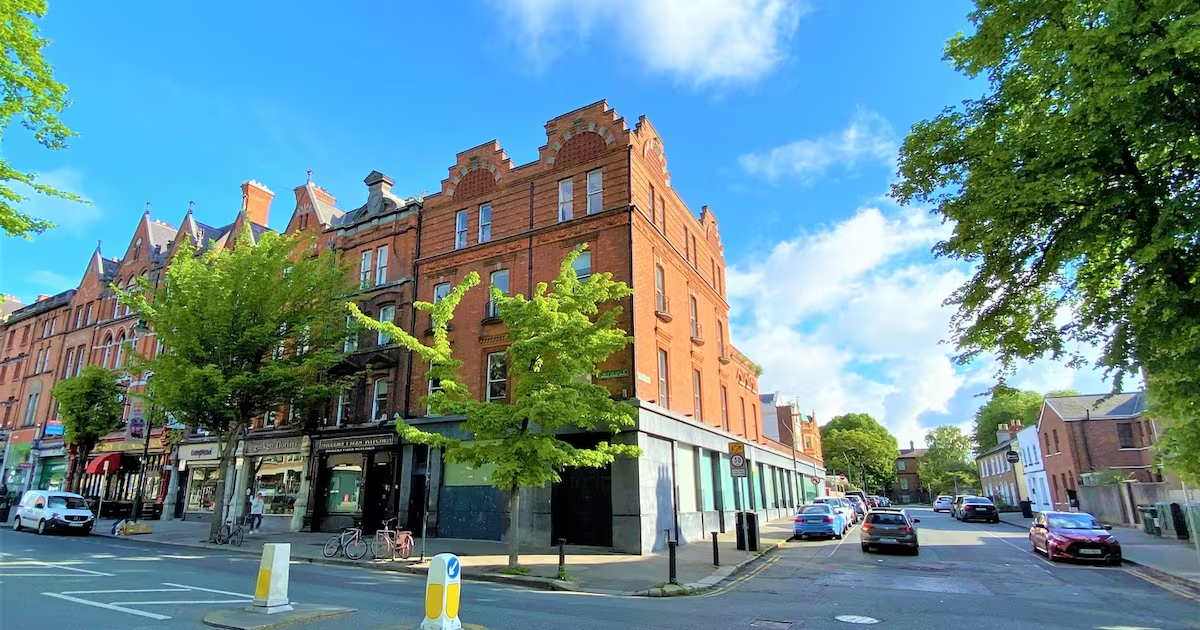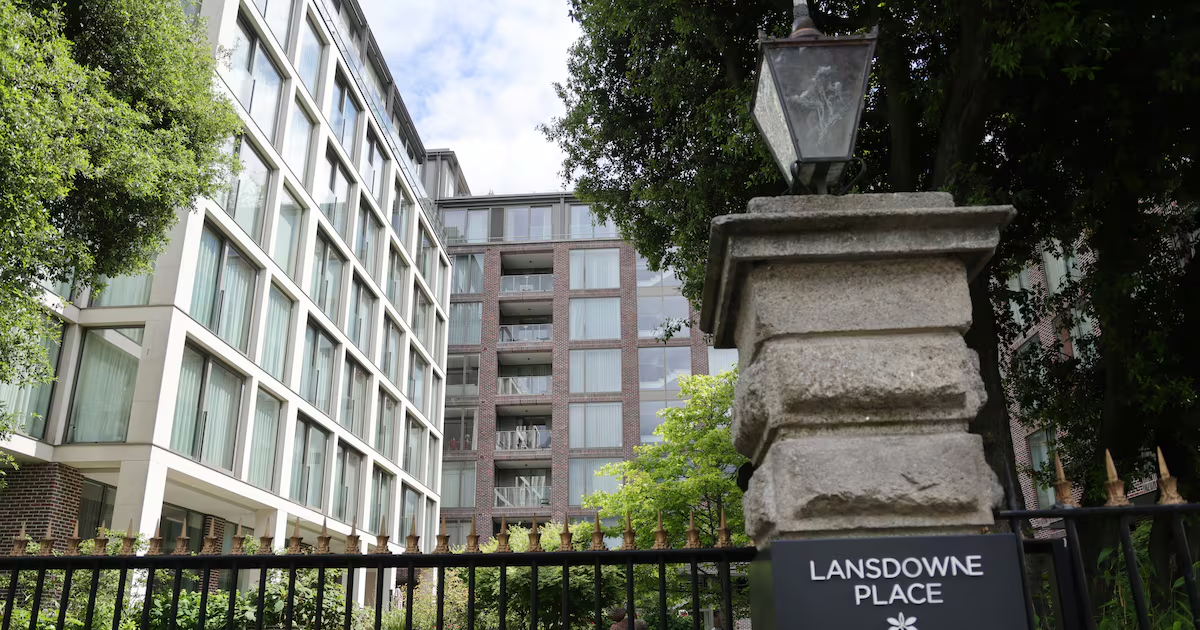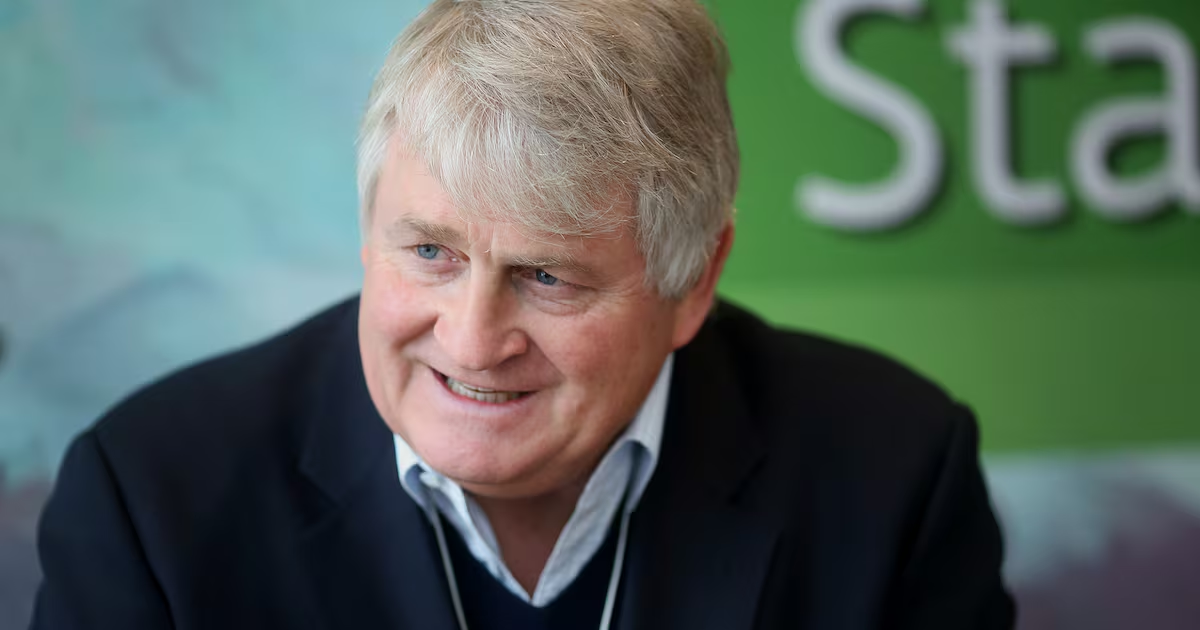
It was once done down in the High Court as damp, dreary and dangerous to inhabit, but it’s still worth €10.4 million these days. There was excitement at Overheard towers this week as one of the most famous houses in the recent history of tax law appeared on the Property Price Register as sold. Number 6 Raglan Road, Ballsbridge, Dublin 4 is a storied address, and not because of the poetic connection. It was this expansive Victorian redbrick that was at the centre of Denis O’Brien’s 2013 tax case. It was once, if you can cast your mind back, the nation’s prime source of kitchen sink drama, after it was suggested that it was “uninhabitable”, its Aga and kitchen fittings having been removed by the people who sold it to the billionaire tycoon.O’Brien argued successfully that the house was not his permanent home under the terms of the Ireland/Portugal double taxation agreement. At stake was €57,848,753 worth of capital gains tax arising from the sale of his Esat Digifone shares in 2000. Why was it not his permanent home? Well, there are several reasons. “No stick of O’Brien furniture ever went into this house,” Dermot Gleeson, counsel for O’Brien, argued at the time. It was “dark, damp and dreary”, according to architect John Meagher in evidence. John Rooney, a civil engineer, noted that some of its decorative cornices were “dangerous”. Concerning stuff.Some renters may find the scene familiar, but it doesn’t automatically make it a home. Home is in fact where the heart is, and the High Court accepted O’Brien’s contention that his heart was in Portugal in the 2000-2001 period in question, along with his wife’s DVD collection and the family’s life in general. It was also claimed that the Raglan Road redoubt was acquired as an investment as O’Brien was “assembling properties in the area”. Did the investment pay off? The logged sale price of €10.4 million in April represents an uplift from the €7.1 million he spent in May 2000. But it hasn’t quite captured the value locked up in the recent property-price boom: the average second-hand house in Dublin is up 240 per cent in the same period. The trendiest crisp in townThe Republic of Ireland's Mr Tayto plays football with former Ireland manager Giovanni Trappatoni There was a positive notice for the national snack published this week in The Times (no relation), with an extensive write-up of Tayto’s growing desirability in London. They’re the “trendiest crisp in town” and one of the pillars of the “revival of Celtic cool”, we learn.Which Tayto? The article is ecumenical on this matter, extolling the virtues of both the ROI Taytos and NI Taytos (no relation). It is illustrated online with a photograph of a particularly shimmering red and blue packet of the 26-county version. This may be somewhat misleading to unwitting Britons looking for ways to live up to their newly received Irish passports.Irish cheese and onion Taytos, brought to market by Joe “Spud” Murphy in 1954, were the first of their kind on Earth to expand beyond salt flavouring. In 1956, with eyes on national domination, Murphy cut a deal with Hutchinson’s of Northern Ireland for the rights to make and sell the crisp in the UK and beyond. This deal, notwithstanding Irish Tayto being rolled up into German crunch giant Intersnack, still holds. It is therefore very difficult to get the Tayto of this jurisdiction in London, outside of the sort of pub that might have photos of the 1994 Leitrim team on the wall. One pub landlord quoted by The Times says he has been asked by customers “about getting the Republican Tayto” into stock. But Tayto Northern Ireland say no: “We have the trademark to sell Tayto crisps in the UK and Tayto ROI do not,” they said. “Therefore, they legally cannot sell their crisps in London.”Every little helpsData centres are well known for energy use but water is less discussed With the sun beating mercilessly down on Ireland this week, Uisce Éireann issued an early water conservation notice to the people of Kildare, who may have been resorting to hosepipe-based solutions on the back patio as record May temperatures were reached.“Following a significant increase in water usage by households and businesses in the current spell of warm weather,” the appeal read, “customers are being asked to be mindful of their usage, allow supply to catch up with demand and enable reservoirs to fully replenish.”Cue some confusion, given the reasonably wet winter and how soon into the warm spell the notice was issued on Monday. Eoghan Forristal of Uisce Éireann reminded Lilywhite locals that “even small changes can make a significant difference”. Overheard wonders whether the proposed construction of a complex of six data centres, approved for the Naas area last year, counts as a small or a big change. Data centres are well known for energy use – 22 per cent of all metered electricity consumption in Ireland, according to 2024 CSO data – but water is less discussed. The Naas project will use air cooling for more than 90 per cent of the year, according to a report prepared by RPS Group for its operators Herbata, but “water may be needed” in the “data halls” the rest of the time. [ AI boom sparks concern over Big Tech’s water consumptionOpens in new window ]“At peak, during usually a couple of weeks in the summer, elevated amounts of water are required,” the report says. Rainwater storage tanks are planned to reduce the amount needed. It does tend to be hot in the rest of the country at the same time it’s hot in the data centres. So it’s something to consider.Adoration of the magiIan McKellen as Gandalf in The Lord of the Rings “All practices of magic or sorcery”, says the Catechism of the Catholic Church, “are gravely contrary to the virtue of religion”. So Overheard was surprised this week to find, deep in section 213 of Pope Leo XIV’s extensive encyclical on AI and humanity, a quote from Gandalf the Grey. “It is not our part to master all the tides of the world, but to do what is in us for the succour of those years wherein we are set, uprooting the evil in the fields that we know, so that those who live after may have clean earth to till,” quotes Leo. Gandalf, who was memorably portrayed by Ian McKellen in the film version of The Lord of the Rings, is a good guy in JRR Tolkien’s story, battling the fiery Balrog and the Witch-King on behalf of his hairy-footed hobbit wards.He’s definitely a wizard, though, which seems suspicious to us, but we’re not the experts.All popes come with what we might call a cultural hinterland. Francis was a fan of cryptic Argentinian postmodernist Jorge Luis Borges. John Paul I, in a display of Italian anglophilia common to clerics and laity alike, loved Charles Dickens. [ When Pope Leo and the IMF agree on AI’s dangers then it’s time to pay attentionOpens in new window ]Leo, once described by an Oxford historian as a “nice geek from the Midwest”, is a man from Chicago with a mathematics degree who grew up in the second half of the 20th century. Maybe it’s not a surprise he’s bringing sci-fi/fantasy to the pulpit. At least it wasn’t Star Wars.
Denis O’Brien’s once ‘uninhabitable’ Raglan Road house sells for €10m
Plus: Republican Taytos sneak into London, Kildare goes dry even before data centres, and Pope Leo the geek
1,226 words~6 min read