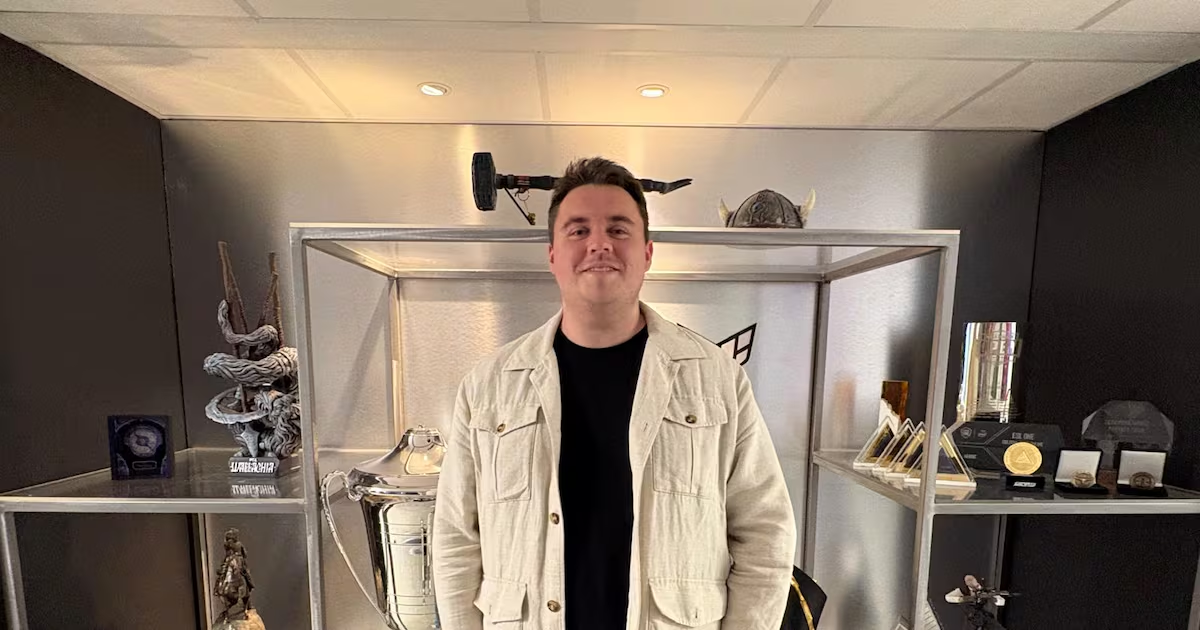
A casual interest in the computer game series Counter-Strike led Co Wicklow-native Sam Molloy into running the commercial wing of a major Norwegian esports organisation and to a life in Oslo.Competitive video gaming – or esports for those in the loop – is a major market among the 16-to-24 age group. The global esports market could be as big as €2 billion annually, though valuations vary widely. Regardless, interest is huge, with some events attracting millions of viewers.Molloy’s employer, Heroic, has “salaried, full-time players travelling the world ... competing for millions of dollars and trophies”, he says.Heroic is one of the biggest international esports organisations, with teams in different competition fields such as first-person shooter series Counter-Strike and the popular Dota 2 battle game.Its players are from across Europe and South America, but it is probably best known for its Danish Counter-Strike team, which was the best in the world in 2023.Esports is a difficult field to get a job in, with huge numbers of young people interested in working in a commercial segment that has often struggled to extract market value from an immense global fan base.That’s the task in front of Molloy in his role as head of commercial for Heroic.Esports tournaments attract plenty of gamers as well as spectators. File image. Photograph: Getty “Sponsorship works the exact same [way] as it does in football, GAA or rugby: brands see reach, an attractive consumer base and want to connect authentically with that,” he says.The group’s social media branding is, Molloy says, “a bit like a Ryanair”, with a cheeky attitude that works well with their teen and young adult audience. The challenge is turning that audience into revenue to support their teams across so many games through advertising and sponsorship.There is a balance to be found. Whereas “no one wants to be seeing an ad”, advertisers want eyeballs on their product. Molloy tries to find that balance with humour: “More often than not we are making you laugh. That is the exchange to watch the ad and to engage with this advertiser.”The strategy is working for Heroic and, for Molloy, this is a dream come true.“I’ve been playing games pretty much all my life,” he says. His first experiences of gaming were on the Nintendo DS handheld game console before he found Counter-Strike in his teens.“I just fell in love with the game to the point where my Leaving Cert holiday was not going with some of my mates to Zante, but I went to ESL One Cologne,” he says, referring to one of the largest and longest-running esports tournaments. “It was like a big rugby or football match but [with] people playing Counter-Strike, and I just thought that was the absolute maddest thing.” At the time, it never occurred to him that the sector might become his career – he ultimately got the job at Heroic by chance.[ Amsterdam is a whole lot easier to get around than Dublin ... You get a much better quality of life here’ ]Like many others in Ireland, his start in esports came through the Irish collegiate esports scene. He did a considerable amount of unpaid work for different organisations during his college years.His first paid role in the sector was with an esports betting website, Pinnacle, for whom he handled esports partnerships and social media marketing from its London office.It was a great introduction into how the money side of the industry works, but ultimately, Molloy says, he got unlucky with timing as Pinnacle closed its office just eight months after he made the move across the Irish Sea.His luck turned, however, after he offered a spare bed to someone looking for accommodation to attend an event. “He happened to work for Heroic.”The chance meeting turned into an introduction then a job opportunity as a commercial manager. Two years and a few promotions later, Molloy is now head of commercial.“Honestly, it’s the maddest job,” he says. He finds it a challenge to convince people that his job is “going to watch teenagers play video games for millions of dollars and convincing brands to sponsor it”.Nonetheless, the job is real and it brought him to Oslo, where he has now lived with his girlfriend for nearly two years.Spectators watch a top-level esports tournament in Stockholm in 2023. Photograph: Jonathan Nackstrand/Getty While moving to London was an “easier change” due to the cultural similarities and large Irish diaspora, all of which helped Molloy to settle quickly there at the time, resettling in Oslo was “a massive change”.The task has been helped by the shared interest in esports of everyone in the office and the “stellar” English that Norwegians have. Molloy’s Norwegian isn’t quite as strong.A bigger difference is in the outlook of people in Oslo. While the sense of humour among his colleagues is quite similar to what he was used to growing up in Ireland, he has found Norwegians, generally, to be “more reserved” than Irish people. “In Ireland, you can be outside smoking, outside a pub, and people will just chat to you. When I describe this to Norwegians, it blows their minds. To a lot of Norwegians, just chatting to strangers is abnormal.”Life in Oslo is “very civil and cordial”, but can at times lack the “Irish spice” and “chaos”.A frequent experience from his life in Wicklow, the 133 bus “sometimes just not turning up”, would never happen in Oslo. “That would melt the brain of a Scandinavian, because everything just works here,” he says.“The quality of life in Norway is remarkable,” but, while salaries are high, the cost of living is too.A pint in Oslo, he says – still slightly shocked – sets him back the equivalent of €10 or €12. “It is pricey – and they have high tax as well. But to be honest, I don’t mind paying for the odd €12 pint, because everything else in the country feels like a fair exchange of value.”While he might miss the craic back home, the opportunities in his field in Ireland are limited as the domestic esports scene here lags behind other similarly-sized countries in Europe.Denmark, a country of nearly six million people, is home to some of the esports scene’s greatest players, including Henrik “Froggen” Hansen, of Riot’s League of Legends franchise, and two of the most notable Counter-Strike team leaders, Finn “karrigan” Andersen of FaZe Clan and Casper “cadiaN” Møller, formerly of Heroic.Ireland, however, has far fewer well-known names. Molloy hopes someone will break into the professional esports scene and ignite it in a similar way to how Offaly racing driver Alex Dunne’s progression in open-wheel racing has sparked renewed interest in Formula 1.
‘The maddest job’: How competitive video games led one Wicklow native to Norway
Wild Geese: Sam Molloy runs the commercial wing of esports group Heroic in Oslo
1,109 words~5 min read