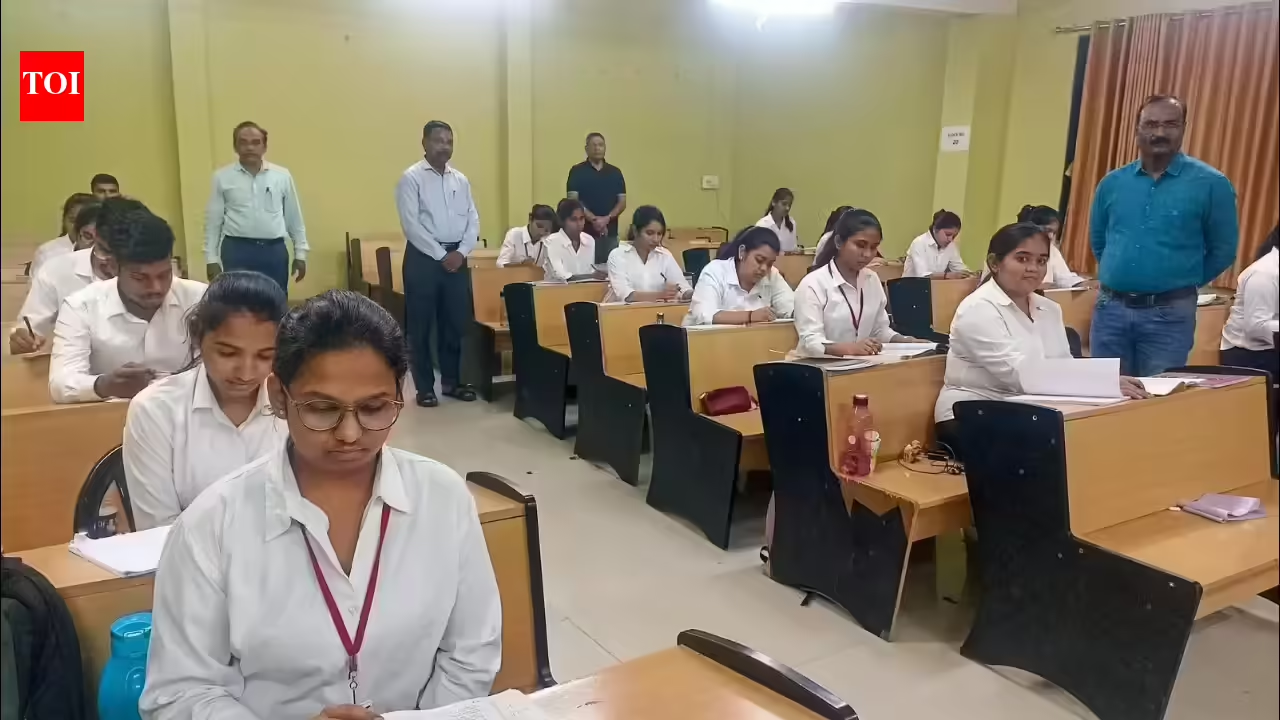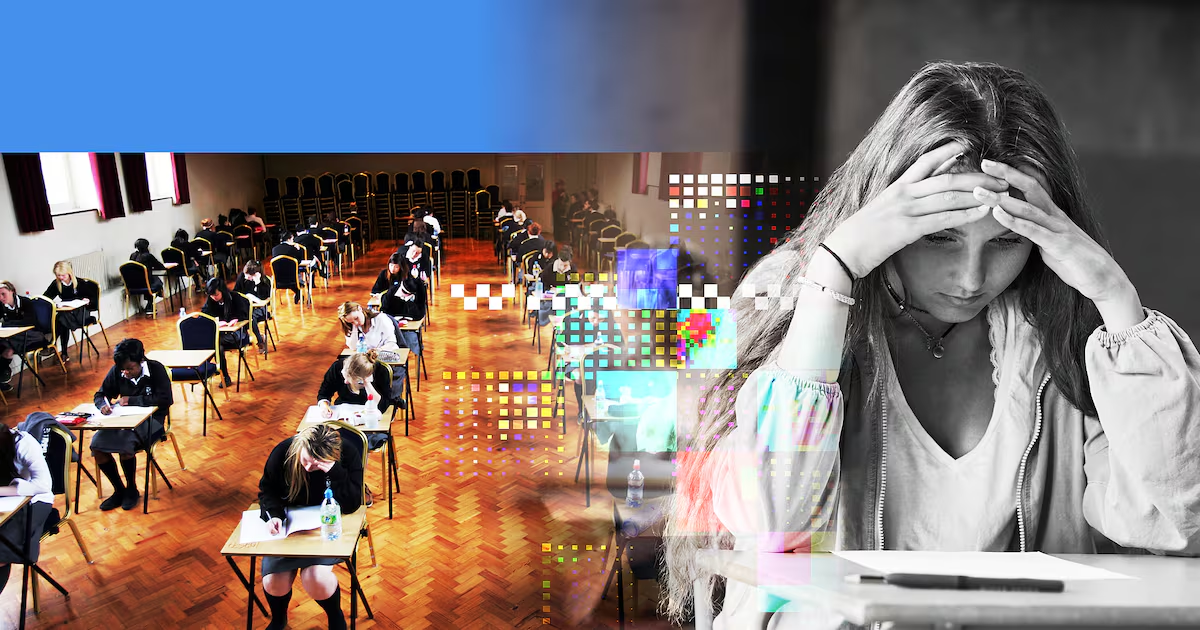
In theory, any student in first year right now will never sit the Leaving Certificate for which current students are nervously preparing. Instead, they will complete Additional Assessment Components (AACs) worth 40 per cent of the total mark and sit reformed senior cycle exams in every subject. While there are good aspects to the revised subjects, there are also serious problems. The new senior cycle is being introduced on a phased basis, so the first year of Ancient Greek, Arabic, biology, business, chemistry, climate action and sustainable development, drama, film and theatre studies, Latin, and physics has just been completed by fifth years.While most of these are minority subjects, last year nearly 49,000 students sat exams in biology, chemistry and physics, while more than 20,000 sat business. Although supportive of reform, after a year, none of the teachers’ initial concerns has abated but further ones have emerged.Given that only 60 per cent of the marks are allocated to the final exam, it might seem logical that the courses should therefore contain less material, but they are more or less the same length. This is despite 20 hours of class time now being allocated to the AAC. Those 20 hours are supposed to be used over fifth and sixth year for the six steps of the AAC investigation: that is, the initial response to the brief, research, design and planning of the investigation, the investigation itself, analysing the data, writing the report and submitting it in the required pdf format, with stringent requirements as to font, spacing, margin size and word count.Speaking to an experienced biology teacher recently, he told me he had already spent more than 20 hours of class time on the investigation but his students had not even begun the process of writing, much less formatting the final report. All the marks are given for the final report, with none for the experiment itself. Given the extra time the AAC guzzles and the sheer amount of subject material, he expressed fears that, for the first time, he might not finish the course with his students.Twenty hours might work in a private school with 12-14 students per class but most science classes have 24 students. Only eight students can carry out an experiment at a time. If you allocate a double period of two hours to eight students for the labwork, inevitably, at least one will be sick. Even when all are present, the experiments require extra work at lunchtime or after school, making a mockery of the 20 hours.[ ‘There’s no way I’m going to the US now’: Irish students choose Europe over J1 for summer jobsOpens in new window ]Teachers are frustrated by the inexplicable lack of exemplars to allow them to gauge what is required by the somewhat vague “features of quality” provided for AACs. Similarly, there are no marking schemes for either the exam or the AAC. Teachers were told that marking schemes are set according to the abilities of the cohort sitting the exam, not the subject matter. This surely strengthens the case for really good exemplars demonstrating a range of achievement from excellent to inadequate.The move to AACs has also accelerated the slide towards every student having an individual digital device, which began with the Junior Cycle classroom-based assessments. We have drifted into dependence on iPads and Chromebooks, driven by a change in curricula, not by a forensic analysis of their educational merit.This has led to a farcical situation where the Minister for Education, Hildegarde Naughton, issued a letter to schools demanding that parents not be burdened with the requirement to buy individual digital devices for their children. Yet she is simultaneously presiding over curricular change that practically demands access to them. The State does not fund individual devices but it expects students to be technologically competent, not to mention able to submit impeccably formatted reports on AACs. Even if schools can afford to buy devices for students, no school has the expertise or financial resources to maintain, upgrade and troubleshoot devices for hundreds of students. So some private providers of managed devices and tablets are making a fortune.Meanwhile, Sweden, once a leader in educational technology, is now leading a drive back to books, pens and paper because children’s ability to focus on and comprehend information was being compromised. As Ella McSweeney pointed out recently, the evidence for the educational benefit of extensive usage of digital devices is patchy, especially in younger students. Perhaps it is some comfort that the proposed timetable to roll out this curricular reform is unlikely to be implemented on schedule. Already, the introduction of the new single paper English course and of accounting has been delayed at least until autumn 2027, while the State Examinations Commission tries to figure out how to facilitate an oral for every single English student and what software packages will be needed for the accounting AAC. We may experience enough delay to allow us to quietly ditch some of the dafter aspects, such as allocating 40 per cent to an AAC instead of say, 20 per cent, and to have a real debate about the place of digital devices in schools.
Teachers are frustrated by some of the dafter aspects of reformed senior cycle exams
How Additional Assessment Components are working in classrooms and an increasing dependence on iPads and Chromebooks raise concerns
858 words~4 min read