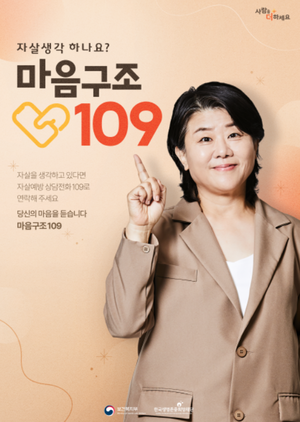
The OECD’s highest-suicide country is expanding its 109 hotline after more than half of daily calls went unanswered A poster promoting the Ministry of Health and Welfare’s suicide prevention hotline 109 (Ministry of Health and Welfare) "If you’re thinking about self-harm or suicide, contact the Ministry of Health and Welfare’s helpline at 109, available 24 hours a day, 7 days a week. Please request a translator for English-language services."In Korea, news articles about suicide often end with this public service notice directing readers in crisis to call 109, the government’s 24-hour suicide prevention hotline.But the hotline answered fewer than half of its daily calls in the first quarter of 2026, even as the country continues to record the highest suicide rate among members of the Organization for Economic Cooperation and Development.The gap has raised questions over whether the government’s most visible suicide prevention tool has been equipped to handle the demand placed on it, even as President Lee Jae Myung pushes to strengthen the country’s response to suicide and mental health crises.The Ministry of Health and Welfare said Friday it plans to nearly double the number of counselors for the 109 hotline and introduce new technologies to reduce administrative burdens on staff, with the goal of answering all incoming calls to the emergency counseling line.Lee Sun-young, director general for mental health policy at the ministry, said the government would soon announce a policy package to expand round-the-clock staffing for the hotline.“The number of counselors will increase from 103 to 200 by October, which is the level needed to handle the current volume of incoming calls,” Lee said.The ministry also plans to give callers the option of being connected to Lifeline Korea, a civilian suicide prevention organization, during nighttime hours, when more than half of all calls are concentrated. Lifeline Korea handles more than 10,000 counseling calls a year through 249 volunteers, according to the ministry.Staff shortages have long been cited as a key reason behind complaints that calls to 109 often go unanswered. According to ministry data, counselors answered only 582 of the 1,118 calls received daily on average during the first quarter of this year, putting the response rate at 47 percent.That was down from 56.9 percent in 2024, as call volumes continued to rise.Online users who sought help through the hotline have often described long waits before reaching a counselor, while also praising the quality of support they received once connected.The pressure has also fallen heavily on counselors themselves.“Because these are highly difficult and emotionally sensitive consultations involving people in extreme situations, counselors themselves experience severe emotional exhaustion and stress,” a health ministry official said.The work requires advanced counseling skills, as many callers are seeking last-minute emotional support during severe mental crises. But the average length of employment remained below three years as of 2024, with the previous four-team, three-shift system contributing to fatigue because counselors had to remain constantly alert during shifts.The ministry said it plans to improve retention by maintaining a recently introduced five-team, three-shift system, increasing performance-based allowances by 20,000 won ($13.26) and expanding programs designed to prevent emotional burnout among counselors.With expanded staffing, the ministry aims to answer all incoming calls, following Lee’s directive during a Cabinet meeting earlier this month to mobilize “all possible means” to ensure that no calls for help go unanswered. Health Minister Jeong Eun-kyeong (left) inspects the suicide prevention hotline office on Friday. (Ministry of Health and Welfare) But some experts and advocates say answering the phone is only the first step.They argue that the current system still functions largely as an emergency stopgap for people at immediate risk, rather than a pathway to sustained care. Without stronger links to local mental health centers, welfare services and follow-up support, they warn, repeated calls for crisis counseling may not address the underlying conditions that brought callers to the edge.The ministry said it plans to introduce artificial intelligence tools, not to counsel callers directly, but to help draft and analyze counseling reports and route cases to appropriate local mental health institutions, including regional mental health welfare centers.It also plans to build dedicated communication channels with police and emergency agencies for cases requiring immediate rescue.“To advance suicide prevention counseling services, we plan to establish dedicated channels with police and emergency agencies for immediate rescue requests in life-threatening cases identified through counseling,” a ministry official said. “We also plan to strengthen connections with outside support resources and follow-up care functions.”For now, the government’s challenge is not only to tell people in crisis who to call, but to make sure someone is there to answer when they do.
Korea’s suicide fix starts with answering calls
"If you’re thinking about self-harm or suicide, contact the Ministry of Health and Welfare’s helpline at 109, available 24 hours a day, 7 days a week. Please re
765 words~3 min read