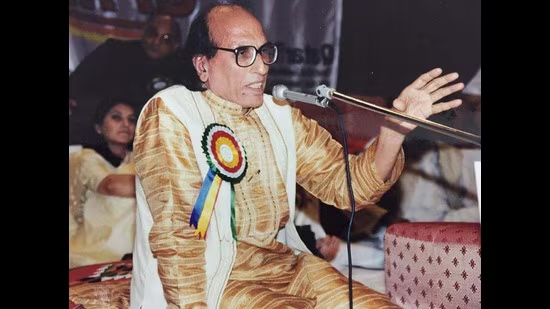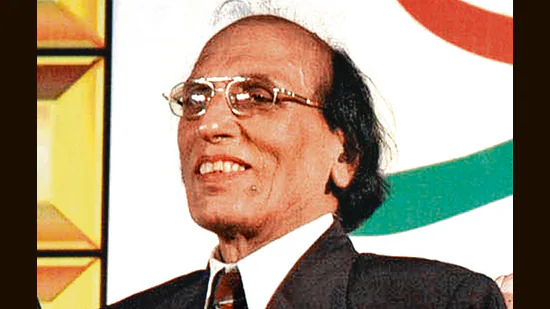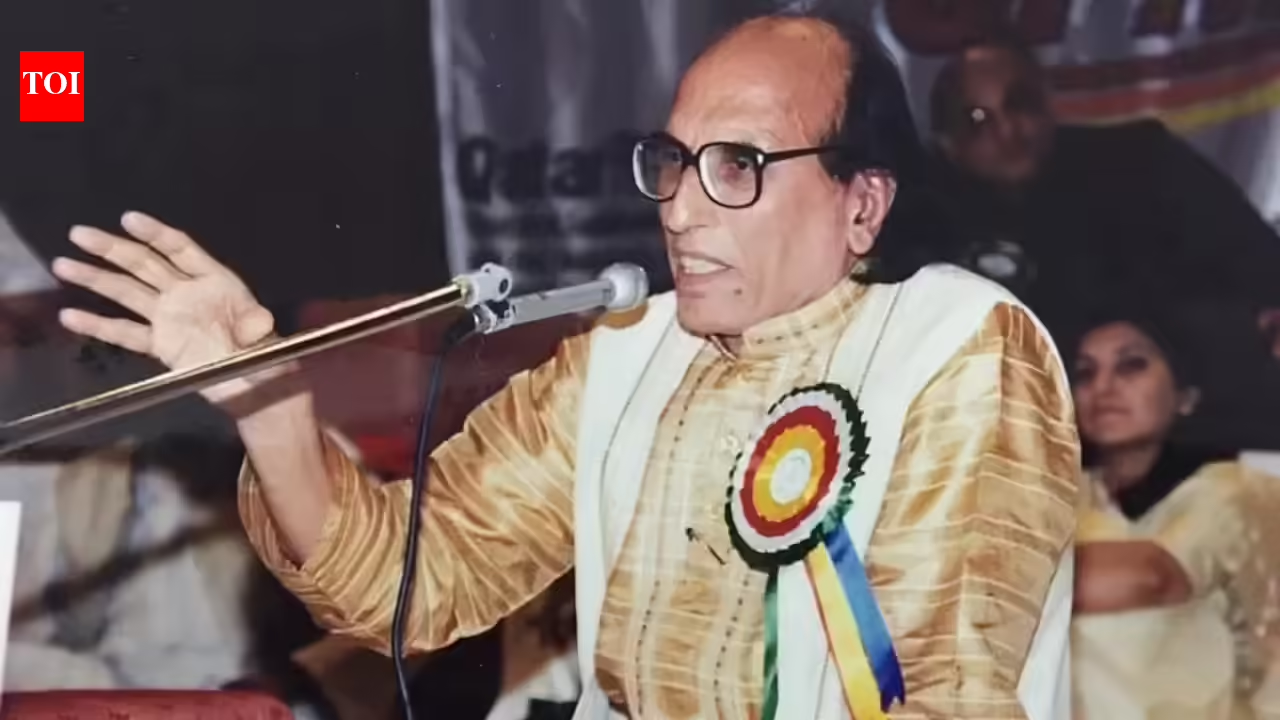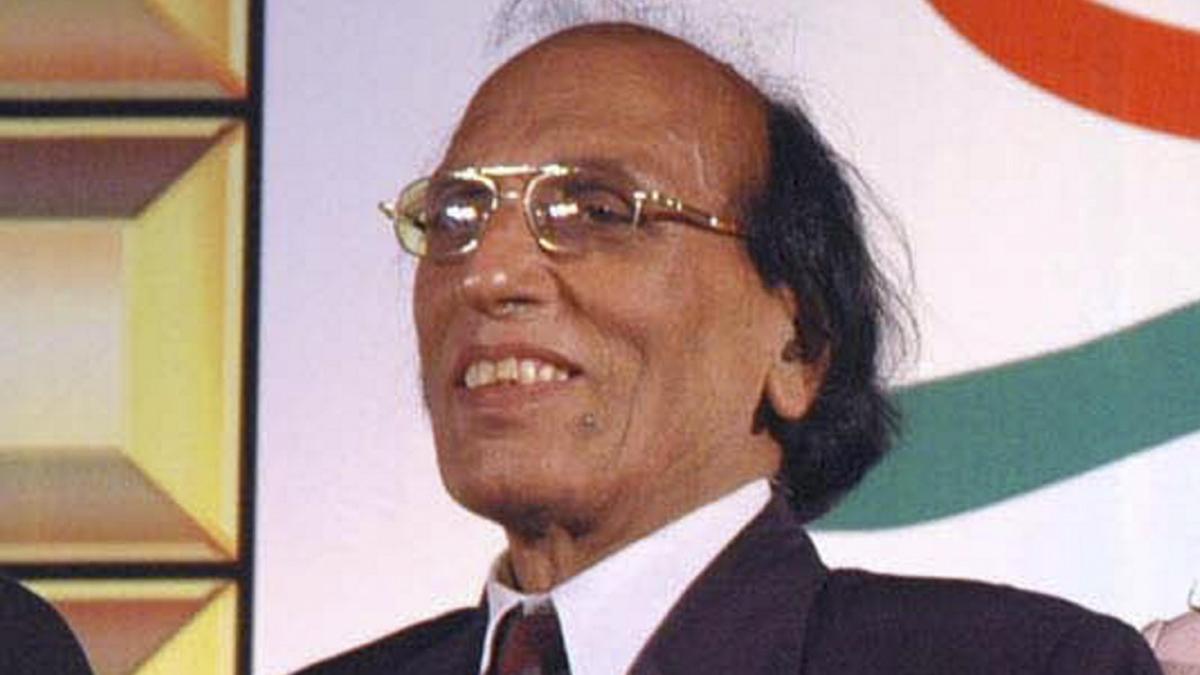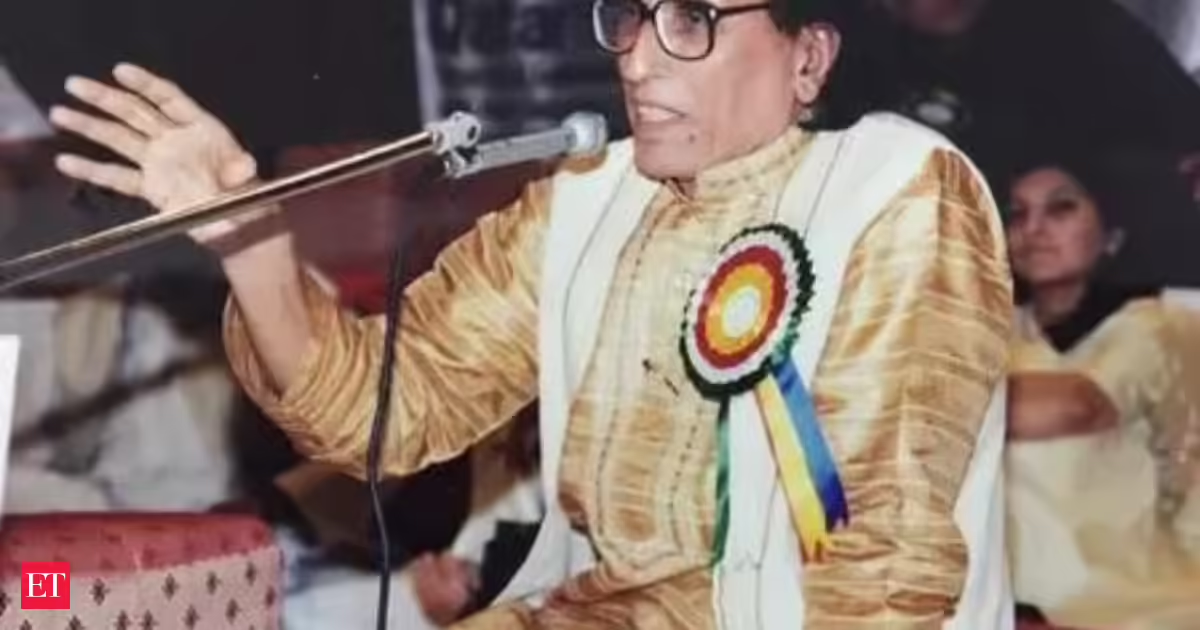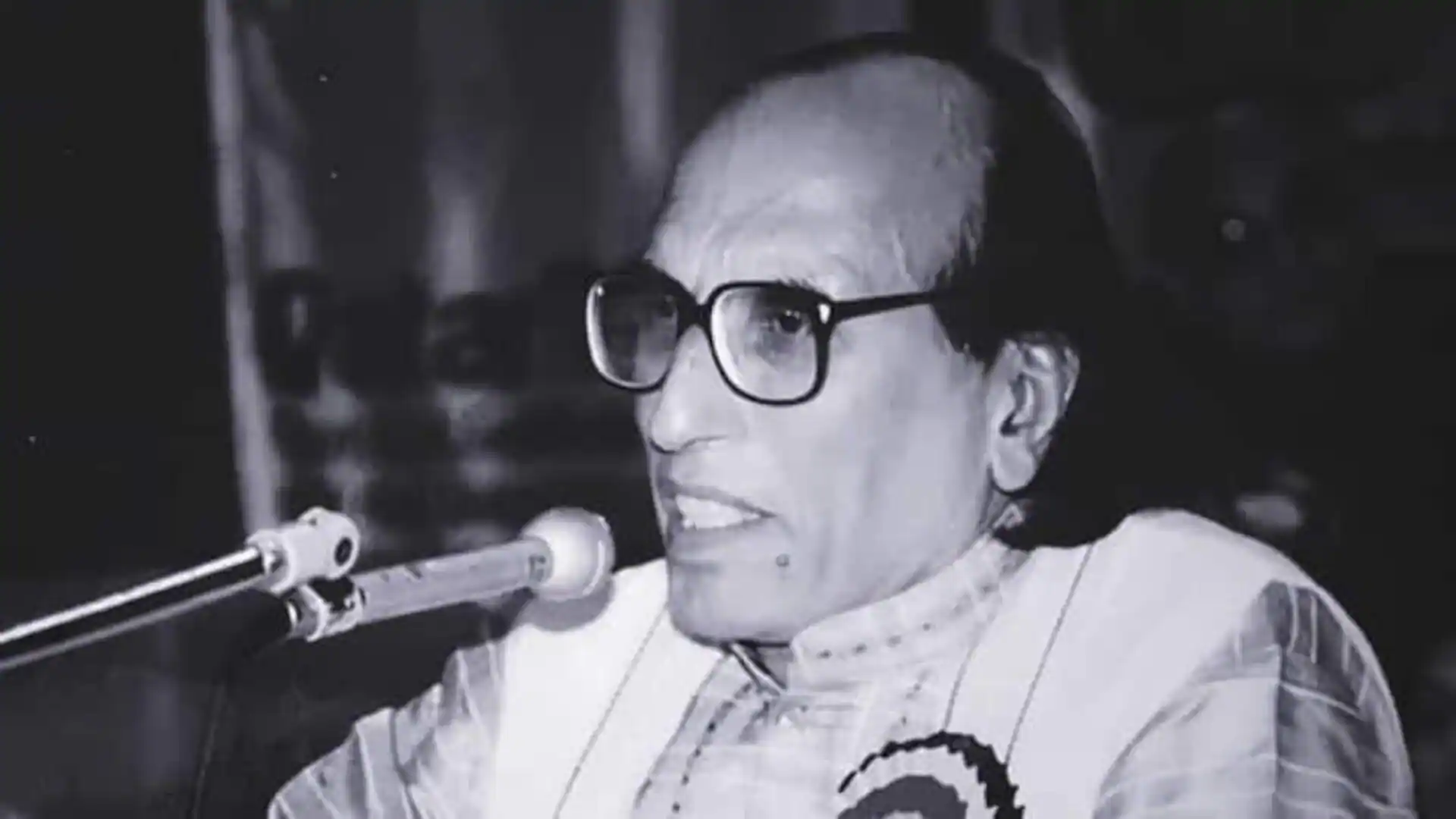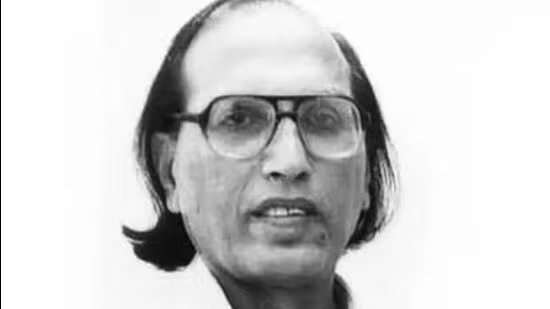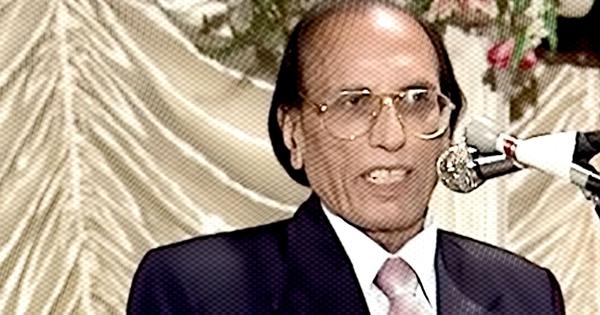
On May 28, 2026, the last of the progenitors of modern Urdu poetry, Bashir Badr, left the grand mushaira of the living and took his place among those forbears of his whom he had once remembered thus:“vo itradaan sa lehja mere buzurgon karachi basi Urdu zabaan ki khushbu”“a bottle of perfume, my forefathers’ tonguethe fragrance of Urdu suffusing through it”Changing the languageLike any great poet, Badr expressed his deep love for the language he had received as patrimony by changing it irrevocably. His 1985 collection Aamad contains a prefatory note titled “A letter to the ghazal reader of the year 2035” in which he wrote: “In 1955 I became convinced that the foundation of the ghazal should be placed not just on the guilelessness of emotions but on the living and changing power and elegance of language.” Given that he greatly admired Mir, for whom transcendental love was a great theme, and Ghalib, whose work often deals with metaphysical concerns as complex as the language in which they are presented, this line presents the kind of parricide without which the new cannot be ushered in. This is not to say that demotic language was not widely used in the past, nor is it to say that emotional directness was missing from the ghazal: it was just that Badr decided to pursue these twin goals to the exclusion of everything else. There are innumerable examples in his oeuvre that show how he stuck to and developed this programme. Consider, for example":“ye soch lo ab aakhiri saya hai mohabbatis dar se uthoge to koi dar na milega”“remember, love is the last scrap of shadeif you leave this door, you’ll find no doors down the way”There is a kind of naivete here, a sincerity that one would be hard pressed to find in the courtly world of a Daag Dehlvi, for example. The language appears deceptively simple. At first blush, it feels like a commonplace utterance, something a neighbour might have said to a rebellious son in the 1980s somewhere in the northern plain of the subcontinent, but then the rhythm of the ghazal asserts itself and the moment gets elevated while still remaining connected to the world of everyday struggles that structured the lives of most Hindi/Urdu speakers in the decades following 1947.The great success of Badr’s poetry, its ability to draw new readers with every passing decade, can be traced back to the programme laid out in the line quoted above. His language is accessible, his world is your and my world. There is a wistfulness, a willingness to lay bare vulnerabilities that are commonplace. Here, for example, is the life of a young jobless person:“shaam tak kitne haathon se guzruunga meinchai khaane mein urdu ke akhbaar sa”“by evening I will have passed through many handslike an Urdu newspaper at a tea stand”A loving couple feeling their age:“mein isi gumaan mein barson bada mutmain rahatera jism betaghayyur mera pyaar javidaan hai”“for many years I was happy deluding myselfthat your body wouldn't change, my love would never end”He can be political, but is not revolutionary, as in the oft-quoted“log tuut jaate hain ek ghar banane meintum taras nahin khaate bastiyaan jalaane mein”“building just one home can break a personyou burn settlements without compassion”One could imagine that other protagonists of the modern ghazal would have done the same thing differently. Dushyant Kumar or Rahat Indori, if they were to write something around the same image, might have hit harder; Muneer Niazi would be angrier. Faiz would have written a nazm.The language of ghazalThe ghazal, to Badr, is not just a poetic form within Urdu, but a language in itself. To be clear, this is not a poetic abstraction, but a very specific move whose rationale he lays out in the “Letter” quoted above. Post 1947, he argues, Urdu was subjected to neglect and disinterest in India and was made into an official language in Pakistan. This, according to him, led to a decline in the Urdu of textbooks. The ghazal’s form could harness that energy, use it to chart a different course in a changed world without letting that energy change it. And, in doing so, it could help build a new Urdu that would still be a descendant of the old but different from the old, just like Badr himself would be a literary descendant of the poets of yore without being like them. A somewhat direct example of this phenomenon was when he took an old short-metred zameen of Momin:“tum mere saath hote ho goyajab koi doosra nahin hota”“you are with mewhen no one else is”And wrote a ghazal on it, which contained the following much-quoted she’er that used the same metre to express a sentiment that was probably extant in Momin’s time but has been sharply felt in the context of the flawed Indian republic:“ji bahut chaahta hai sach boleinkya karein haunslaa nahin hotaa”“I often feel like telling the truthbut I’m scared, what do I do”An important part of the opening up of Urdu diction in the ghazal was to allow English in. But this was not to be Akbar Illahabadi’s use of English, which was often made with the intention of drawing a laugh. This was to be English as pronounced in the subcontinent; these words were immigrants from another language that had now settled down here: “sunsaan raaston ki savaari na aayegiab dhuul se atii huii laari na aayegi”“nothing to ride will come by these lonely waysthat dusty lorry will not pass by this way”Normally in the subcontinent, English is used to distance and control people, but this use of English has the opposite effect: it draws Urdu speakers closer, asks them to sit a while and share their joys and sorrows in the language that comes naturally to them, that grows and changes as it needs to, as they need to.It can be argued that Badr’s programme to bring Urdu into the modern age, standing on the two pillars of sincerity of emotion and demotic language, was not the only programme. Arguably, poets like Muneer Niazi, Jaun Elia, Faiz, Nida Fazli, Ahmad Faraz, to name a few, took different, and equally valid, routes through language and sensibility to bring Urdu out of the death spiral that 1947 could have been. But today, with just nine years left to 2035, when that letter is supposed to be read, we find that Badr is still quoted in movies and on Instagram, in Parliament and on TV. Videos of him at mushairas clock millions of views on YouTube. Videos with people talking about him are also very popular. Popularity depends on many factors, but it is hard to shake the thought that Badr’s success is due to his vision of how Urdu would evolve post-1947 and his efforts to build on that vision in his poetry. And beyond Badr, there is a larger story unfolding. Rekhta Foundation’s events are swarming with people. People are signing up to learn how to write ghazals. Vastly popular YouTube channels are monetising poetry. One could say that Urdu is back, arms linked with Hindi, or one could say that poetry and literature in this Siamese twins-like hyphenated Hindi-Urdu is back. It didn’t just come back on its own. Several people of great talent and great emotional depth contributed their lifetimes to make it happen. One of the greatest of those is now dead. The one who wrote:“yuun hi besabab na phira karo koi raat ghar bhi rahaa karoye ghazal ki sachchi kitaab hai is chupke chupke padha karo”“stay home some nights, don’t wander aimlesslythis is the true book of ghazals, read it silently”Postscript I was looking clueless in the Sriram Centre bookshop one morning in the late 1990s when the shop attendant said to me, “Read Bashir Badr. He is one of our great poets.” What would have happened if he had been on a tea break at the time? I don’t know. But what happened was that my first two novels had epigraphs from Badr. For a book about young men driven by destructive ambition:“mujhe maaluum hai uskaa thikaana phir kahaan hogaparindaa aasmaan chuune mein jo naakaam ho jaye”“I know where it will sleep tonightthe bird that fails to touch the sky”For a book about people thrown out of their houses by gentrification:“ghulaami ko barkat samajhne lageinasiiron ko aisi rihaai na de”“they will begin to prefer incarcerationdon’t give the prisoners this kind of liberation”But, perhaps, the one story that most needs to be told today is of the tree. Soon after my father’s death, my wife and I came out of the metro station at Mandi House and decided to walk to Bengali Market. It was a short tree, not more than a couple of hundred metres away from the Sriram Centre bookstore, where I first heard the name Bashir Badr. Its trunk split into two branches, some four feet from the ground. The sight of that cleft made me weep like I had not wept before because I remembered this:“ye ek ped hai aa is se mil ke ro lein humyahaan se tere mere raaste badalte hain”“this is a tree, let’s stand by it together and weepfrom here the roads diverge, diverge for you and me”Amitabha Bagchi is the author of five novels. He has also translated the ghazals of Muneer Niazi into English.
Emotional directness, common man’s language: What made Urdu poet Bashir Badr (1935-2026) great
Writer Amitabha Bagchi pays a tribute to Badr, who died on May 28.
1,562 words~7 min read