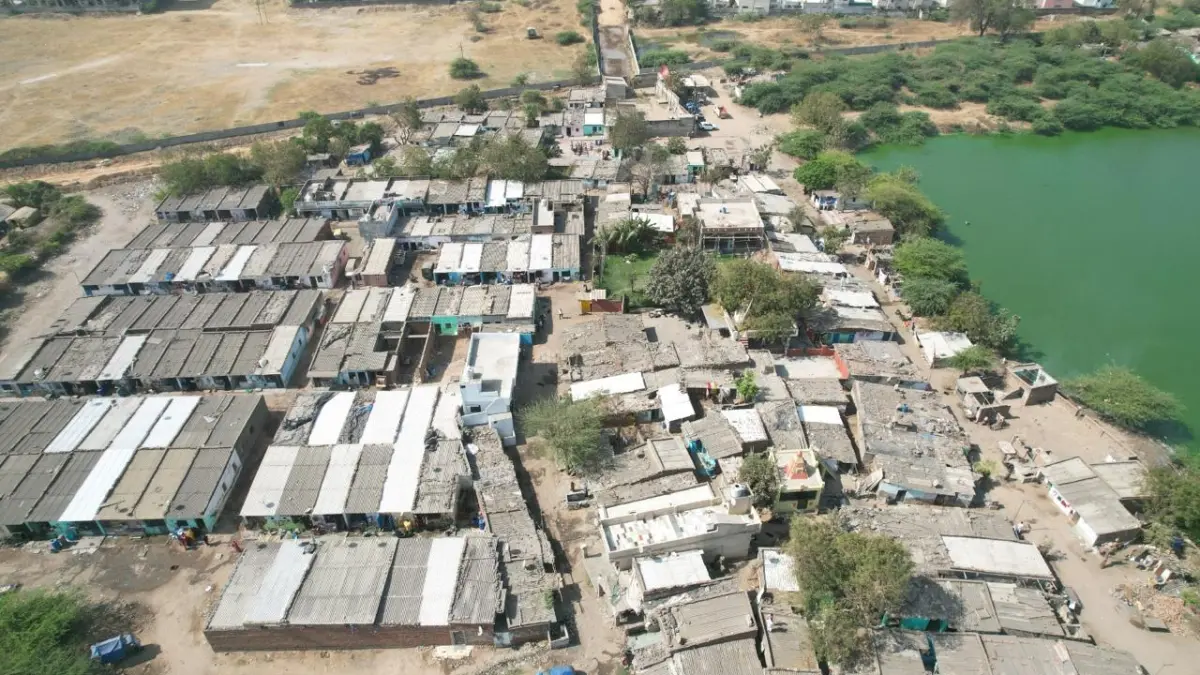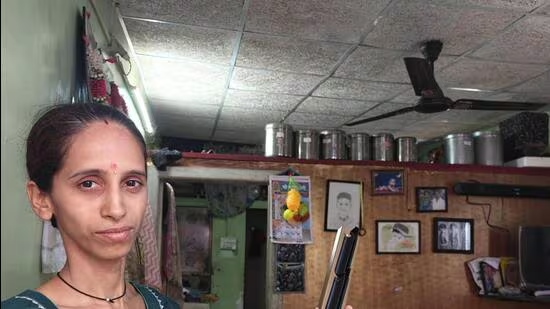
MUMBAI: As mid-day approaches in Bhayander’s Navghar area, septuagenarian Sunanda Lakan watches a Marathi television soap with a table fan blowing cool air in her face. In her one-room slum dwelling, she has been keeping the ceiling fan off. “This is enough,” she said, pointing to the table fan.Eco-friendly ceilings in Bhayander slums bring relief from blazing heatNot too long ago, Lakan’s unbearably heated home felt like an oven. But three months ago came a gamechanger—a wood-wool false ceiling attached to the inside of her asbestos roof, which brought the temperature down by five to six degrees.“There has been some relief after we got this,” said Lakan’s neighbour Sandeep Sukale, 59, looking up at his own shiny charcoal-grey alu-foil ceiling. His son Prajyot is a Class 12 student gearing up for a year of rigorous studies. “Earlier, it was impossible to sit inside the house and study,” said Prajyot. “I used to go out and sit near the taaki (water tank) to get some air.”The asbestos roofs in slums absorb heat that permeates into the walls of the tenements. “The heat would radiate through the walls. Even our floor tiles would be warm,” said Priyanka Gurav, 33, who assembles window vents at home like many women in her neighbourhood and now lives under a beige wood-wool ceiling. “We would just sit outside our homes, move from one side to another, hiding from the harsh sun.” Asbestos sheets, made of cement and asbestos fibres, are used in roofs across slums in MMR.A report by the Aga Khan Agency for Habitat (AKAH) India, under whose pilot project the homes of Lakan and Sukale and 81 other units in Bhayander have benefited, states, “In informal settlements, low-cost roofs, high density, and poor ventilation raise surface temperatures by 8°C to 12°C, worsening heat exposure, blocking night cooling, and causing health stress, lost work hours, sleep loss, and higher risk for women, children, and the elderly. Since most heat exposure occurs indoors, housing retrofits become one of the most immediate and equitable points of intervention.”Under the AKAH project, 75 slum tenements were installed with alu-foil and eight with wood-wool ceilings. The cooling solutions are set to scale up to another 150 units in the coming year, of which half will be in Mira-Bhayander and half in Chandrapur. The project began as a pilot with the Mira Bhayander Municipal Corporation (MBMC) in 2025, and AKAH is now collaborating with Tata Trusts to take it forward. On May 20, AKAH also signed an MoU with Maharashtra Information Technology Corporation Limited (MahaIT) to scale habitat improvement and build the resilience of vulnerable communities to heat and other climate change impacts.Yogesh Gunijan, assistant commissioner, MBMC, said the civic body had worked together with AKAH as a part of its Climate Action Plan 2025. “Our ASHA workers helped them with carrying out the surveys,” he said. “It was done on a trial basis and it has shown positive results. The heat is expected to rise every year, and these cooling solutions are a good start. We are yet to discuss how we can take it forward. Many factors like cost, which other departments or agencies can be involved, will have to be discussed.”In September 2025, AKAH India was selected by the United Nations Framework Convention on Climate Change to present its heat-resilience framework at Climate Week 2025 in Addis Ababa, Ethiopia. Its heat mitigation measures, including wood-wool and alu-foil ceilings, were selected among 16 top hyper-local climate-adaptive solutions in the world, said AKAH India CEO Prerna Langa. It will now be presented at the Innovate4Cities Conference 2026 to be held from June 21 to June 24 at the UN Habitat headquarters in Nairobi.“Heat is not recognised as a disaster,” Langa pointed out. “There is no specific fund for it and it sits between different government departments. We would like to emphasise that it is a problem, and needs to be addressed.’The CEO said their efforts were aimed at getting heat factored into policy-making. “By highlighting that heat is a disaster, and that the world is not getting any cooler, we now need to think of how we can help communities adapt to this,” she said.
Eco-friendly ceilings in Bhayander slums bring relief from blazing heat
Not too long ago, Lakan’s unbearably heated home felt like an oven. But three months ago came a gamechanger—a wood-wool false ceiling attached to the inside of her asbestos roof, which brought the temperature down by five to six degrees. | Mumbai news
695 words~3 min read