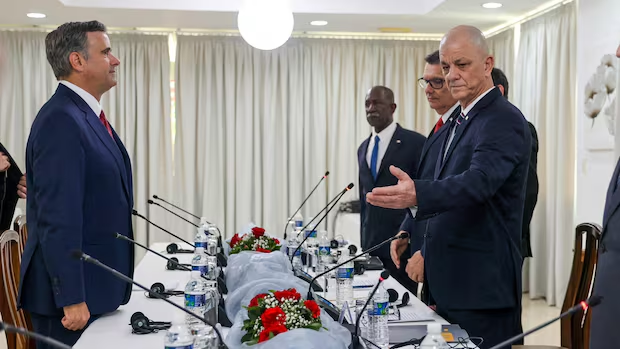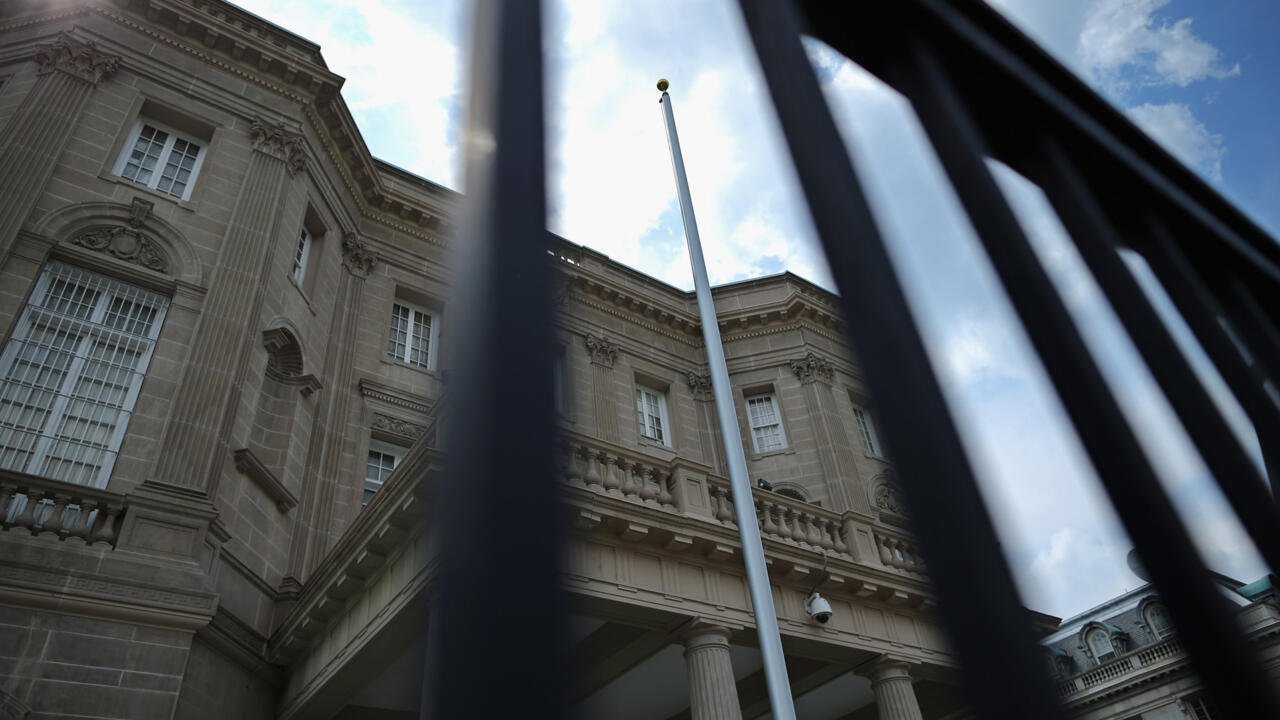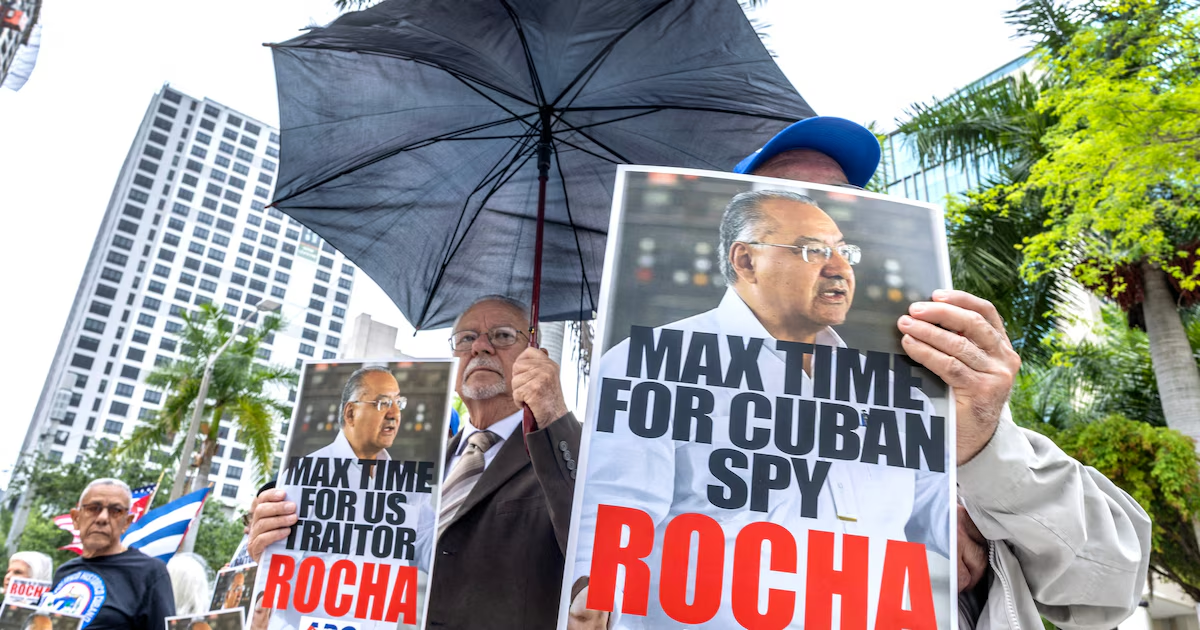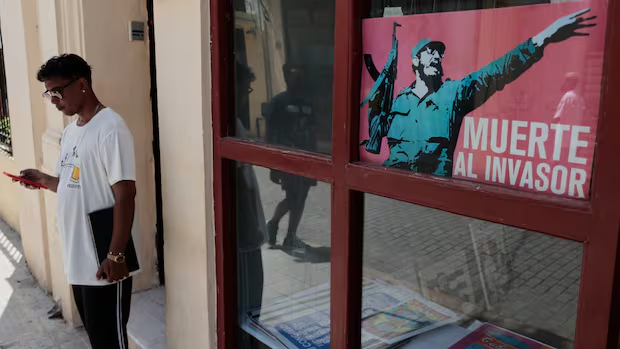
WorldU.S. demands that Cuba close its Russian and Chinese spy outposts have come as the Trump administration exerts maximum pressure on the island with an energy blockade and widening sanctions. Here's a look at how some of the most noteworthy agents from both counties managed to operate under the radar — until they were caught.The two countries have a long history of espionage, but the U.S. wants Cuba's spy outposts closedGeoff Nixon · CBC News · Posted: May 30, 2026 4:00 AM EDT | Last Updated: 8 hours agoListen to this articleEstimated 6 minutesThe audio version of this article is generated by AI-based technology. Mispronunciations can occur. We are working with our partners to continually review and improve the results.The U.S. Central Intelligence Agency released images of its director, John Ratcliffe, attending a May 14 meeting with Cuban leaders in Havana. (CIA/X/Reuters)The American spy chief sitting across from a group of besuited Cuban officials was in Havana this month to deliver a message, but there was no spycraft involved. Instead, what the U.S. wanted was loud and clear: close Chinese and Russian spying outposts and make "fundamental changes" on the island. These demands, seen by one analyst as "an ultimatum," come as the Trump administration continues to exert maximum pressure on Cuba with an energy blockade and widening sanctions resulting in frequent blackouts, food shortages and protests.The U.S. has said these measures are necessary because Cuba poses a serious national security threat due to intelligence ties with Russia and China and friendly relationships with U.S. foes in Latin America. Meanwhile, Chris Simmons, a retired U.S. spy-catcher, told CBC News in a recent interview that Havana views the U.S. as "the only external threat in their eyes."Because spies and spying are never far from conversations between Cuba and the United States, here's a look at how some of the most noteworthy agents have managed to operate under the radar — until they were caught. Pentagon's top Cuba expert was a spyTwenty-five years ago, the Pentagon's top expert on Cuba was Ana Belén Montes.The then-44-year-old veteran analyst had joined the U.S. Defense Intelligence Agency (DIA) in 1985. The problem was, Cuba had recruited her before she got there.Ana Belén Montes, right, is seen being presented with a certificate of distinction by former CIA director George Tenet, in an undated photo. It was eventually discovered that she was a long-term Cuban spy. (U.S. Department of Defence/Reuters)The FBI has said she was motivated by ideology and her views on U.S. foreign policy drew attention at her workplace — eventually leading to an interview by a security official, who later shared suspicions that she was a spy.Simmons also worked at the DIA as its lead Cuba analyst for counterintelligence issues — reports he worked on were eyeballed by Belén Montes and vice versa."Everything she wrote, I saw," said Simmons, who helped identify her role as a Cuban spy.In spies he trusts? In Cuba, Trump looks again to CIA chief, rather than a diplomat, to deliver a messageFormer U.S. ambassador gets 15-year prison sentence after decades as secret Cuban agentBelén Montes was arrested in September 2001, with a press release announcing that she was accused of delivering national defence information to Cuba. The following year, she received a 25-year sentence after pleading guilty to conspiracy to commit espionage.After serving more than two decades in prison, she was released in 2023, at the age of 65.Husband and wife retiree spies reeled inFellow Cuban spy Walter Kendall Myers, meanwhile, made it to retirement before he was busted.The former State Department employee was arrested on June 4, 2009, and accused of acting — along with his wife, Gwendolyn — as long-term clandestine agents for the Cuban government.A February 2009 photo shows Walter Kendall Myers standing behind his wife, Gwendolyn. (Reuters)Within a year, the septuagenarian great-grandson of Alexander Graham Bell was handed a life sentence, for what prosecutors said was "a nearly 30-year conspiracy to provide highly-classified U.S. national defence information to the Republic of Cuba." He died in a U.S. prison hospital in March at age 88.Gwendolyn Myers got an 81-month sentence for her involvement. The New York Times reported that she died in 2015.U.S. ambassador a secret agent for CubaThe U.S. would reel in yet another long-serving, retirement-age Cuban spy in the years to come: Victor Manuel Rocha, a former U.S. ambassador to Bolivia who acted as a secret agent for Cuba for decades.In 2024, Rocha pleaded guilty to conspiring to act as an agent of a foreign government, and received a 15-year sentence. An Aug. 3, 2000, photo, shows then-Bolivian president Hugo Banzer shaking hands with Victor Manuel Rocha, who was, at that time, the new U.S. ambassador to Bolivia. (Reuters)His punishment continues post-conviction: The U.S. Justice Department announced this month it will seek to strip the Colombian-born Rocha of his U.S. citizenship.Jason A. Reding Quiñones, the U.S. Attorney for the Southern District of Florida, has said the effort is about "finishing the job" in holding the 75-year-old Rocha accountable. Jacqueline Arango, a lawyer listed in a court document as Rocha's representative in the denaturalization case, did not respond to a request for comment.Spy swap for America's man in HavanaThe U.S. has also had its own agents apprehended — including a cryptologist in Cuba's Directorate of Intelligence who was caught working for the Americans in the mid-1990s.The U.S. agent spent nearly two decades in a Cuban prison before being freed in a 2014 spy swap during a thaw in bilateral relations between Washington and Havana.Then U.S. president Barack Obama said the freed spy was "one of the most important intelligence agents that the United States has ever had in Cuba." From left, Ramón Labañino, Antonio Guerrero and Gerardo Hernández, visit Havana's National Assembly on Dec. 20, 2014. The three men were released by the U.S. in December 2014, in a spy swap between Washington and Havana. (Ramon Espinosa/The Associated Press)The swap also saw three members of the Cuban Five — a group of intelligence agents that worked out of Florida in the '90s — released from prison.American aid contractor Alan Gross was also allowed to leave Cuba in the same exchange, after he spent five years in prison.Media reports identified 51-year-old Rolando (Roly) Sarraff Trujillo as the Americans' unnamed man in Havana. It was said the information he provided helped the U.S. bring eventual cases against Belén Montes, the Myerses, and others."Roly was priceless in terms of what he did to help us," said Simmons, explaining that Sarraff Trujillo passed on valuable information about how Cuba communicated with its agents abroad.But that assistance came at a cost, with Sarraff Trujillo spending more than half his adult life in a Cuban prison prior to the spy swap.Simmons said many intelligence defectors who have helped the U.S. were people who initially joined their line of work to support the revolution in Cuba and later became disillusioned.When they finally reached a tipping point, they switched sides, he said.With files from CBC's Front Burner
Spy vs. spy: A look at how some of Havana and Washington's most noteworthy agents operated | CBC News
U.S. demands that Cuba close its Russian and Chinese spy outposts have come as the Trump administration exerts maximum pressure on the island with an energy blockade and widening sanctions. Here's a look at how some of the most noteworthy agents from both counties managed to operate under the radar — until they were caught.
1,163 words~5 min read