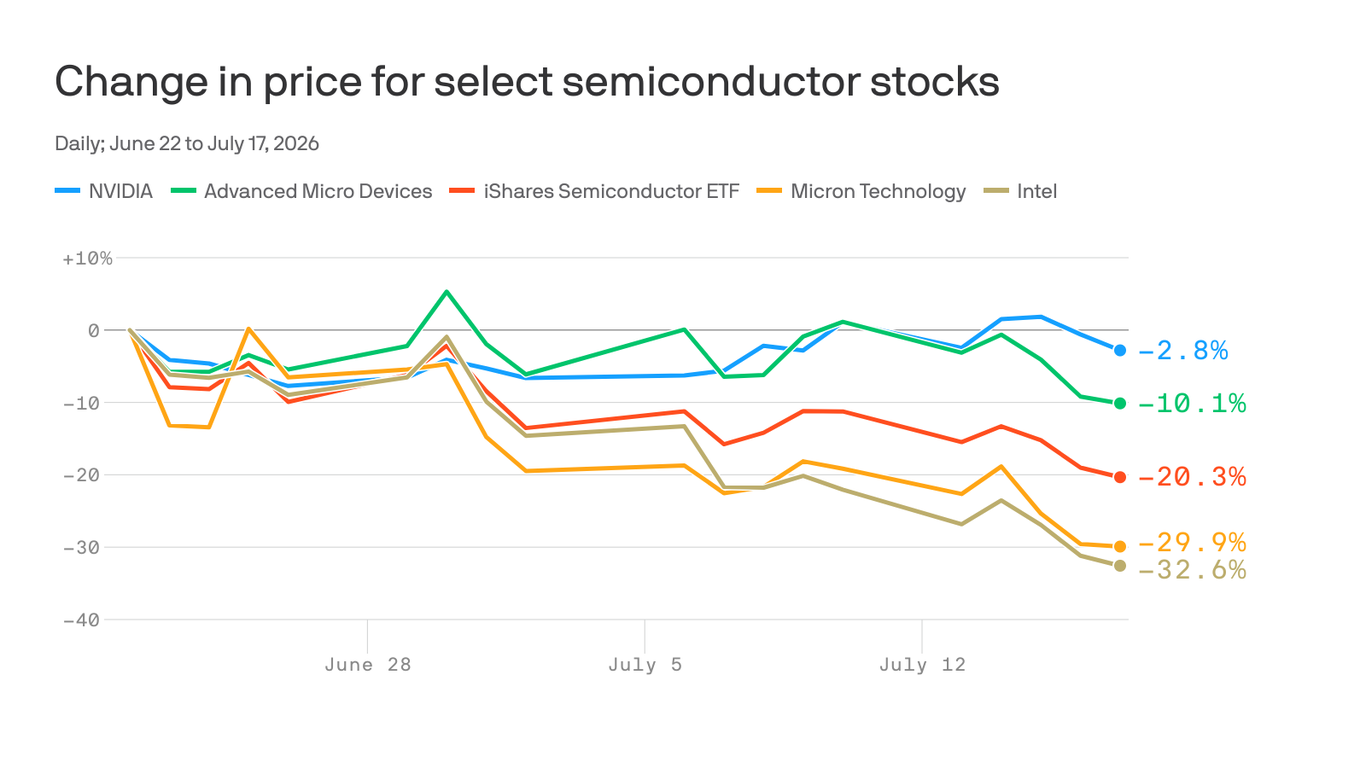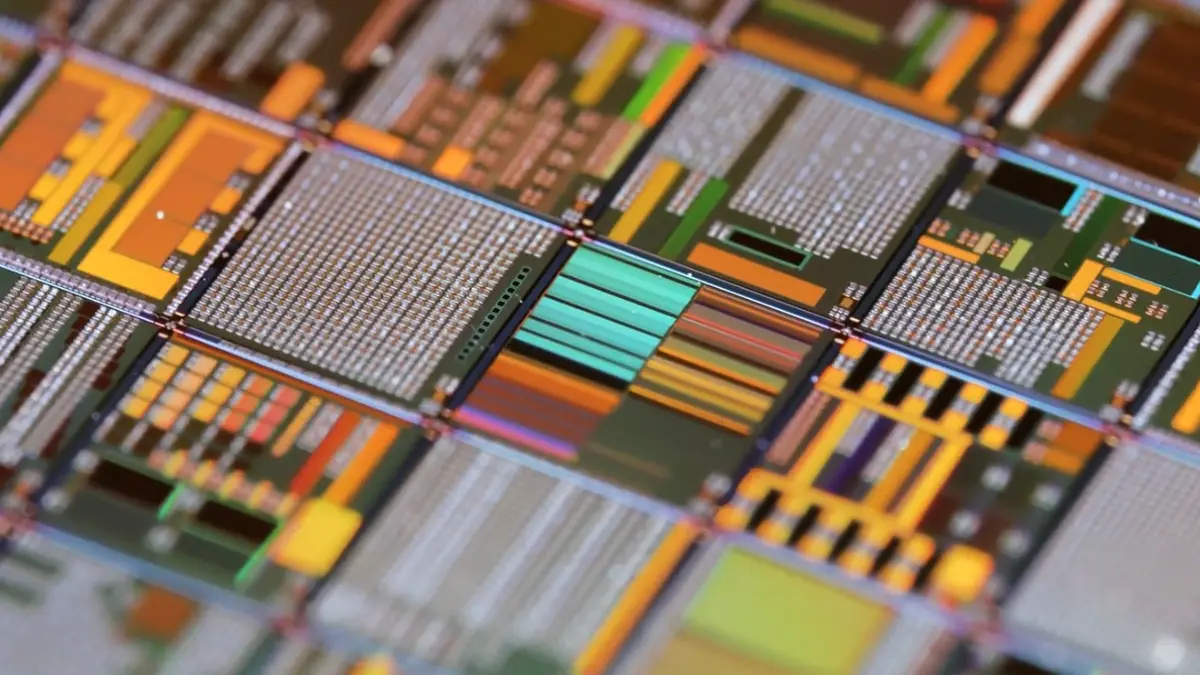
If you are an investor and you have not heard the word ‘semiconductors’ recently, you have been living under a rock! The world is in the grip of an AI gold rush and at the heart of it all? Semiconductors. These are computer chips that form the muscle behind AI and the building blocks responsible for every lightning-fast response from your favourite AI model.Companies that design or manufacture these chips are seen as shovel sellers of this gold rush and investors have been going hammer and tongs at lapping up stocks of these companies like there is no tomorrow!Ten Trillion dollars! Yeah, trillion with a ‘T’. That’s the wealth these stocks have generated for investors over the past year. For perspective, that’s about twice of India’s total market cap. Did your jaw just drop? Blame those stocks!Chip stocks have given unreal returns in the past 12 months, and every other stock is at its all-time high or thereabouts. Key among them include SK hynix’s (South Korea) 1,008 per cent rise, Micron Technology’s (the US) 903 per cent and Samsung’s (South Korea) 468 per cent. Samsung, Micron and SK hynix even joined the ‘$1-trillion market-cap club’ only in the past few weeks. Wealth-creation wise, Nvidia tops the list, having added $1.7 trillion to its market-cap, followed by TSMC (Taiwan Semiconductor Manufacturing Company) at $1.1 trillion.The US-listed SOXX ETF (iShares Semiconductor ETF) that tracks the performance of a basket of 30 semiconductor stocks is up 172 per cent in one year, dwarfing the S&P 500’s rather healthy 28 per cent. Semiconductor stocks that form part of S&P 500 now make the single-largest cohort, accounting for 17 per cent of the index’s total market cap.Got FOMO already? Looking to invest? Hold that thought for now and read on as we analyse whether the rally is real or mere speculation, whether it still has legs and as long-term investors, should you hop on to the bandwagon.Understanding 0s and 1sBefore moving on to those pertinent questions, let’s pull over to make sense of what’s behind all the euphoria.AI is supposed to be the next-generational leap in technology such as personal computers, Internet and cell phones of the past. AI with robotics is even projected to completely replace human labour, going by some extreme views in the industry. Farming, mining, driving, you name it. Whether AI reaches there or stops short at just being an effective tool for search, summarising or writing code, this is real: The fact that AI models need bleeding-edge semiconductors working non-stop in data centres — both for training and inference. ‘Training’ here refers to feeding massive amounts of data for the model to learn from, recognise patterns. ‘Inference’ is getting a response from a trained model with respect to a prompt.‘Semiconductor’ is a broad term. These chips are ubiquitous — from your calculators to smartphones, all run on them. But for AI/ data centre applications, a few kinds of these chips are more relevant. They are GPUs, CPUs, NANDs, DRAMs and HBMs — and the companies that dot their value chain are squarely in the spotlight. Here is a simplified brief on what these chips do.GPU: Graphics Processing Units or GPUs are the undisputed kings when it comes to parallel processing (doing thousands of calculations at the exact same time), lending themselves for training AI models.CPU: While GPUs handle the core computation, Central Processing Units or CPUs handle the logistics in data centres — fetch massive datasets to and from storage for the GPUs to process. They are also capable of light inference tasks.NAND flash memory: This acts as the data warehouse and is non-volatile by nature (data stay after shutting down), just like hard drives in a laptop.DRAM: Dynamic Random-Access Memory or DRAMs are not a lot different from the RAM sticks on our computers but only more advanced in data centres — they provide a kitchen with ingredients retrieved from the warehouse (NAND) for the CPU to cook. They are volatile by nature (data therein is erased once the device is switched off) and in data centres, they hold active operating systems, apps and hot datasets in memory, for the CPU to process without latency.HBM: If DRAM is for a CPU, a HBM (high-bandwidth memory) is for a GPU. Since a GPU processes thousands of tasks simultaneously, a DRAM is far too slow and hence AI data centres use HBM chips where multiple DRAMs are vertically stacked and placed next/ close to the GPU to ensure faster speeds.Broadly, in semiconductor lingo, GPUs and CPUs are called logic chips and NAND, DRAMs and HBMs are called memory chips.The market opportunityOver fiscals ending in 2026 and 2027, the major hyperscalers – Amazon, Alphabet (Google), Microsoft, Oracle and Meta Platforms are projected to incur about $1.6 trillion in capex (about 40 per cent of India’s GDP), per Bloomberg consensus. There could be more in succeeding years and also if companies beyond these five are considered. These investments are more likely to flow into building data centres, one way or the other.If a data centre costs $100 to build, about $60 goes towards compute hardware (which comprises the above chip types), reveals a McKinsey report. Applying this proportion, the semiconductor industry is poised to take advantage of close to a trillion-dollar opportunity ($1.6 trillion x 60 per cent) — and this is probably what the chip companies are after.A pitch deck from Analog Devices (a US-based semiconductor company) further corroborates this growth — that the semiconductor industry, with a market size of about $750 billion currently, is projected to grow to $1.6 trillion by 2030, at a 16 per cent CAGR.The hyperscalers may have the wherewithal to splurge on capex in two years. That’s only the demand side. However, on the supply side, these are unprecedented levels of demand (we will circle back to this later), almost impossible to be met as and when orders are received. Hence, order-books are likely be satiated in a staggered manner, explaining the variance.Ecosystem playersThere are numerous players in the chips space. But in this story, we look at what’s happening through the eyes of eight large, entrenched players namely — Nvidia, Micron, Broadcom and AMD (the US); Samsung Electronics and SK hynix (South Korea); Taiwan’s TSMC and ASML from Netherlands.Why the craze?The market expansion mentioned earlier is expected to convert into earnings growth. Look at the table. Revenue and earnings of chip titans are projected to grow multi-fold over CY26-27. These are not ordinary numbers.For instance, in CY25-27, Nvidia, which flaunts the largest numbers, is expected to treble its earnings to about $300 billion. Broadcom’s and AMD’s earnings are likely to become 3.5x and 5.3x. What you should not miss is a pattern among memory chip players – Micron, Samsung and SK hynix. Profit growth of these three rank at the top between 7.5x and 8.6x. Their stocks have rallied close to 5x and 10x in the last year and yet, forward earnings multiples look dwarfed at mid-single-digits, when factoring in the sharp rise in expected earnings.However, these numbers do not paint the full picture. Most of such earnings are going to be led by price spikes, driven by an ever-expanding demand pool that is larger than the supply pool by a country mile — this is especially true of memory chip companies. The perception one derives from the management commentary is the existence of a monstrous hunger for AI/ data centre memory chips that the suppliers are simply not able to match. Thus, companies are in sort of a purple patch with respect to pricing power at the moment, particularly since late 2025.For instance, in its recent quarter (February 2026), Micron’s DRAM sales rose 74 per cent sequentially, primarily due to a ‘mid-60 per cent’ growth in average selling price and a mere ‘mid-single-digit’ increase in bit shipments (volume metric measured in bits). A similar trend was seen in NAND segment too. SK hynix’s DRAM sales spiked 64 per cent in Q1 CY26 over Q4 CY25. Bit growth (volume) was flat, while average selling price was up ‘mid-60 per cent QoQ’.This trend is best captured in gross margins. There is also the factor of favourable mix, but it is safe to assume that the spike in the last two quarters is largely attributable to price. The managements expect this trend to sustain in the near term.While all numbers and opinions sound convincing, market veterans have provided counter-views. Michael Burry of The Big Short fame and Peter Berezin of BCA Research are sceptical and call this phenomenon the ‘bullwhip effect’ or the ‘toilet paper effect’. It is when a short, panic/ FOMO-driven spike in consumer demand (like toilet paper during lockdowns) sets off a wave of placing larger orders at each node of the supply chain, eventually leading to a drastic ramp up in production by the manufacturer. By the time the ramped-up supply hits the shelves, consumer panic ends, leading to a flooding of inventory and price correction.Berezin in an X post: Call it the “toilet paper effect”! As companies realised that memory was in short supply, they began hoarding inventory and placing orders as far out as possible. All to make sure they weren’t caught short-handed. The risk now is that AI capex estimates top out and memory prices start to fallThe three memory players are estimated to incur a combined capex of about $230 billion over 2026-27 (per Bloomberg consensus).CyclicalityUnlike software, a sector generally considered to be defensive during downcycles, semiconductors is typically a cyclical industry, just like infrastructure, capital goods and consumer discretionary. Look at the chart. It captures the year-on-year growth in the real output (volume) of semiconductors and allied industries in the major markets of the US, China and Taiwan. Growth has never been uniform. Observe how, following bursts of high growth, a slowdown ensues.Also look at the chart. It contains revenue growth of Microsoft, as a representative of the software industry, and that of Micron, as a representative of the semiconductor industry, across cycles over a 10-year period.Both companies saw good growth before the dot-com bust of 2000. Post 2000, while Microsoft’s revenue consistently grew in a range of 10-16 per cent, that of Micron was in short bursts, volatile and uneven — showing signs of cyclicality.This anecdote will more firmly drive home the point. Per a New York Times article, in March 2000, before Micron reported results for its Q2 FY00 quarter, a couple of investment firms had issued favourable reports about the company’s prospects (just like UBS’ recent upgrade from $535 to $1,625; current price $971). The company did post 7x year-on-year increase in profit for the quarter. However, it didn’t meet Wall Street expectations, owing to a 20-per cent sequential drop in average selling price. The company admitted that the drop followed strong pricing in Q1 FY00, and that it demonstrated ‘the volatile nature of semiconductor memory pricing’. Today’s situation bears an eerie resemblance to those times. The stock corrected briefly before it made a peak of $97.5 in July 2000. But in the crash that followed and in the following decades, the stock would never breach that July peak, until eventually in April 2021.Going by the numbers, it is difficult to argue against the notion that a chip super-cycle has begun and that these are the industry’s days in the sun. How long can the cycle persist is anyone’s guess, especially as the demand is almost entirely dictated by AI use-cases. With the world divided on what exactly could be AI’s ultimate potential, the outlook remains highly unpredictable.Dot-com lessonsSemiconductor companies, today, are in a position reminiscent of where many chip stocks stood ahead of the dot-com crash. Back then, the Internet was the defining next-generation technology; today, that role is being played by AI. In this context, looking at the past can give a taste of how things might unfold — particularly if sentiment and conditions deteriorate for chip stocks from here.The eight stocks analysed here (today’s cohort) are expected to post earnings growth CAGR of anywhere between 45 per cent and 164 per cent (except ASML’s 19 per cent) over CY23-26E. Micron and SK hynix are expected to bounce to CY26E profits of $98 billion and $131 billion from CY23 losses of $5.5 billion and $6 billion respectively.These are similar to the robust earnings CAGR that the chip stocks of dot-com era (dot-com cohort) witnessed in FY97-00. The range was between 15 per cent and 65 per cent. But they had limited wisdom at that time that the good times were over and that it would take years to recover from the disaster that followed FY00. Earnings jumped off a cliff. FY01 PAT decline (over FY00) of the dot-com cohort ranged between Applied Materials’ 75 and Micron’s 142 per cent (over 100 represents slipping into losses). Intel and Micron could reach their then peak earnings of FY00 only in FY10. It took until FY21 for STMicroelectronics to reach FY00 profits. Some of them even saw multiple years of losses in the intervening period. Stock returns reflected fundamentals as drawdowns of the dot-com cohort invariably measured over 80 per cent — from their peaks before the crash in 2000 to the 2002-03 troughs.As highlighted throughout this article, unimaginable sums of money are at stake, riding on AI and its prospects. Chip stocks could remain bullish for a while as markets digest any earnings beat in the upcoming quarters, if managements execute well. Would the ‘bullwhip effect’ play out? It is certainly a possibility and can’t be written off. However, with the true extent of AI-driven disruption still under cloud cover and offering little more clarity than it did two or three years ago, long-term investors would be better served prioritising caution over the pursuit of quick gains. Drawing parallels with the dot-com era suggests that downside risks can be fatal and lead to irrecoverable losses for years, if not played right. In such an environment, long-term investors may be better off observing from the sidelines.Published on May 30, 2026
Micron, Samsung, SK hynix, TSMC, Nvidia: When bits and bytes take a large bite of the stock markets
Explore the semiconductor market's volatility amidst the AI gold rush, weighing potential gains against historical investment risks.
2,334 words~11 min read