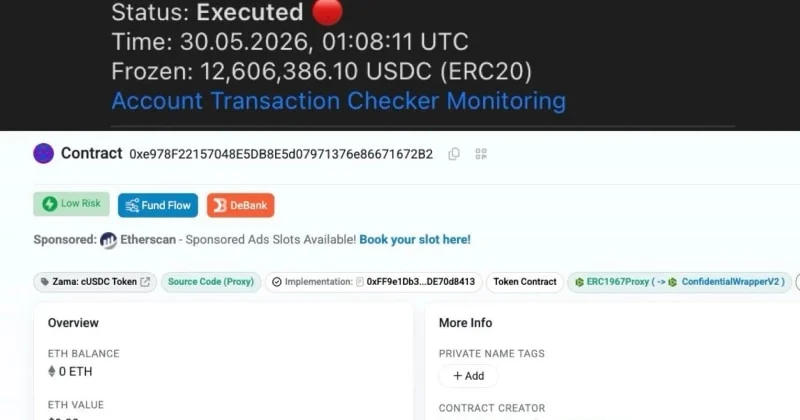
Circle just reminded the crypto world who actually controls USDC. The stablecoin issuer froze Zama’s cUSDC contract on Ethereum on May 30, locking approximately 12.6 million USDC, roughly $13M, after on-chain investigator ZachXBT linked the contract’s address to the Overnight Finance project amid rug pull allegations.
Zama, a cryptography firm known for its work in fully homomorphic encryption (FHE), acknowledged the freeze. CEO Rand Hindi stated the team is investigating and will provide updates as more information becomes available.
What is cUSDC and why does this matter
Zama’s cUSDC is built on the ERC-7984 standard, a framework designed to enable encrypted balances and transfers while maintaining composability on public blockchains like Ethereum. It was designed to let users hold and transfer stablecoins without broadcasting balances to the entire world — a useful concept for institutions that don’t want competitors tracking their treasury movements, or for everyday users who’d prefer not to have their financial life on a public ledger.
The freeze demolishes one assumption that some privacy-token advocates have been operating under. Encrypted balances don’t mean encrypted compliance powers. Circle still controls the underlying USDC, and that means Circle can still blacklist addresses.