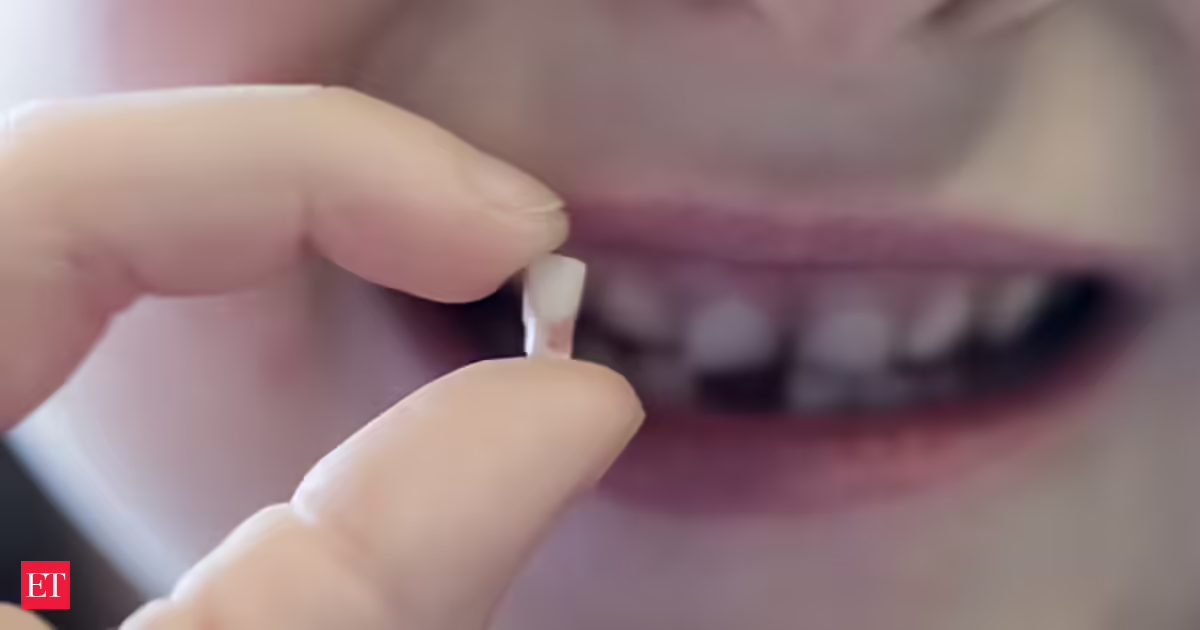
A Japanese biotechnology company developing what could become the world's first tooth-regeneration therapy has secured fresh funding to accelerate clinical trials. Kyoto-based Toregem BioPharma announced that it has raised approximately $5.3 million (¥850 million) in a Pre-Series C financing round. The company said the funds will help support Phase II clinical trials of its experimental drug, TRG035, in Japan and prepare for future clinical development in the United States.The latest funding comes months after Toregem began Phase I clinical trials of TRG035, a tooth-regeneration drug that works by blocking a protein that suppresses tooth growth. The trial, launched at Kyoto University Hospital in October 2024, enrolled 30 healthy adult men between the ages of 30 and 64 who were missing at least one molar. Researchers used the study to evaluate the treatment's safety before advancing to later-stage trials. Funding pushes total support beyond $29 millionAccording to the company release on May 19, the latest investment round brings Toregem's cumulative funding, including grants, subsidies, and equity financing, to more than $29 million (¥4.6 billion).The Pre-Series C round included participation from existing investor JIC Venture Growth Investments (VGI) and new investors including Osaka University Venture Capital (OUVC), BI Holdings, SHOFU, SIIF Impact Capital, and Chushin Venture Capital. In addition to private investment, Toregem has secured significant support from Japan's government-backed innovation ecosystem.What is TRG-035, a drug that can regrow lost teeth?TRG-035 is an experimental tooth-regeneration drug. Unlike dental implants, dentures, or bridges, which replace missing teeth, TRG-035 is designed to help the body grow new teeth naturally.The treatment is based on research led by Associate Professor Katsu Takahashi of Kyoto University Graduate School of Medicine. Scientists believe the drug could offer a new treatment option for people born with missing teeth and, in the future, potentially for those who lose teeth due to injury, decay, or aging.How does TRG-035 work?Humans typically grow two sets of teeth during their lifetime, baby teeth and permanent adult teeth. However, scientists believe tiny dormant tooth buds remain in the jaw, even after permanent teeth have developed.TRG-035 targets a protein called USAG-1, which acts as a natural blocker of tooth development in the human body. Scientists discovered that USAG-1 suppresses the activity of bone morphogenetic protein (BMP), a molecule that plays an important role in tooth formation. The protein also helps keep dormant tooth buds, tiny structures capable of forming teeth, inactive after a person's permanent teeth have developed.TRG-035 works by neutralizing or blocking USAG-1. Once this biological barrier is removed, researchers believe dormant tooth buds can become active again, triggering processes similar to those involved in natural tooth development.Focus on children born without teethThe company's initial target population is patients with congenital tooth agenesis, a rare condition in which children are born missing some or all of their permanent teeth.Currently, treatment options for these patients are limited. Because children's jawbones are still developing, dentures and implants are often difficult to use until adulthood. The condition can also affect nutrition, growth, and quality of life.Toregem believes tooth regeneration could offer a curative treatment rather than a long-term management approach."We are in the process of researching and developing a therapeutic for patients with congenital tooth agenesis, first," the company said in its announcement.Thus far, evidence supporting tooth regeneration has primarily come from animal studies (mice), while human trials are currently focused on establishing safety and effectiveness. Could the treatment eventually help older adults?While the first focus is congenital tooth loss, researchers see broader potential for the technology.The company says USAG-1 antibodies may be capable of stimulating the development of a "third dentition" after permanent adult teeth, opening the possibility of treating tooth loss caused by aging, decay, or injury.If future trials prove successful, the therapy could eventually help address oral frailty among older adults, a growing concern in aging societies such as Japan.Expert’s cautionary hopeMontse Timoneda, director of the Montse Timoneda Dental Clinic, cautioned that the excitement surrounding TRG-035 should be viewed in the context of the evidence currently available.According to the Spanish specialist in implantology, the Phase I clinical trial had stopped recruiting participants by March 2026 and is considered operationally complete. However, full results from the study have not yet been published in peer-reviewed scientific journals."That means the available evidence remains preliminary," she explained on her website. "While the initial data appear to suggest a favorable safety profile, tooth regeneration in humans has not yet been officially confirmed."Timoneda said that this distinction is important because much of the enthusiasm surrounding the treatment stems from promising animal studies rather than proven human outcomes."After analyzing all the available evidence, I believe TRG-035 represents an exciting advance, but it is still far from replacing dental implants," she said.She added that the therapy has opened "a real door to the biological regeneration of teeth," but years of additional research, larger clinical trials, and published data will be needed before scientists can determine whether the treatment is both safe and effective in humans."Science seems to be moving in the right direction, but years of research will be needed to confirm its safety and efficacy. For now, implants remain the best and most predictable solution for replacing missing teeth," Timoneda concluded.
Japanese biotech developing tooth-regrowing drug raises $5.3 million to advance human trials
Toregem BioPharma has secured $5.3 million to advance its experimental tooth-regeneration drug, TRG035, into Phase II clinical trials. The drug targets a protein that suppresses tooth growth, aiming to stimulate dormant tooth buds. Initial trials focus on children with congenital tooth agenesis, with potential future applications for tooth loss due to aging or injury.
859 words~4 min read