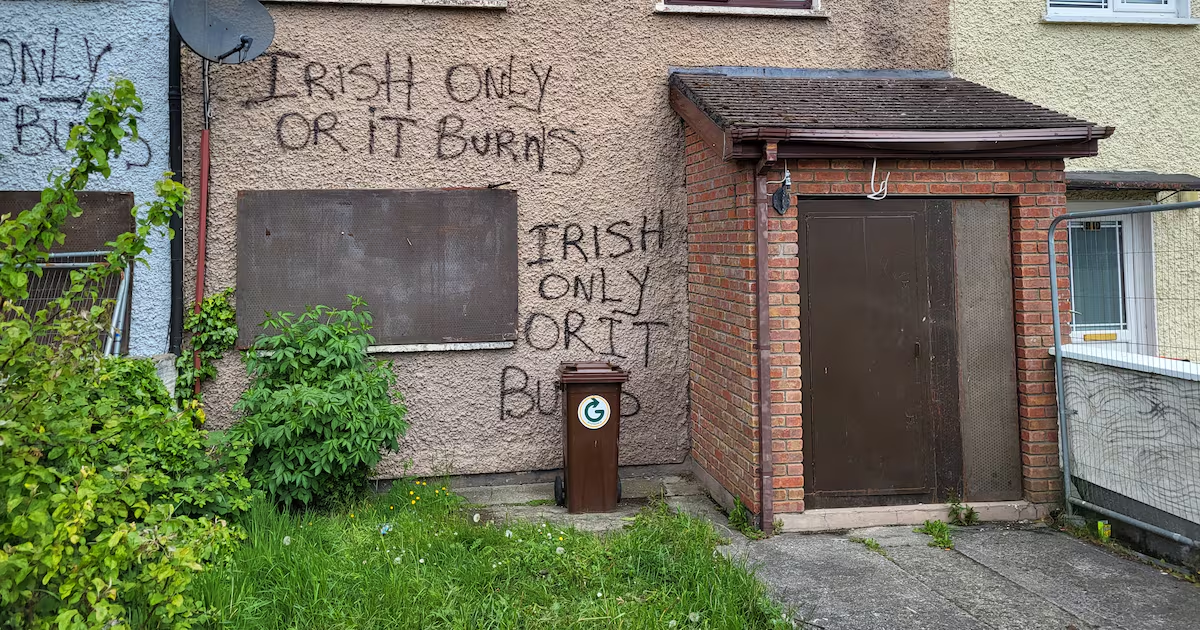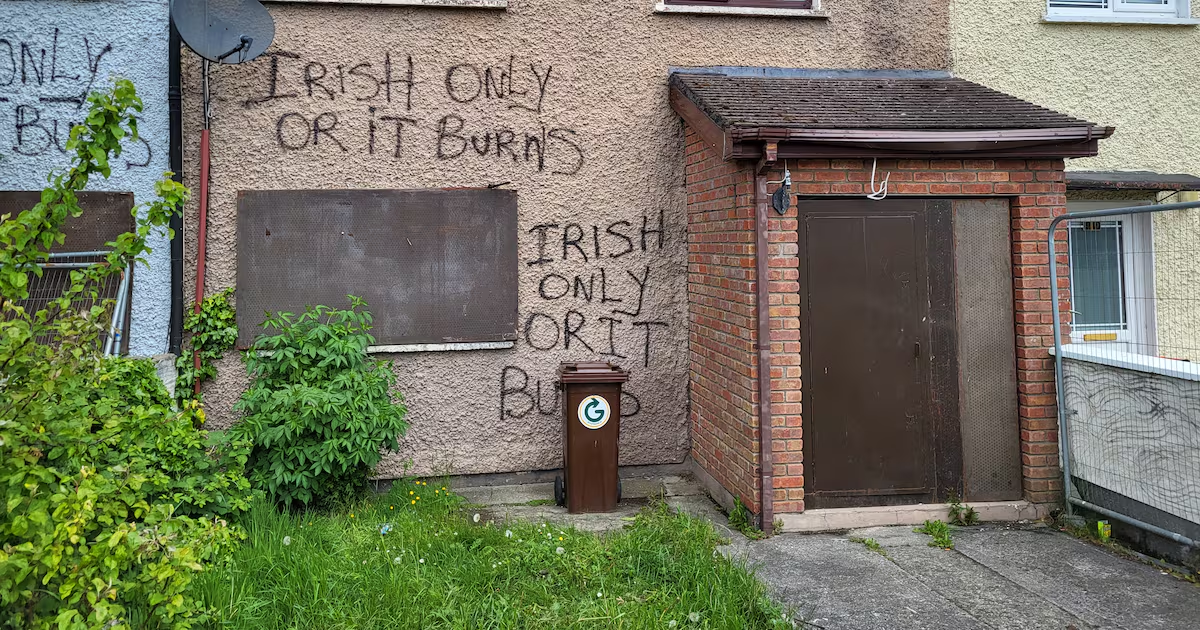
The messages spray-painted across two boarded-up council houses in Finglas, north Dublin, leave no room for ambiguity: “Irish only or it burns” and “Muslims will be shot”. In other Dublin suburbs – Coolock, Ballymun and Ballyfermot – similar graffiti is daubed on houses: “Irish familys [sic] first” and “house our own”.This is the new frontline of hate crime in the Republic. Anti-immigrant agitators are moving in marginalised communities to exploit rumours that vacant local authority houses have been allocated to families from ethnic minority backgrounds.They attack houses, usually smash windows and paint racist and xenophobic graffiti, vandalising in the name of “Irish only” motives.Some properties visited by The Irish Times had been extensively renovated, often at great cost, before the vandals struck. Many houses have been so badly damaged the council has boarded them up and they have been left vacant for months.This issue has become worse since offers for accommodation centres run by the International Protection Accommodation Services (IPAS) have been paused and arson attacks against these centres have declined, leading agitators to redirect their protests to local authority houses believed to be earmarked for ethnic minority families. It has become more common in some parts of Dublin for Tricolours to be placed around vacant council houses. Photograph: Conor Lally Dublin City Council started collecting data late last year on the number of vacant properties vandalised in suspected racist attacks as the trend became more pronounced. It is the first Irish council to compile such information. Some 24 attacks have been recorded. The incidents appear in working-class suburbs where, in recent times, territory has been marked out by Tricolour flags, which also festoon some of the damaged houses. Garda sources say council workers now often fear going into certain areas to perform routine tasks and, in the absence of a Garda escort, council workers or contractors are at times reluctant to repair the houses for fear of reprisals.Gavin Pepper, the Dublin councillor who represents the Ballymun-Finglas local electoral area, says the houses are being targeted at a time of deep frustration about how local authority properties are allocated and intense competition for homes amid the housing crisis.At times labelled far right, Pepper insists he is not anti-immigration but is “anti-illegal immigration”. He says he has close Nigerian friends who are neighbours in Finglas, coaches children from a local direct provision centre and has worked alongside Lithuanians who became friends when he was a plasterer. Asked whether some of those behind the vandalism simply do not want ethnic minority neighbours, Pepper says he does not believe that is the case. He condemns the vandalism.“When I see a house damaged or sprayed on, that is horrible to see. I don’t want to see that in my community. But I can understand why people are doing it,” he says.The lack of transparency in house allocation, as he sees it, leads some to believe that ethnic minority families are “skipping” the housing waiting list, getting ahead of others waiting a decade or more. “We have not got the supply to house people, to house our own people. So how can we house people from everywhere else? It’s just common sense,” says Pepper, a first-time councillor.Though he condemns the attacks, he says he can see how anger could arise when residents see a local family, years on the housing list, missing out on a home to people with no roots locally who may be prioritised for council housing because they are classified as homeless.Graffiti on a boarded-up council house in Dublin. Photograph: Conor Lally “People are saying ‘well, she’s number three on the list, why is she still waiting?’ or ‘that [house] should go to a family like hers’. And they’ve every right to say that.”In reply to queries, the Garda and Minister for Justice Jim O’Callaghan described the attacks as “hate crimes”. O’Callaghan said he was “concerned” about the attacks, but welcomed that the council was now recording hate-based attacks on properties, saying it would aid the State’s response and Garda policing policies at local level. Rory Hearne, the Social Democrats TD for the Dublin North-West constituency where many incidents have occurred, says the attacks are “concerning”.Hearne, his party’s housing spokesman, says in areas such as Finglas and Ballymun there is “massive overcrowding, people living with mould and damp” and communities feel abandoned. There is clear evidence they are not getting the proper resources they need from Government, especially around housing, he says. “This is the context in which people trying to foment an anti-immigration agenda can grow, and this is the problem,” he says. “This is part of the far-right organising and it’s becoming a tactic to target these homes.”Hearne expresses concern that the far right’s tactics might work: that houses might, in response, be allocated to white Irish families out of fear that ethnic minority families could be targeted in a property previously vandalised. “Behind the organising of this is a white ethnonationalism that being Irish is white, but that’s not the case, it’s not the reality. We are an Ireland of different colours and backgrounds,” he says. Gemma, a mother of four from north Dublin who didn’t want to give her real name, has been on the housing list 12 years. She met The Irish Times outside a house she hoped she would be allocated. Daubing on a vacant council house in Dublin. Photograph: Conor Lally Her family still lives in the area and the property she longed for was recently renovated for new tenants. But then a rumour spread that a Romanian family had been allocated the property. It was soon vandalised and is now boarded up.“It’s very frustrating, seeing other people getting a house before you,” she says, adding that her mother was born and raised nearby. “Every single day I rang them ... eventually they told me to stop ringing the office,” she says of her repeated inquiries about the house. She later heard the local rumour about a Romanian family viewing the property.She believes people coming from abroad “are getting places handed to them left, right and centre”.Gemma is living in private rented two-bed accommodation. One of her children, who has profound special needs, is in a bedroom on his own, with the rest of the family sleeping in the other room.“I’m living in torture,” she says, adding the property is so damp and mouldy that her children have been repeatedly admitted to hospital, one dozens of times, with respiratory issues.Crosscare, which helps vulnerable people struggling to access accommodation, including migrants and IPAS residents, says the attacks on council properties are “very disturbing” for residents “and those hoping to join these communities”. Some of its recent clients have been affected.“One family were waiting five years in homeless accommodation, were offered social housing only to have it daubed with graffiti, leaving them incredibly fearful. With a lot of support, they eventually moved in,” says Crosscare chief executive Conor Hickey.To complicate matters, if families refuse the offer of a property, and another suitable house is not available, they could “fall down the housing list” and into years of homelessness because anyone who refuses two offers is removed from the list.In another case, an ethnic minority family with four children, including two with special needs, were offered a property in Dublin 5. They were put under “significant pressure” to make a decision very quickly and were fearful of taking a house in the area.“Before they moved in, anti-immigrant graffiti was sprayed on the front of this newly renovated home,” Hickey says. “The local [council] office was quick to remove it. The family were even more fearful but took the house. They understood that it was a great house and they knew the repercussions of not taking this offer.”Since then, their experience has been “very positive” and they say “their neighbours are very nice”. However, they regularly see “anti-immigrant posting on a local Facebook page and this is difficult for them”, he says.Some local residents believe some immigrants are being allowed to 'skip' waiting lists for council housing in Dublin, councillor Gavin Pepper says. Photograph: Photograph: Conor Lally Overall, Hickey says the attacks stem from “Ireland’s poor performance on housing and immigration” and many communities becoming “increasingly marginalised”.[ David McWilliams: Ireland needs immigrants. But our economy can’t accommodate an infinite numberOpens in new window ]“This has allowed a very small number of disenfranchised individuals, fuelled by misinformation and far-right propaganda, to take these types of criminal and racist actions,” he says. The solution is for the Government to formulate “a fair and just immigration system” and “an urgent ramp-up” of local authority-built social and affordable housing, he says.Dr James Carr, an associate professor of sociology at the University of Limerick, has been researching racism – much of it in the context of housing – against Muslims in Ireland for 16 years.For his most recent study, with postdoctoral researcher Tiba Bonya, published last December, they spoke to 69 council workers and 193 members of the Muslim community in Dublin, Cork, Limerick and Galway.Carr found council staff trying to shield Muslim families from being housed where they would be more likely to face racist violence. While a prospective tenant would be invited to view a property, “there may be an intimation that they ‘might not fit in this area’”, his research found.One council worker referenced deliberately housing “four or five Muslim families” in a scheme of 15 houses as it was near a mosque. Despite efforts to house them together, they were still targeted with “antisocial” behaviour.Carr’s research concludes that, however well-intentioned, these ad-hoc efforts by council workers to protect ethnic minority tenants lead to segregation. Some areas will be predominantly white Irish because the councils believe ethnic minorities cannot be housed there. And other areas will have an over-representation of ethnic minority tenants because the councils perceive them as safer.“You have actors seeking to lay the blame for housing shortages ... at the feet of minority communities. And they are de facto directing who goes to live where,” he says.[ ‘Absolutely traumatising’: Ireland sees surge in arson attacks on council homesOpens in new window ]A narrative around “who is getting what” has grown strong on social media, generated by a “small but very loud” Irish far right, feeding claims that foreign nationals are receiving significant help from the State that is not being extended to white Irish people, he says.Even though unfounded, those tropes – which Carr described as “gutter politics, importing the Farage politics” – are so widely accepted in Ireland that, for some, targeting houses has “become legitimised”, he says. This narrative is “also nudging the centre parties towards the right and then you’re in a downward spiral, lowest-common-denominator stuff”, Carr says.“And what we’re not doing is having a serious conversation about Government failures to deal with the housing crisis.”It is no surprise to him that vandalism attacks on vacant local authority houses have taken place in areas where Tricolour flags have been set out to create “bordering” and convey a message about “who really belongs” there.“That idea of who really belongs is a very narrow, reductive idea of Irishness as being white, and maybe being from that area as well,” says Carr.“It’s an exclusionary use of the flag, it’s being used as a means to intimidate people.”
‘House our own’: How the far right targets Dublin’s council houses
The far right is hijacking anger on working-class Dublin estates over a shortage of council houses by vandalising vacant properties
1,879 words~9 min read