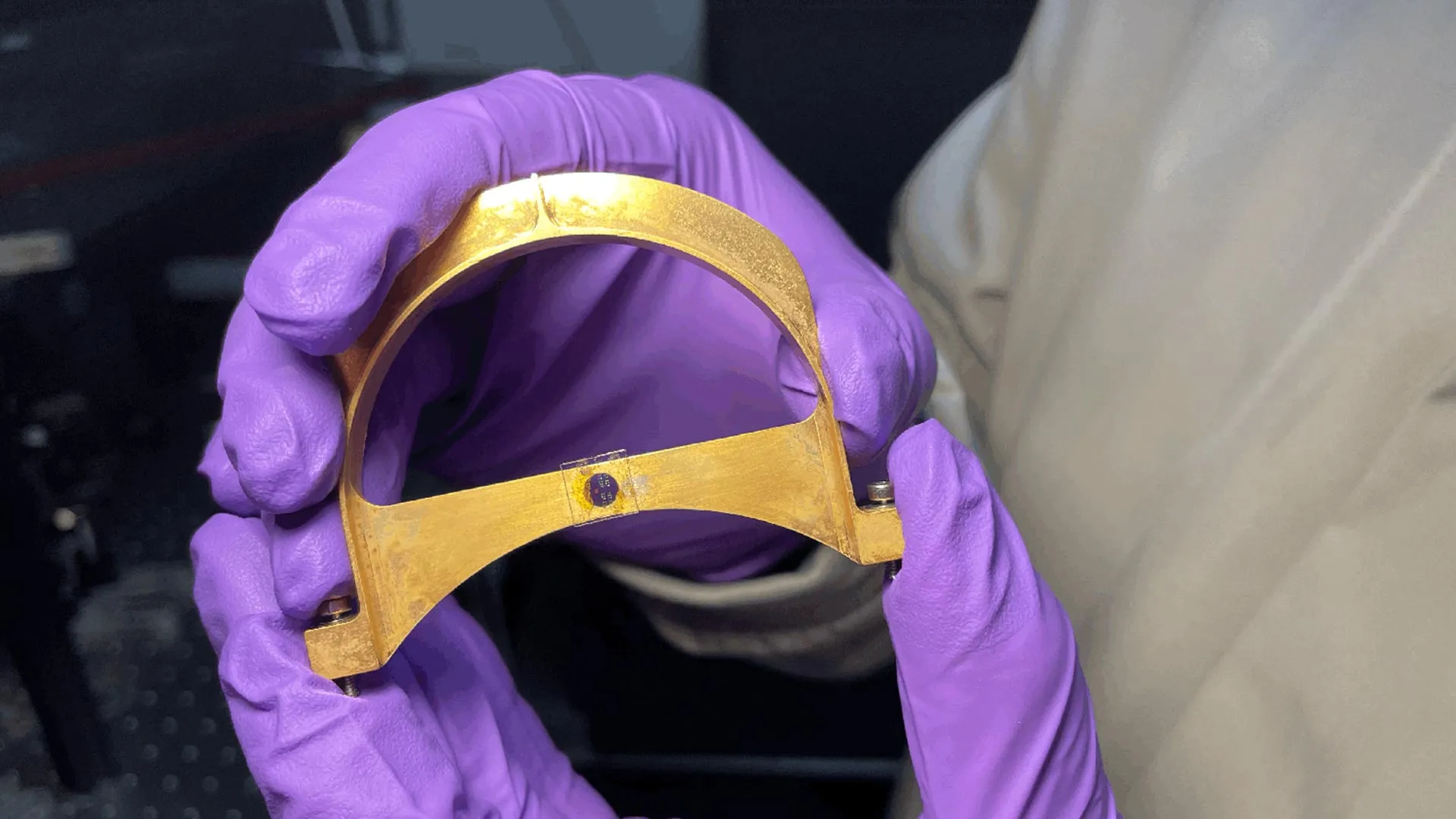
Quantum computers today are notoriously difficult and expensive to operate. Most require temperatures near absolute zero, about -459 degrees Fahrenheit, to maintain the fragile quantum states needed for computation and communication.
Now, researchers at Stanford University have developed a nanoscale optical device that functions at room temperature while linking the quantum properties of light and electrons. The advance could help pave the way for smaller, lower-cost quantum technologies capable of transmitting information across long distances.
The new device enables entanglement between photons, the particles that make up light, and electrons. This quantum connection is considered a fundamental requirement for future quantum communication systems.
"The material in question is not really new, but the way we use it is," says Jennifer Dionne, a professor of materials science and engineering at Stanford and senior author of the study published in Nature Communications. "It provides a very versatile, stable spin connection between electrons and photons that is the theoretical basis of quantum communication. Typically, however, the electrons lose their spin too quickly to be useful."
Twisted Light and Quantum Spin