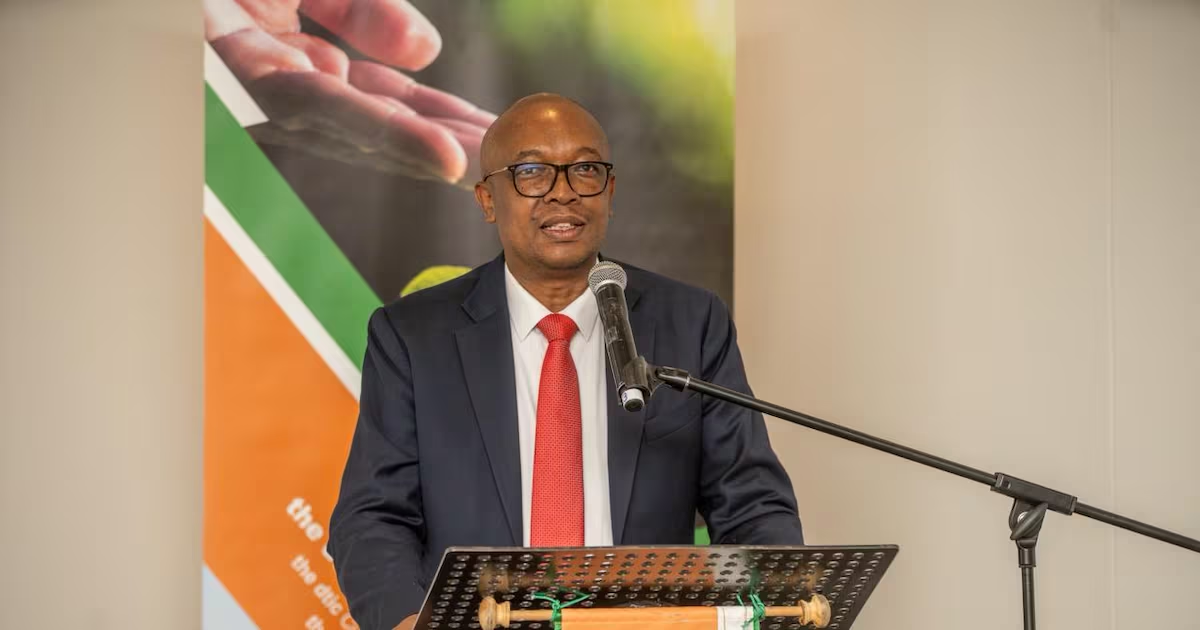
The pharmaceuticals sector is a key site in the battle to localise production and procurement and reindustrialise but foreign investors make this difficult, says the minister of trade, industry & competition, Parks Tau. He told a stakeholder engagement this week that investors from the West still expressed interest in the South African market but tended to bargain in a way that undermined localisation.Tau said a company from the EU would, for example, offer to put money into Cape Town-based Biovac but would impose conditions on the deal. “They say ...’We’re going to give Biovac some money, we’ll give them a grant deal, we’ll give them a loan here, but it’s important that they use certain products from Europe.’“So they use these instruments for their own industrialisation, not because they have the money. So they say, ‘OK, we’ll give you money, but these are the conditions: we need our factories involved in South Africa.’”Pharmaceuticals are one of the biggest priority sectors for localisation and industrialisation. However, according to the trade association Pharmaceuticals Manufactured in South Africa (Pharmisa), importers of foreign products win many of the procurement tenders issued by the public sector. The government accounts for an estimated 70% of pharmaceutical procurement in the country, it says. Tau said South Africa wanted to attract investment while at the same time boosting localisation and transformation in sectors such as pharmaceuticals and vaccine production.“And of course some of them [investors] say, ‘No, we don’t like this matter of localisation and transformation, but we want you to use our companies to achieve your objective.’ And we say, ‘But that can’t be a fair argument.’”When he tabled his 2026 budget vote in parliament, Tau referred to Biovac, a public-private partnership that is black-owned, managed and controlled. It has become a world-class vaccine manufacturing facility.“The funding raised through various development finance institutions will see Biovac expand its end-to-end vaccine manufacturing facility in Cape Town, enabling it to produce up to 40-million vaccines ready for global export.”He said the clean trade & investment partnership (CTIP) with the EU and the Global Gateway initiative were starting to bear fruit, with EU investment in clean energy and in the pharmaceutical sector.The funding raised through various development finance institutions will see Biovac expand its end-to-end vaccine manufacturing facility in Cape Town, enabling it to produce up to 40-million vaccines ready for global export.“This financial instrument is benefiting several provinces, including the three Cape provinces, in the context of transitioning to our green hydrogen ambitions. These include projects in Prieska, Coega and Saldanha Bay.”Biovac CEO Morena Makhoana told Business Times that the company is developing four products for such buyers as the UN Children’s Fund (Unicef).“There are vaccines that we are supplying locally through the department of health. The plan… is that there are four products that are under way, currently in tech transfer development. Those four products are largely earmarked for exports to Unicef and Gavi.” Gavi is a vaccine alliance that supplies vaccines to children around the world. Aspen executive Stavros Nicolaou, who is chair of Pharmisa, said that 12 years ago 55% of pharmaceuticals in some categories were procured locally, but this proportion had declined to 14%. He said this dampens the competitiveness of the local pharmaceuticals sector.“In 2008… we were awarding 92% [of tenders to local producers]. We are now down to 22%. In terms of the value, we were awarding 71% local. We are now down to 24%. Charity starts at home… so before we ask Gavi and Unicef to buy vaccines, before we ask Pepfar, Global Fund, Unitaid, and before we ask these other African countries to buy our insulin… we’ve got to fix our own house.”Neel Andhee-Shah, the interim country president for the African cluster at AstraZeneca, said health ministries and local government will always focus on trying to support local manufacturing and local access to medication.“It is the right thing to do for the people of those countries. There will always be a portion of that available to innovative and global pharma because you can’t normally manufacture that in the country.“So you have to still allow for access to some of this innovation, especially when it comes to cancer care and cancer treatment. There are not many locally manufactured cancer products, purely because they are highly specialised products. A lot of them are injectables.”Andhee-Shah said some categories of pharmaceuticals and vaccines require specialised delivery systems. “The challenge that all innovative and global companies have is that, because of their price points, they don’t normally sit within the public sector. And even if it’s on tender, you will always be competing against generics, which have the volume. And we try to balance that with the governments to position the products where there is a specific need.”He said many companies, including AstraZeneca, have looked at the possibility of local manufacturing, but that the deciding factor was whether there was enough volume to sustain demand and capacity across the African continent.Business Times
Pharma investment comes with side effects
Pharmaceuticals are a major priority sector for localisation and industrialisation, but investors and importers want a chunk of the market.
826 words~4 min read