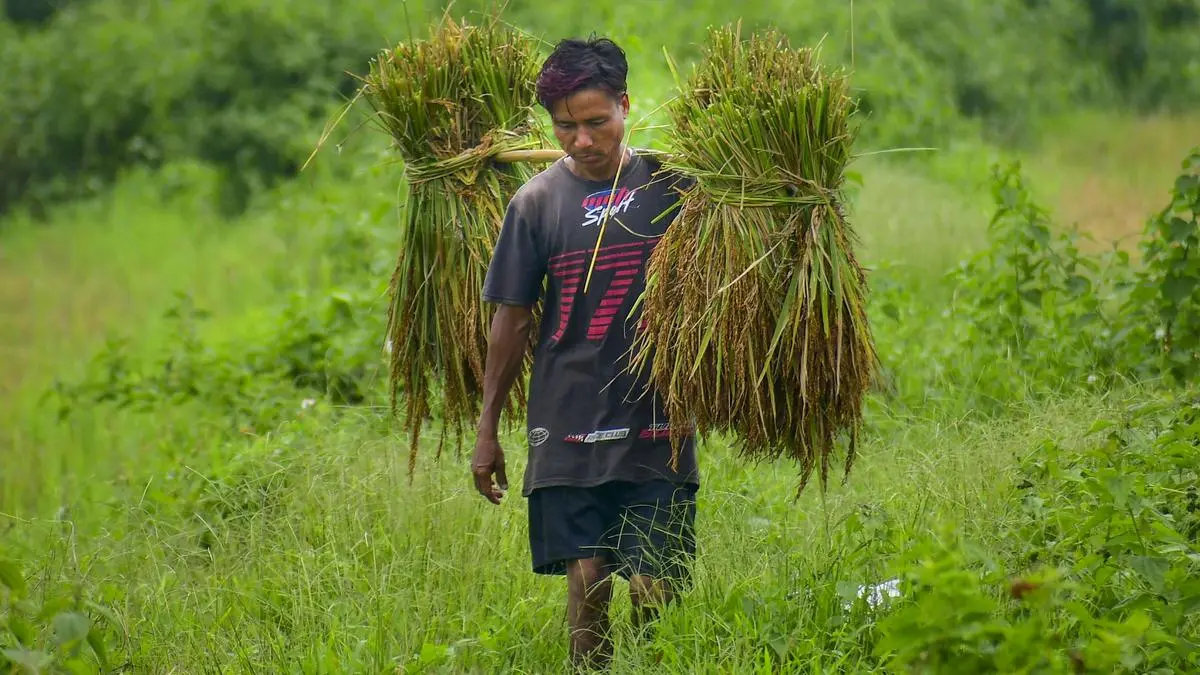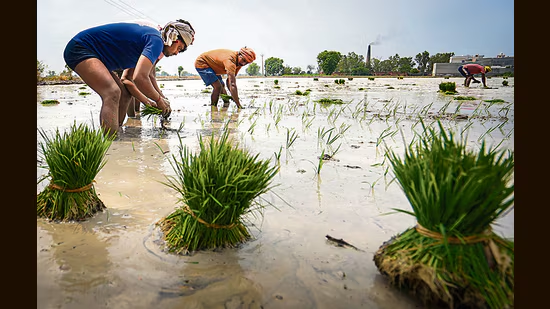
Punjab is staring at a challenging monsoon. The India Meteorological Department (IMD) has forecast below-normal rainfall and a hotter-than-usual June marked by an increased number of heatwave days.With the southwest monsoon expected to reach Punjab around July 1, the outlook has raised concerns over agriculture, groundwater depletion and electricity demand as the state prepares for the paddy-sowing season.With the southwest monsoon expected to reach the state around July 1, the outlook has raised concerns over agriculture, groundwater depletion and electricity demand as the state prepares for the paddy-sowing season.Releasing its second-stage long-range forecast on Friday, the IMD said the southwest monsoon rainfall (June–September) was likely to remain below normal over northwest India, including Punjab and Haryana. The agency projects seasonal rainfall in the region at less than 92% of the long period average (LPA). This marks a sharp reversal from last year, when Punjab received 41% excess rainfall.Groundwater crisis deepensThis deficit comes at a crucial time for Punjab, where paddy cultivation relies heavily on intensive irrigation. The state grows paddy on nearly 32 lakh hectares annually. Any rainfall deficit will instantly increase dependence on groundwater extraction via the state’s 13.94 lakh tubewells. A majority of these tubewells operate in districts where the water table is already critically overexploited.Punjab’s groundwater situation is already alarming. The stage of groundwater extraction (SoE) has reached 156.36%, indicating that water is being drawn far beyond sustainable levels. While the state’s annual extractable groundwater resources stand at 16.80 billion cubic metres (BCM), total extraction in 2025 soared to 26.27 BCM.The primary driver behind this deficit is the emergence of El Niño conditions over the equatorial Pacific Ocean. Climate models indicate a high probability of El Niño developing during the monsoon season, a phenomenon historically associated with below-normal rainfall over India.DSR to the rescuePunjab agriculture department officials said a target had been set to bring 5 lakh acres under the Direct Seeding of Rice (DSR) technique during the 2026-27 kharif season, with a budgetary provision of ₹40 crore for the initiative.Officials said farmers adopting the technique instead of transplanted flooded rice will be provided financial assistance of ₹1,500 per acre through an online portal.They added that DSR technology can substantially reduce water consumption, labour requirements and electricity usage compared to conventional paddy cultivation methods, making it a key intervention for addressing Punjab’s agrarian and environmental challenges.Grid braces for demandCompounding the water scarcity, the IMD has warned of above-normal maximum and minimum temperatures, alongside extended heatwave days across Punjab and Haryana in June.This combination of deficient rainfall and extreme heat is expected to put unprecedented pressure on Punjab’s power sector. Officials project peak electricity demand to touch an all-time high of 18,000 MW this summer, surpassing the previous record of 17,300 MW registered last year.The surge will be driven by farmers running tubewells for longer durations to sustain water-intensive paddy crops through soaring temperatures. Energy experts warn that prolonged heatwave conditions could strain the state’s power distribution infrastructure, risking outages.The IMD has cautioned that the cascading effects of the deficit could ultimately impact hydropower generation, ecosystem sustainability, and escalate drought risks.Inderpal Singh, director (Generation), PSPCL, said the corporation was fully prepared for the upcoming paddy season and to meet the peak power demand.He added that PSPCL would ensure eight hours of uninterrupted power supply to farmers during the paddy season.“We will try to draw the maximum possible power from the central pool to meet the peak summer demand. However, if extreme weather conditions push the demand beyond our capacity, some power regulation measures may have to be undertaken,” he said.High and drySeasonal monsoon rainfall projected at less than 92% of the Long Period Average (LPA).Annual groundwater extraction stands at 26.27 BCM, far outstripping the state’s extractable limit of 16.80 BCM.Punjab’s stage of groundwater extraction (SoE) has hit an alarming 156.36%.Over 13.94 lakh agricultural tubewells will bear the burden of irrigating 32 lakh hectares of paddy.Peak power demand is projected to touch an all-time high of 18,000 MW, surpassing last year’s record of 17,300 MW.
Weak monsoon, heatwave to push Punjab to brink
With rainfall projected below 92% of average and power demand set to hit record 18,000 MW in Punjab, the upcoming paddy sowing season faces groundwater and power pressures
TL;DRAI
India's IMD forecasts below-92%-LPA monsoon for Punjab in 2026, while groundwater extraction has already hit 156% of sustainable limits (26.27 vs. 16.80 BCM). Peak grid demand is projected at a record 18,000 MW — irrigation-driven load could strain power infrastructure and affect reliability across northwest India.
666 words~3 min read